Get your free personalized podcast brief
We scan new podcasts and send you the top 5 insights daily.
A free trial for an AI agent hosting service revealed an unexpected user behavior: spinning up powerful AI agents for specific, time-bound tasks (like a coding project or planning a trip) and then letting them self-destruct. This concept of temporary agents opens up new possibilities beyond persistent personal assistants.

Related Insights
To discover high-value AI use cases, reframe the problem. Instead of thinking about features, ask, "If my user had a human assistant for this workflow, what tasks would they delegate?" This simple question uncovers powerful opportunities where agents can perform valuable jobs, shifting focus from technology to user value.
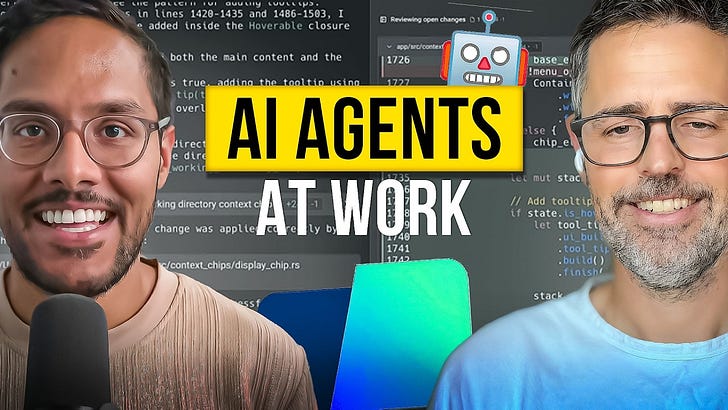
The emergence of personal AI assistants that can be integrated with private data (email, Slack) and execute tasks (send emails, build CRMs) represents a new paradigm. This moves AI from a passive research tool to an active, autonomous agent capable of performing complex knowledge work, fundamentally changing productivity.

The highest immediate ROI from AI agents comes from creating a better user experience for managing personal tasks and information. The most-used agent was a simple, interactive to-do list, suggesting the power of agents as a superior personal UI is more valuable initially than complex system automation.

While complex tasks are the long-term goal, agentic AI like Claude Cowork finds immediate value in simple, one-shot commands like "clean up my desktop." This provides a tangible, low-stakes demonstration of its capabilities for a broad, non-technical user base.

Long-horizon agents are not yet reliable enough for full autonomy. Their most effective current use cases involve generating a "first draft" of a complex work product, like a code pull request or a financial report. This leverages their ability to perform extensive work while keeping a human in the loop for final validation and quality control.
The next evolution for autonomous agents is the ability to form "agentic teams." This involves creating specialized agents for different tasks (e.g., research, content creation) that can hand off work to one another, moving beyond a single user-to-agent relationship towards a system of collaborating AIs.

Tasklet, a platform for automating recurring tasks, found a surprising user behavior: most messages are for ad-hoc, one-off requests. Users invest time creating a highly-contextualized agent for automation, then leverage that same smart agent for immediate, chat-based assistance, making chat the dominant interaction model.

Traditionally, building software required deep knowledge of many complex layers and team handoffs. AI agents change this paradigm. A creator can now provide a vague idea and receive a 60-70% complete, working artifact, dramatically shortening the iteration cycle from months to minutes and bypassing initial complexities.

Non-technical users are leveraging agents like Moltbot to build their own hyper-personalized software. By simply describing a problem in natural language, they can create internal tools that perfectly solve their needs, eliminating the need to subscribe to many single-purpose SaaS applications.

Contrary to their name, software development agents are not just for coders. Their ability to interact with files, apps, and data makes them powerful productivity tools for non-technical roles like sales. This signals their evolution from niche coding assistants to general-purpose AI systems for any computer-based work.
