Get your free personalized podcast brief
We scan new podcasts and send you the top 5 insights daily.
Microsoft's strategy posits that customer data used to train third-party models is a valuable asset that 'leaks' to labs. By providing infrastructure that allows enterprises to control and own their own 'learning loop' from this data exhaust, Microsoft turns a key vulnerability of using closed models into a competitive advantage for its platform.

Related Insights
Nadella posits a future where the winner isn't the company with the best model. Instead, value accrues to the platform that provides the data, context, and tools (the 'scaffolding') that make any model useful, especially as capable open-source alternatives proliferate.
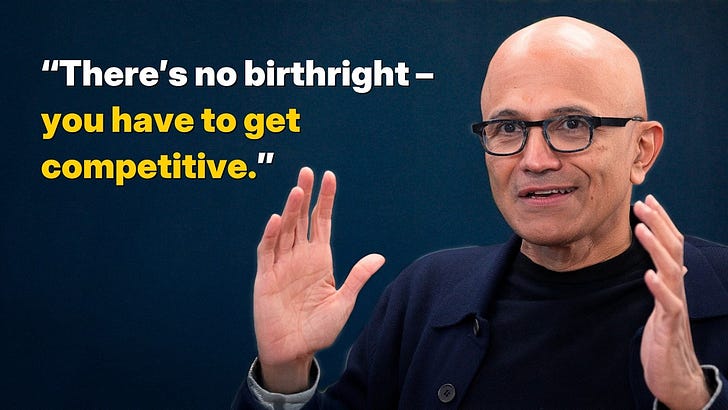
As AI gets embedded in core workflows, the key strategic question becomes who owns the resulting intelligence. Enterprises are wary of outsourcing their core logic to model providers who have explicitly stated they will compete in their customers' industries, making ownership of these learnings paramount.

Satya Nadella posits the key enterprise AI strategy is building a proprietary "learning loop." This system transforms a company's unique human knowledge into "token capital," a defensible asset that compounds over time, independent of any single underlying AI model. This creates a durable competitive advantage against competitors and model providers alike.
As noted by Chamath Palihapitiya, businesses fear deploying major AI models directly, seeing it as letting the 'fox into the henhouse' where their usage data could train a future competitor. This creates a strategic opening for 'harness-first' companies that offer enterprises control and choice over underlying models.
Frontier models from giants like OpenAI force enterprises to share sensitive data, creating platform risk. The future of corporate AI lies in private, fine-tuned, open-source models that keep a company's "intelligence" in-house, preventing it from training potential competitors.

Satya Nadella argues that when enterprises use third-party AI, they give away valuable proprietary knowledge through their prompts and data. This "Reverse Information Paradox" means companies pay twice: once with money, and again by training the vendor's model with their core intellectual property.

Microsoft is marketing its new MAI models by emphasizing their "clean pre-training data set" and lack of distillation from other models. This strategy directly targets enterprise customers' legal and compliance fears around IP infringement from AI, offering them a legally safer foundation model to build upon.

Companies like Thinking Machines Lab and Microsoft are shifting the value proposition from raw API access to platforms for enterprise-specific model customization. This addresses corporate needs for data sovereignty, cost control, and specialized performance, creating a new competitive lane focused on enabling customers to own their own models.
Satya Nadella’s critique of frontier models learning from customer data is a strategic move to sell Microsoft's infrastructure. It promotes a vision where enterprises control their own AI destiny, thereby making Microsoft the essential platform provider.
Satya Nadella argues that using a third-party AI model forces a buyer to give away valuable proprietary knowledge to the model seller. This framing is a strategic narrative by Microsoft to position its own cloud AI offerings as a safer alternative that protects a customer's data and intellectual property.
