Get your free personalized podcast brief
We scan new podcasts and send you the top 5 insights daily.
Satya Nadella argues that using a third-party AI model forces a buyer to give away valuable proprietary knowledge to the model seller. This framing is a strategic narrative by Microsoft to position its own cloud AI offerings as a safer alternative that protects a customer's data and intellectual property.

Related Insights
Microsoft's ambition to become a top AI lab is a defensive move against its partner, OpenAI. Satya Nadella's acknowledgement that OpenAI may eventually build its own cloud services reveals the strategic necessity. Microsoft must develop its own models to avoid dependency on a partner that could become a core competitor to Azure.
The most valuable intellectual property for companies will be their unique, private evaluation benchmarks. These evals allow them to "hill climb" any model, ensuring they retain control and are not locked into a single AI provider. The ability to switch models and improve performance is the key asset.
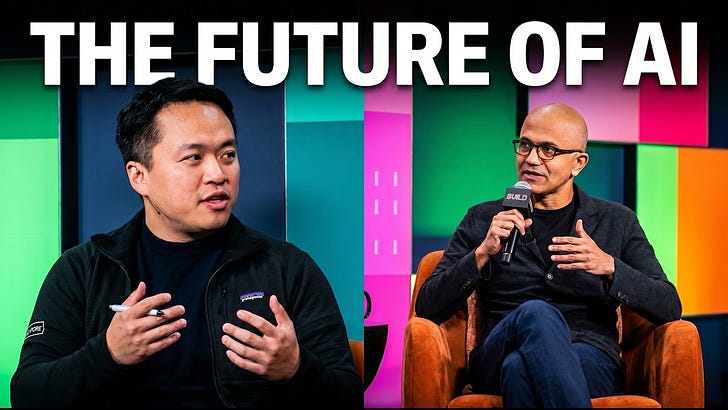
Satya Nadella posits the key enterprise AI strategy is building a proprietary "learning loop." This system transforms a company's unique human knowledge into "token capital," a defensible asset that compounds over time, independent of any single underlying AI model. This creates a durable competitive advantage against competitors and model providers alike.

As noted by Chamath Palihapitiya, businesses fear deploying major AI models directly, seeing it as letting the 'fox into the henhouse' where their usage data could train a future competitor. This creates a strategic opening for 'harness-first' companies that offer enterprises control and choice over underlying models.
Enterprise SaaS companies (the 'henhouse') should be cautious when partnering with foundation model providers (the 'fox'). While offering powerful features, these models have a core incentive to consume proprietary data for training, potentially compromising customer trust, data privacy, and the incumbent's long-term competitive moat.

Using the same AI model provider as your direct competitors is a critical business error. It creates a "lowest common denominator" problem where insights become commoditized, as there is no guarantee of data separation or unique intelligence. Companies cannot rent judgment from the same source as their rivals.

Satya Nadella argues that when enterprises use third-party AI, they give away valuable proprietary knowledge through their prompts and data. This "Reverse Information Paradox" means companies pay twice: once with money, and again by training the vendor's model with their core intellectual property.

Microsoft is training its sales teams to directly pitch its in-house MAI models over partners' by emphasizing cost, efficiency, and superior security integration within its ecosystem. This strategy leverages Microsoft's distribution power, shifting the sales narrative away from raw model performance to enterprise-specific value propositions like security and cost.
Microsoft is marketing its new MAI models by emphasizing their "clean pre-training data set" and lack of distillation from other models. This strategy directly targets enterprise customers' legal and compliance fears around IP infringement from AI, offering them a legally safer foundation model to build upon.

Satya Nadella’s critique of frontier models learning from customer data is a strategic move to sell Microsoft's infrastructure. It promotes a vision where enterprises control their own AI destiny, thereby making Microsoft the essential platform provider.