Get your free personalized podcast brief
We scan new podcasts and send you the top 5 insights daily.
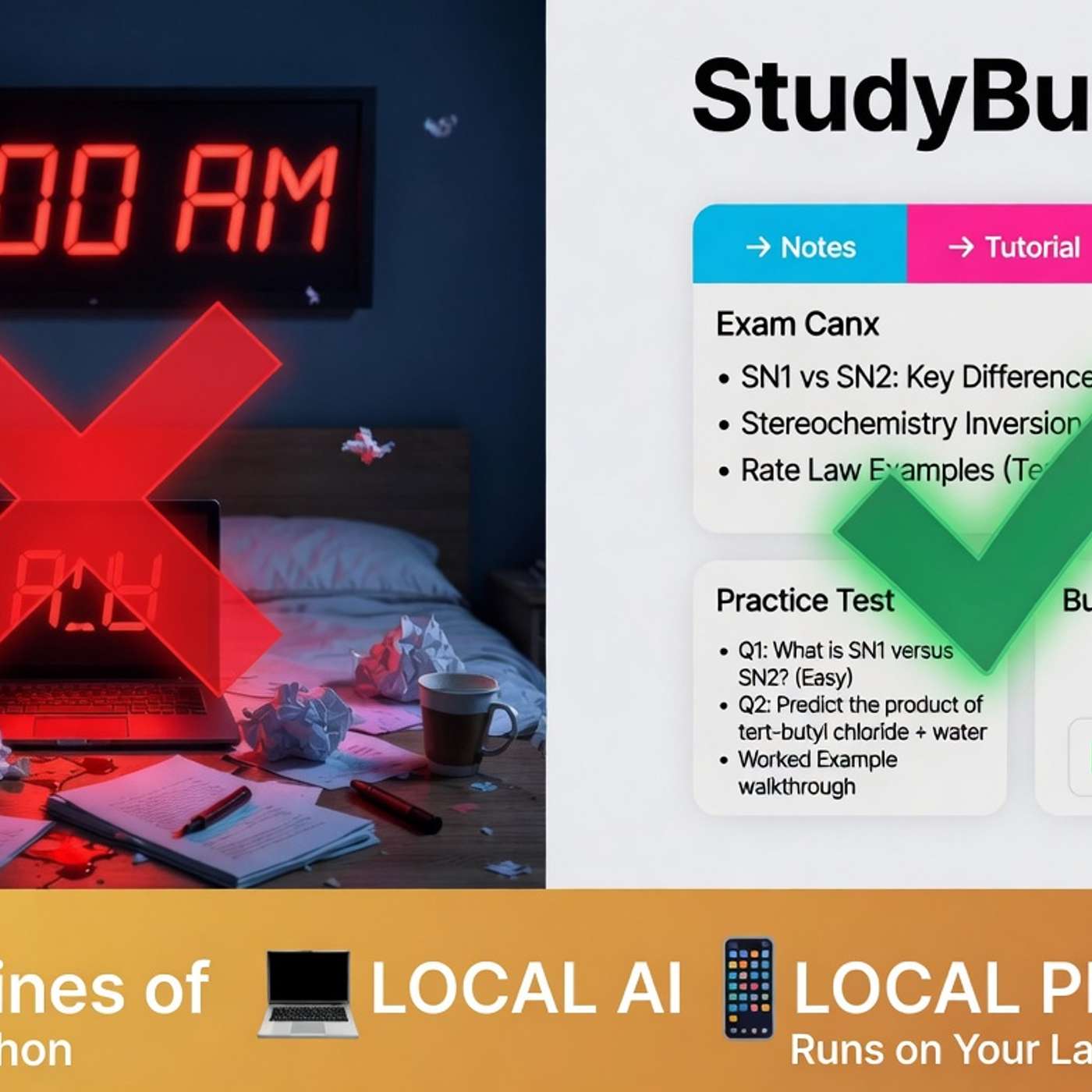
Current AI study tools fail by producing a 'paper thin patchwork' of disconnected outputs. The superior approach is to generate multiple, coherent outputs—like notes, tutorials, and tests—from a single corpus and model. This ensures a consistent and interconnected learning experience for the student.
Related Insights
General LLMs are optimized for short, stateless interactions. For complex, multi-step learning, they quickly lose context and deviate from the user's original goal. A true learning platform must provide persistent "scaffolding" that always brings the user back to their objective, which LLMs lack.

Instead of only using AI to generate final assets, use it as a learning tool to build deep understanding. Ask it to break down complex concepts and explain how things work. This scaffolds your learning and equips you with the foundational knowledge needed to debug real-world problems.

A powerful, underutilized way to use conversational AI for learning is to ask it to quiz you on a topic after explaining it. This shifts the interaction from passive information consumption to active recall and reinforcement, much like a patient personal tutor, solidifying your understanding of complex subjects.

New features in Google's Notebook LM, like generating quizzes and open-ended questions from user notes, represent a significant evolution for AI in education. Instead of just providing answers, the tool is designed to teach the problem-solving process itself. This fosters deeper understanding, a critical capability that many educational institutions are overlooking.

General LLMs are powerful but lack the core architecture of a true learning platform. A dedicated educational tool needs built-in pedagogical methods, multimodal content, and a clear structure, which is absent in a conversational, general-purpose AI that was not built for learning at its core.
A key application for AI is not just summarizing information but weaving isolated data points into a coherent "story." For academic advisors overwhelmed with student data, this transforms dozens of facts into an actionable narrative about the individual.

The current user experience for AI tools is too complex, forcing users to make choices like which model or mode to use. The next major step is a unified, consolidated interface where the AI intelligently handles resource allocation behind the scenes, simply delivering 'intelligence'.

AI tools like Notebook LM produce superior, more factually dense content when fed a curated set of user-provided sources. This demonstrates that the quality of generative AI output is directly proportional to the quality and specificity of its input knowledge base, outperforming models that use a general web index.

Treat AI skills not just as prompts, but as instruction manuals embodying deep domain expertise. An expert can 'download their brain' into a skill, providing the final 10-20% of nuance that generic AI outputs lack, leading to superior results.

Focusing on refining prompts (skills) yields diminishing returns. The breakthrough in AI content quality comes from building a 'foundational layer' of shared intelligence—core documents defining your audience, voice, and positioning—that every AI skill draws from, preventing it from starting from zero each time.
