Get your free personalized podcast brief
We scan new podcasts and send you the top 5 insights daily.
Models built for multilingual use, like Meta's LLaMA, don't necessarily "think" in multiple languages. They often retrieve answers internally in English and then translate back to the source language. This extra step introduces significant opportunities for error, undermining their multilingual promise and losing knowledge in translation.

Related Insights
Popular benchmarks like MMLU are inadequate for evaluating sovereign AI models. They primarily test multiple-choice knowledge extraction but miss a model's ability to generate culturally nuanced, fluent, and appropriate long-form text. This necessitates creating new, culturally specific evaluation tools.

MIT research reveals that large language models develop "spurious correlations" by associating sentence patterns with topics. This cognitive shortcut causes them to give domain-appropriate answers to nonsensical queries if the grammatical structure is familiar, bypassing logical analysis of the actual words.

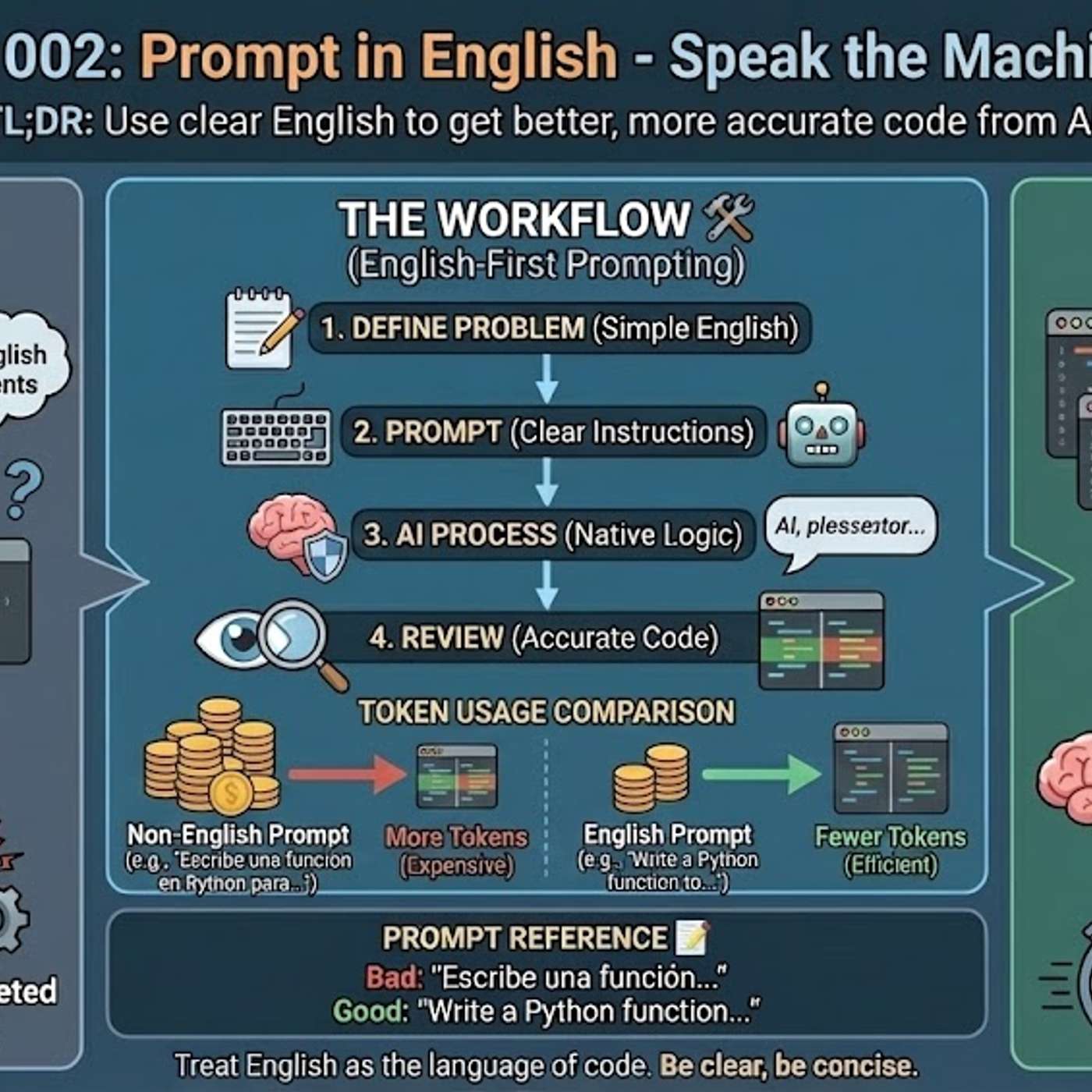
Using languages other than English for technical prompts is inefficient because it forces the AI to perform an intermediate translation. This translation step consumes valuable tokens from the context window, leaving less capacity for detailed instructions and increasing the risk of misinterpretation, which results in weaker solutions.
Analysis of models' hidden 'chain of thought' reveals the emergence of a unique internal dialect. This language is compressed, uses non-standard grammar, and contains bizarre phrases that are already difficult for humans to interpret, complicating safety monitoring and raising concerns about future incomprehensibility.

A non-obvious failure mode for voice AI is misinterpreting accented English. A user speaking English with a strong Russian accent might find their speech transcribed directly into Russian Cyrillic. This highlights a complex, and frustrating, challenge in building robust and inclusive voice models for a global user base.

Beyond the obvious lack of non-English training data, Large Language Models are architecturally biased. Their tokenization process, designed for English, inefficiently breaks down other languages into more fragments. This increases operational costs and reduces comprehension, creating a structural disadvantage.
Poland's AI lab discovered that safety and security measures implemented in models primarily trained and secured for English are much easier to circumvent using Polish prompts. This highlights a critical vulnerability in global AI models and necessitates local, language-specific safety training and red-teaming to create robust safeguards.
Technical terms like "callback" often lack a precise one-to-one translation in other languages. When a non-English prompt is used, the AI may misinterpret these crucial terms, leading it to misunderstand the user's intent, waste context tokens trying to disambiguate the instruction, and ultimately generate incorrect or suboptimal code.
The primary reason AI models generate better code from English prompts is their training data composition. Over 90% of AI training sets, along with most technical libraries and documentation, are in English. This means the models' core reasoning pathways for code-related tasks are fundamentally optimized for English.
Poland's AI lead observes that frontier models like Anthropic's Claude are degrading in their Polish language and cultural abilities. As developers focus on lucrative use cases like coding, they trade off performance in less common languages, creating a major reliability risk for businesses in non-Anglophone regions who depend on these APIs.