Get your free personalized podcast brief
We scan new podcasts and send you the top 5 insights daily.
Focusing life science AI on narrow domains like biologics manufacturing restricts cross-disciplinary utility. Because molecular biology fundamentally reduces to moving liquids between vessels, models trained on atomic actions can generalize widely and flag physical deviations like pipette bubbles across diverse workflows.

Related Insights
The primary bottleneck for creating powerful foundation models in biology is the lack of clean, large-scale experimental data—orders of magnitude less than what's available for LLMs. This creates a major opportunity for "data foundries" that use robotic labs to generate high-quality biological data at scale.

A key benefit of autonomous labs isn't just speed but perfect documentation. AI-driven systems eliminate human variability—like slight changes in pipetting angle—that is impossible to document but critical for reproducibility. This creates the pristine, detailed data needed for advanced AI models to learn effectively.
Pure AI models can't obey physical laws like thermodynamics. The most powerful approach is a hybrid model: embed decades of trusted biochemical knowledge mechanistically, then use machine learning to fill in unknown parameters and discover new mechanisms.

Major advancements in biotech instrumentation are not just software or AI achievements. They are the result of a deeply multidisciplinary effort over many years, requiring innovations and integration across optics, fluidics, chemistry, hardware, and biology to create powerful new tools.

Lila has found that a single, generalist AI model trained on broad scientific data—spanning life sciences, chemistry, and materials—often beats specialized models. This suggests that cross-domain knowledge allows the model to find connections and reasoning patterns that domain-specific training would miss.

A major misconception is that general-purpose Large Language Models (LLMs) can be readily applied to complex biological problems. Biological data, like RNA sequencing, constitutes a unique language that requires custom-built foundation models, not simply fine-tuning of existing LLMs.
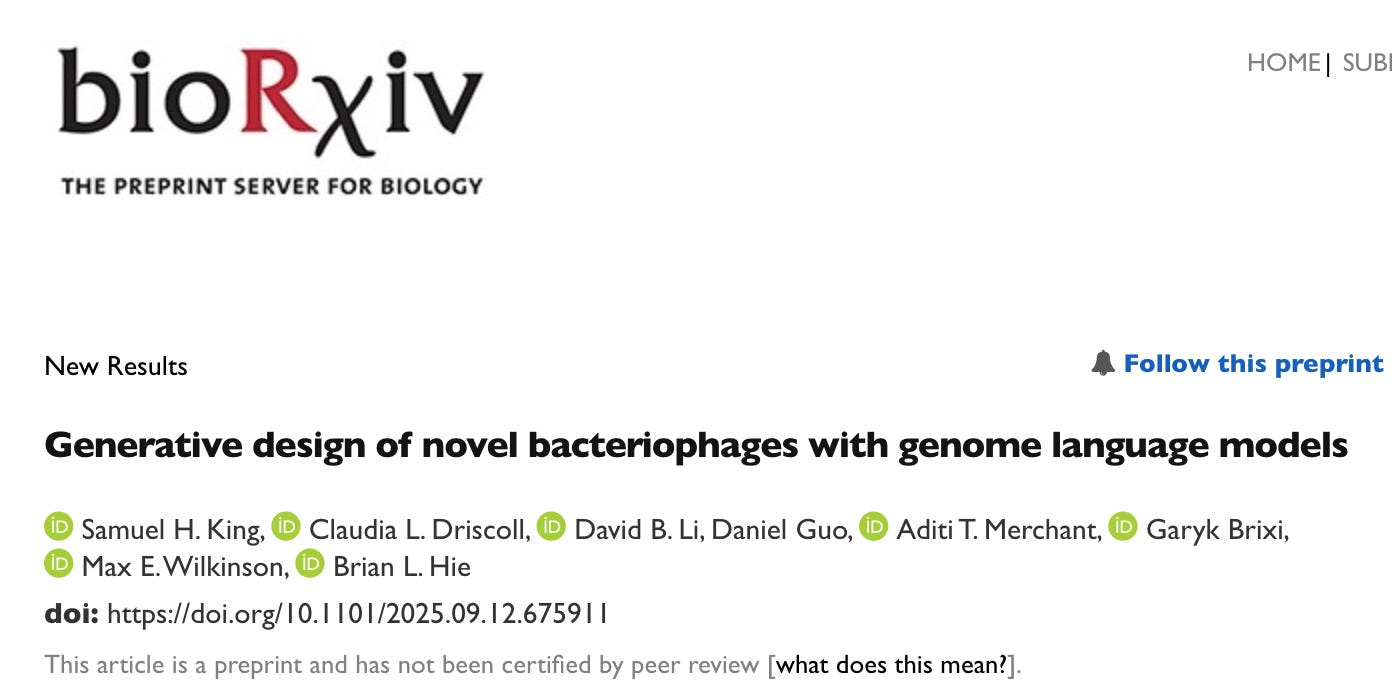
Since DNA is the source code for RNA and proteins, a foundation model pre-trained on DNA can learn underlying biological principles that transfer across modalities. This allows a single model to tackle tasks that previously required specialized protein or RNA models.
Unlike fields with vast training data like image recognition, effective drug discovery has too few successful examples for AI to learn from alone. To be useful, AI models must be explicitly taught the foundational principles and complex rules of medicinal chemistry that human experts use.

Building biologically relevant AI is not a one-off process. It demands a continuous "lab in the loop" system where wet lab experiments generate proprietary data to train models, whose outputs are then physically tested in the lab. This iterative feedback cycle constantly refines the model's predictive accuracy.

When all pharma companies use similar AI models on similar data, competitive moats vanish. The next edge will come from creating superior training data. This means moving beyond raw data to datasets enriched with physical insights, such as a database of 'complexity hotspots' for all known proteins, teaching AI the underlying dynamics.
