Get your free personalized podcast brief
We scan new podcasts and send you the top 5 insights daily.
Large companies will adopt LLMs not as siloed products but as fundamental primitives integrated into every process, much like 'if' statements and 'for' loops are integral to all software. If a business process lacks AI integration by 2026, it will be considered a catastrophic failure.
Related Insights
Corporate America has decided AI is a mandatory strategic bet, shifting from ROI-based adoption to “willing it into existence.” This top-down mandate ensures a 1-2 year boom in AI spending, creating a period of presumed success before a potential retrenchment.

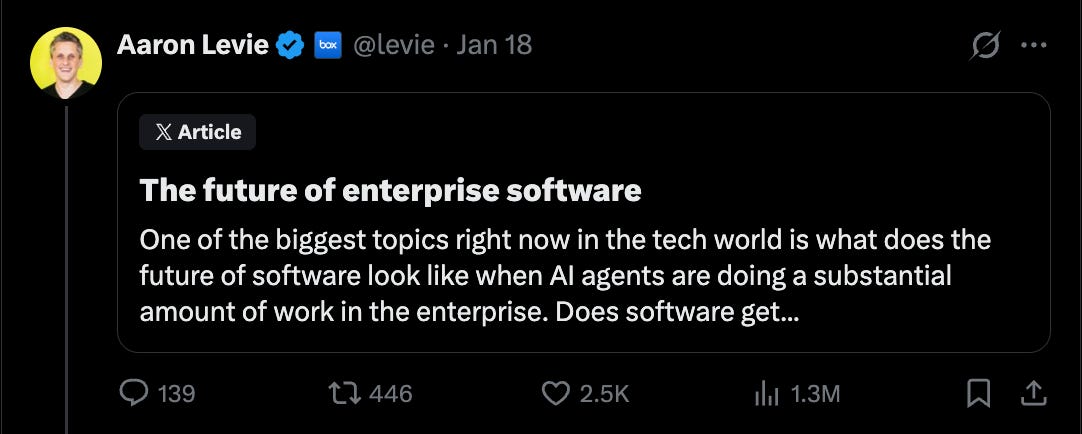
AI's biggest enterprise impact isn't just automation but a complete replatforming of software. It enables a central "context engine" that understands all company data and processes, then generates dynamic user interfaces on demand. This architecture will eventually make many layers of the traditional enterprise software stack obsolete.

Don't just sprinkle AI features onto your existing product ('AI at the edge'). Transformative companies rethink workflows and shrink their old codebase, making the LLM a core part of the solution. This is about re-architecting the solution from the ground up, not just enhancing it.

AI is a foundational layer, not a niche. Asking if a company is an 'AI startup' will soon be as meaningless as asking if it has a website. The adoption timeline is radically compressed: what took the internet 15 years for ubiquity will take AI only four, with non-adopters facing extinction.

AI's impact on manufacturing will be architectural, not incremental. Similar to how the steam engine forced a complete redesign of factories, "LLM orchestrators" will become the central nervous system, prompting a fundamental rebuilding of manufacturing processes around this new AI core to manage physical operations.
Predict AI's enterprise rollout by modeling autonomous driving. It starts as a human-assisted tool, moves to an internal process with a human "safety copilot," and only becomes fully autonomous when society and regulations are ready, not just the tech.

Enterprises will shift from relying on a single large language model to using orchestration platforms. These platforms will allow them to 'hot swap' various models—including smaller, specialized ones—for different tasks within a single system, optimizing for performance, cost, and use case without being locked into one provider.

The historical adoption of electricity in factories shows that true productivity gains came from redesigning the factory floor, not simply replacing steam engines. Similarly, companies must fundamentally re-engineer processes around AI to unlock its transformative potential.

Unlike previous technologies that integrated into existing workflows, AI agents require us to fundamentally re-engineer our work processes to make them effective. Early adopters who adapt their operations to how agents "think" will gain compounding advantages over competitors.
Nadella predicts AI's enterprise adoption will be two-pronged. While executives will push top-down projects with clear ROI, the real transformation will be bottom-up. Individual employees will build their own agents to eliminate drudgery, just as lawyers adopted Word and finance teams adopted Excel, making the tools indispensable.