Get your free personalized podcast brief
We scan new podcasts and send you the top 5 insights daily.
Treating AI risk management as a final step before launch leads to failure and loss of customer trust. Instead, it must be an integrated, continuous process throughout the entire AI development pipeline, from conception to deployment and iteration, to be effective.

Related Insights
When creating AI governance, differentiate based on risk. High-risk actions, like uploading sensitive company data into a public model, require rigid, enforceable "policies." Lower-risk, judgment-based areas, like when to disclose AI use in an email, are better suited for flexible "guidelines" that allow for autonomy.

Instead of waiting for AI models to be perfect, design your application from the start to allow for human correction. This pragmatic approach acknowledges AI's inherent uncertainty and allows you to deliver value sooner by leveraging human oversight to handle edge cases.
The biggest hurdle for enterprise AI adoption is uncertainty. A dedicated "lab" environment allows brands to experiment safely with partners like Microsoft. This lets them pressure-test AI applications, fine-tune models on their data, and build confidence before deploying at scale, addressing fears of losing control over data and brand voice.
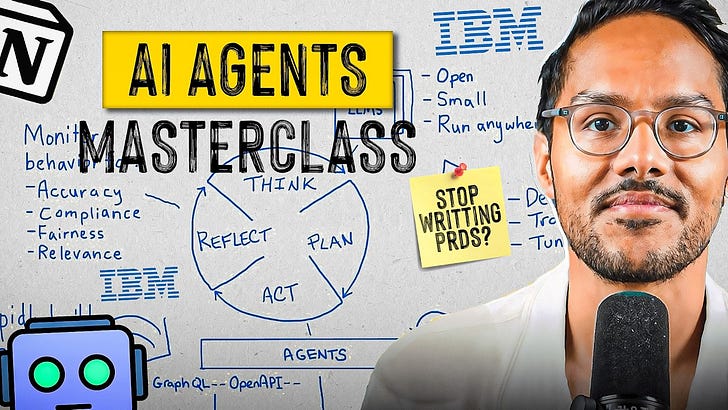
Treating AI evaluation like a final exam is a mistake. For critical enterprise systems, evaluations should be embedded at every step of an agent's workflow (e.g., after planning, before action). This is akin to unit testing in classic software development and is essential for building trustworthy, production-ready agents.
AI evaluation shouldn't be confined to engineering silos. Subject matter experts (SMEs) and business users hold the critical domain knowledge to assess what's "good." Providing them with GUI-based tools, like an "eval studio," is crucial for continuous improvement and building trustworthy enterprise AI.
Organizations must urgently develop policies for AI agents, which take action on a user's behalf. This is not a future problem. Agents are already being integrated into common business tools like ChatGPT, Microsoft Copilot, and Salesforce, creating new risks that existing generative AI policies do not cover.
To navigate the high stakes of public sector AI, classify initiatives into low, medium, and high risk. Begin with 'low-hanging fruit' like automating internal backend processes that don't directly face the public. This builds momentum and internal trust before tackling high-risk, citizen-facing applications.
Borrowing from classic management theory, the most effective way to use AI agents is to fix problems at the earliest 'lowest value stage'. This means rigorously reviewing the agent's proposed plan *before* it writes any code, preventing costly rework later on.

To maximize AI's impact, don't just find isolated use cases for content or demand gen teams. Instead, map a core process like a campaign workflow and apply AI to augment each stage, from strategy and creation to localization and measurement. AI is workflow-native, not function-native.

To balance security with agility, enterprises should run two AI tracks. Let the CIO's office develop secure, custom models for sensitive data while simultaneously empowering business units like marketing to use approved, low-risk SaaS AI tools to maintain momentum and drive immediate value.
