Get your free personalized podcast brief
We scan new podcasts and send you the top 5 insights daily.
For serious development or internal tools, logs are insufficient. An API gateway provides essential operational signals—like latency metrics, error rates by model, and readiness checks—that help diagnose failures unrelated to model quality. These gateway-specific metrics are crucial for building reliable systems on top of local LLMs.

Related Insights
An API gateway for local LLMs should preserve the shape and data of tool call protocols without executing the functions themselves. This maintains a critical security and architectural boundary, preventing the gateway from becoming an insecure code execution environment with access to the file system, browser, or other local resources.
Many companies initially build their own AI gateway, viewing it as a simple, thin proxy layer. However, upon moving agents to production, they quickly discover that real-world complexity around governance, observability, and security requires a far more robust, specialized control plane platform.

Teams often mistakenly debate between using offline evals or online production monitoring. This is a false choice. Evals are crucial for testing against known failure modes before deployment. Production monitoring is essential for discovering new, unexpected failure patterns from real user interactions. Both are required for a robust feedback loop.

Don't let LLMs make raw HTTP calls. Instead, provide a code execution tool with a statically typed SDK. This environment can run a type-checker, instantly catching errors when the model hallucinates a non-existent endpoint or parameter, then provide helpful, in-context documentation to correct its mistake.

AI product quality is highly dependent on infrastructure reliability, which is less stable than traditional cloud services. Jared Palmer's team at Vercel monitored key metrics like 'error-free sessions' in near real-time. This intense, data-driven approach is crucial for building a reliable agentic product, as inference providers frequently drop requests.

Inference backends focus on complex runtime problems like GPU scheduling and quantization. API gateways should handle different concerns like request validation and lifecycle endpoints. Separating these layers prevents duplicating API logic across runtimes and allows each component to specialize, leading to a cleaner architecture.
While starting with a vertically integrated system is fine, enterprises inevitably need two key components: an LLM Gateway to manage and route traffic to various models, and an MCP Gateway to securely connect those models to real-world systems.

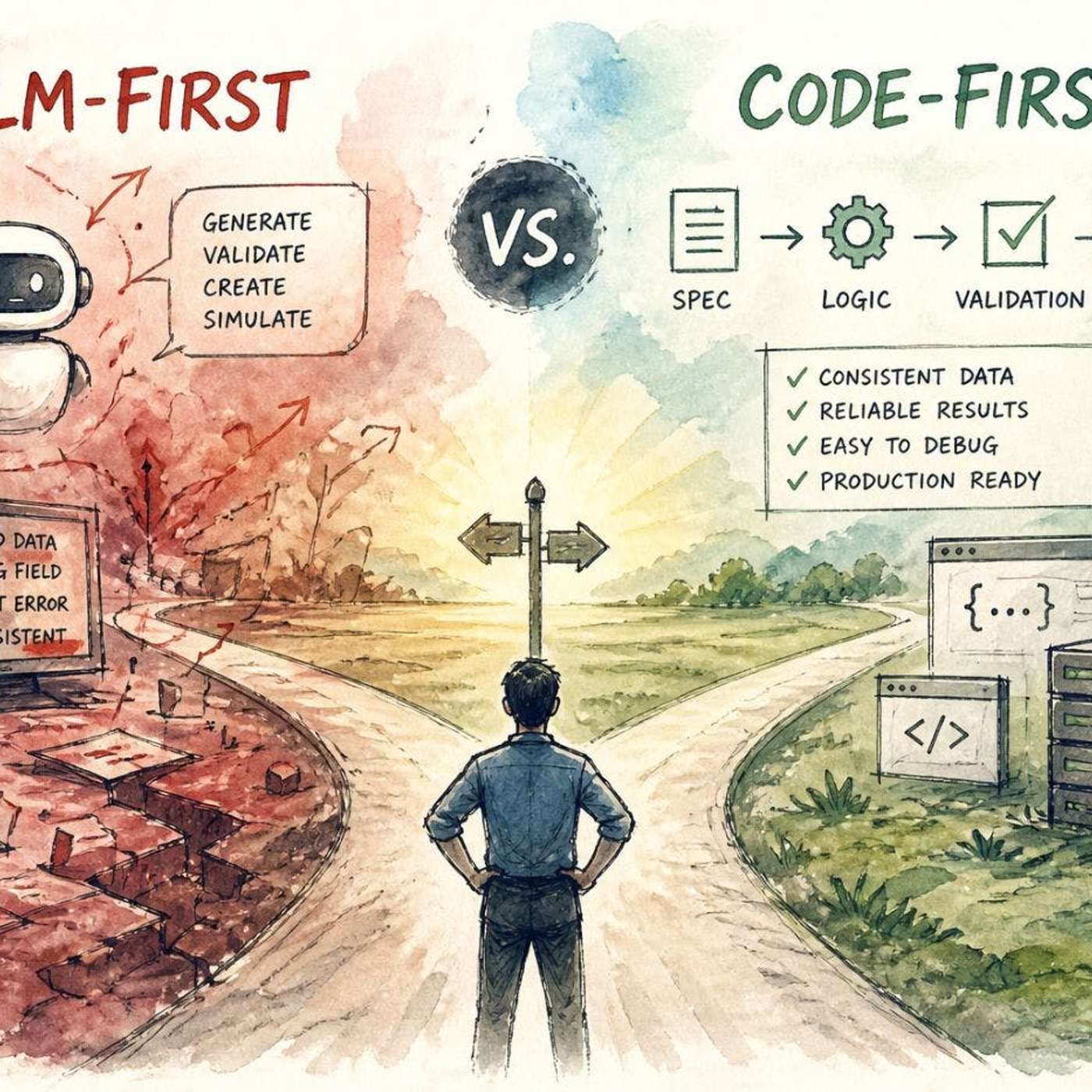
LLMs in production don't often crash spectacularly. Instead, they introduce subtle, probabilistic errors—like incorrect enum values or missing fields—that are hard to debug because they lack clear error patterns, unlike deterministic code failures.
Many developers believe tweaking prompts and logic ('harness engineering') is the hardest part of building agents. The real bottleneck, however, is scaling, reliability, and managing production infrastructure—a common miscalculation that managed services aim to solve.
Modern LLM clients expect more than just text generation. They require state management, lifecycle endpoints, and consistent API contracts, features often missing from local inference servers. An API gateway layer can bridge this gap between a simple model server and a full-featured platform.