Get your free personalized podcast brief
We scan new podcasts and send you the top 5 insights daily.
Instead of manually mapping system architecture, developers can ask AI tools like Cursor to analyze a feature's code and generate a graphical system diagram. This quickly visualizes service connections and potential impacts of code changes, aiding both engineers and product managers.

Related Insights
Historically, design workflows moved from low-to-high fidelity due to tool constraints. AI tools like Codex remove these barriers, allowing designers to begin with functional wireframes in code for immediate interaction testing, bypassing static sketches.

Field engineers can bypass documentation limitations by querying the entire codebase with AI tools like Claude Code. This provides detailed, step-by-step answers that public docs lack, directly addressing complex customer problems and reducing reliance on the engineering team.

By creating a skill that connects to an image generation API (e.g., Gemini), you can empower Claude Code to create technical diagrams. Feed it the context of a Product Requirements Document (PRD), and it can generate a relevant architecture diagram, embedding visual creation into your workflow.

To improve communication with engineering, PMs should use AI to analyze their company's actual codebase. Asking the AI for a high-level architecture diagram or to explain a component is a practical way to learn the system and develop a shared language with developers.
Tools like Claude Code are democratizing software development. Product managers without a coding background can use these AI assistants to work in the terminal, manage databases, and deploy apps. This accelerates prototyping and deepens technical understanding, improving collaboration with engineers.
At Cursor, development is increasingly happening in Slack channels. Team members collectively kick off and redirect a cloud agent in a thread, turning development into a collaborative discussion. The IDE becomes a secondary tool, while communication platforms become the primary surface.
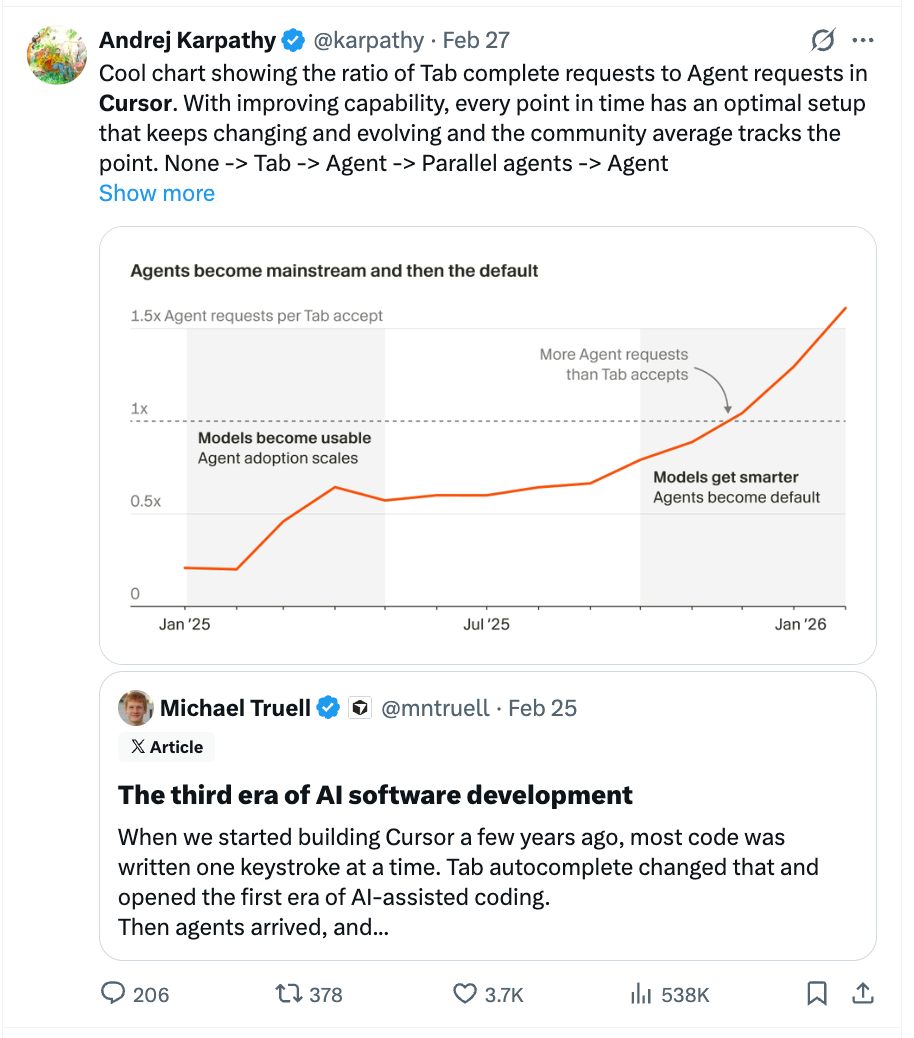
Instead of prompting for code line-by-line, "Plan Mode" has the AI agent generate a detailed plan in a markdown file first. The user reviews and modifies this plan like a spec document, elevating their role from coder to architect before the AI executes the build.
Move beyond basic AI prototyping by exporting your design system into a machine-readable format like JSON. By feeding this into an AI agent, you can generate high-fidelity, on-brand components and code that engineers can use directly, dramatically accelerating the path from idea to implementation.

For over a decade, software development fragmented into siloed roles (PM, Design, Eng) with their own tools. AI code editors are collapsing these boundaries by creating a unified workspace where a single "maker" or a streamlined team can build, iterate, and ship, much like in the early days of computing.

Feed AI coding tools text-based Mermaid diagrams which compress complex application logic into a format AIs can parse much faster and more accurately than raw code. This improves the quality and speed of AI-generated work by providing compressed, robust context.