Get your free personalized podcast brief
We scan new podcasts and send you the top 5 insights daily.
A critical inflection point for deploying humanoid robots at scale is enabling them to work safely alongside humans without physical barriers. Agility Robotics' Digit v5 is designed from the ground up to meet this requirement, a complex engineering feat that is essential for real-world applications in warehouses and factories.

Related Insights
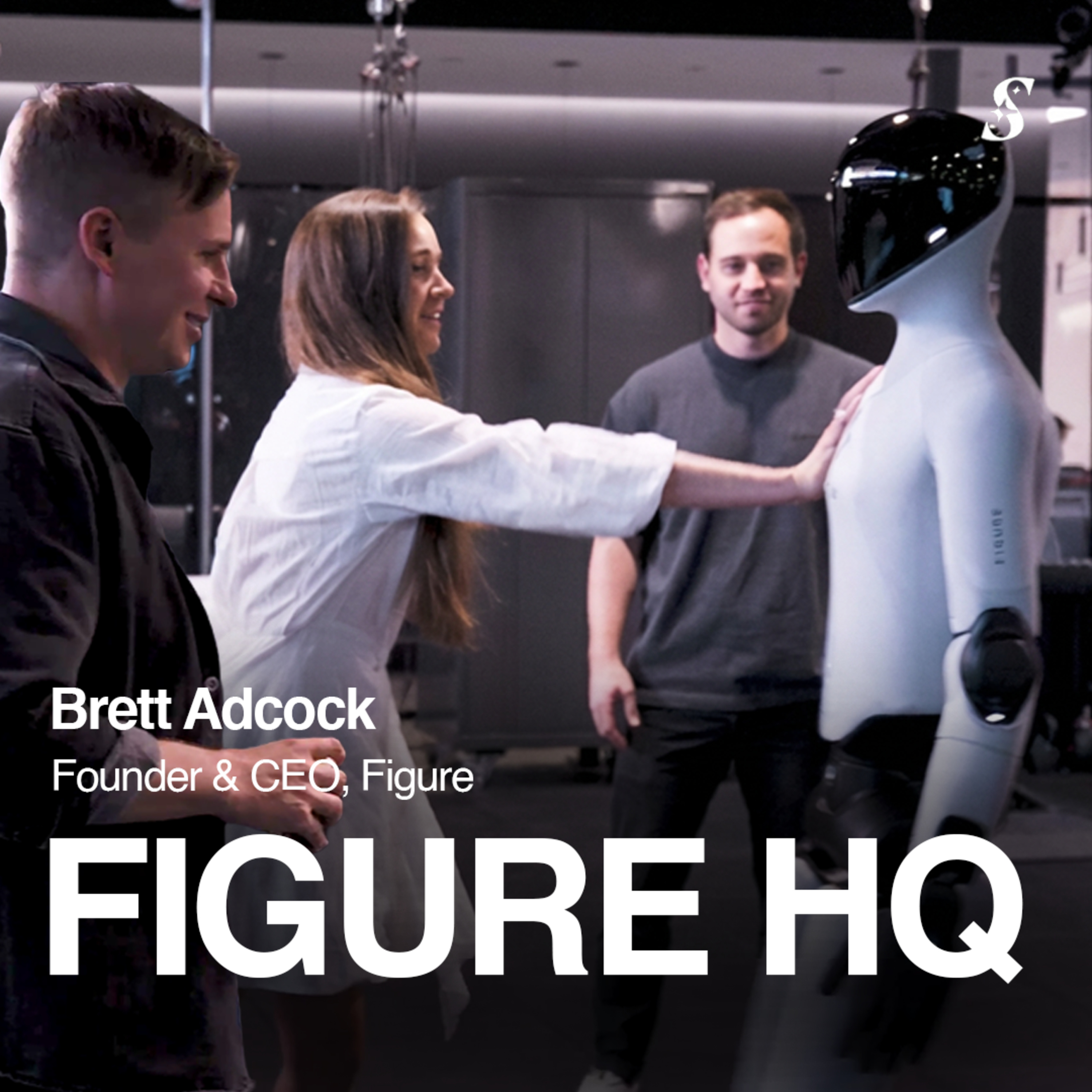
According to Figure's CEO, the company's biggest challenge is no longer hardware reliability but acquiring enormous amounts of diverse, high-quality data. This data is essential for pre-training their Helix AI model to generalize and handle countless real-world scenarios in homes and commercial settings.
The adoption of humanoid robots will mirror that of autonomous vehicles: focus on achievable, single-task applications first. Instead of a complex, general-purpose home robot, the market will first embrace robots trained for specific, repeatable industrial tasks like warehouse logistics or shelf stocking.

Unlike fixed industrial robots, a simple emergency power-off is unsafe for humanoids. They require constant energy to balance, so an emergency stop would cause them to fall over, creating a new and unpredictable hazard. This fundamental difference requires an entirely new set of safety protocols for the industry.

Standard Bots CEO Evan Beard argues that a key barrier for domestic humanoid robots is safety and robustness, which he calls the "Home Alone test." A robot must be able to withstand unpredictable, chaotic interactions, like children jumping on it, a scenario that current RL training methods cannot adequately simulate or solve.

The true economic advantage of a humanoid robot is not outperforming specialized automation at a single, repetitive task. Instead, its value lies in its versatility—the ability to perform a wide range of tasks in environments designed for humans, justifying its form factor for multi-purpose workflows rather than hyper-optimized ones.
While China's humanoid hardware demonstrates impressive locomotion in programmed tasks, the major obstacle to widespread deployment is the "robot brain." Current AI lacks the ability to autonomously navigate unpredictable, real-world environments, making massive data collection the current R&D focus.

The humanoid robot industry is stalled by a data paradox: robots need vast amounts of real-world data from factory tasks to become useful, but they cannot be deployed in factories until they are already useful. This catch-22 forces companies to rely on simulated data, slowing the transition from entertainment props to industrial tools.

Moving a robot from a lab demo to a commercial system reveals that AI is just one component. Success depends heavily on traditional engineering for sensor calibration, arm accuracy, system speed, and reliability. These unglamorous details are critical for performance in the real world.

Despite industry hype, humanoid robots are not imminent. They lack the massive datasets of real-world, unpredictable interactions needed to operate safely and usefully in a home environment, which is far more complex than a structured factory floor.

Musk identifies three primary challenges for humanoid robots: real-world intelligence, manufacturing at scale, and the hand. He asserts that from an electromechanical standpoint, perfecting the human-like hand is more difficult than all other physical components combined, requiring custom-designed actuators from first principles.