Get your free personalized podcast brief
We scan new podcasts and send you the top 5 insights daily.
Pure, curiosity-driven research into quantum physics over a century ago, with no immediate application in sight, became the foundation for today's multi-billion dollar industries like lasers, computer chips, and medical imaging. This shows the immense, unpredictable ROI of basic science.

Related Insights
Contrary to the belief that it has no current utility, quantum computing is already being used commercially and generating revenue. Major companies like HSBC and AstraZeneca are leveraging quantum machines via cloud platforms (AWS, Azure) for practical applications like financial modeling and drug discovery, proving its value today.

Wet lab experiments are slow and expensive, forcing scientists to pursue safer, incremental hypotheses. AI models can computationally test riskier, 'home run' ideas before committing lab resources. This de-risking makes scientists less hesitant to explore breakthrough concepts that could accelerate the field.

A "software-only singularity," where AI recursively improves itself, is unlikely. Progress is fundamentally tied to large-scale, costly physical experiments (i.e., compute). The massive spending on experimental compute over pure researcher salaries indicates that physical experimentation, not just algorithms, remains the primary driver of breakthroughs.

Building the first large-scale biological datasets, like the Human Cell Atlas, is a decade-long, expensive slog. However, this foundational work creates tools and knowledge that enable subsequent, larger-scale projects to be completed exponentially faster and cheaper, proving a non-linear path to discovery.
Luckey's invention method involves researching historical concepts discarded because enabling technology was inadequate. With modern advancements, these old ideas become powerful breakthroughs. The Oculus Rift's success stemmed from applying modern GPUs to a 1980s NASA technique that was previously too computationally expensive.
![Palmer Luckey - Inventing the Future of Defense - [Invest Like the Best, CLASSICS] thumbnail](https://megaphone.imgix.net/podcasts/f7c9aa8e-cb8d-11f0-828e-0b281809c10a/image/cc07f91ec47f95abbde771a4956b37b7.jpg?ixlib=rails-4.3.1&max-w=3000&max-h=3000&fit=crop&auto=format,compress)
AI is developing spatial reasoning that approaches human levels. This will enable it to solve novel physics problems, leading to breakthroughs that create entirely new classes of technology, much like discoveries in the 1940s led to GPS and cell phones.

The model that powered ChatGPT was not new; its world-changing potential was unlocked by a simple application experiment (RLHF for instruction following). This proves massive opportunities are often hidden in plain sight, requiring not a breakthrough invention but the willingness to 'do the damned experiment.'
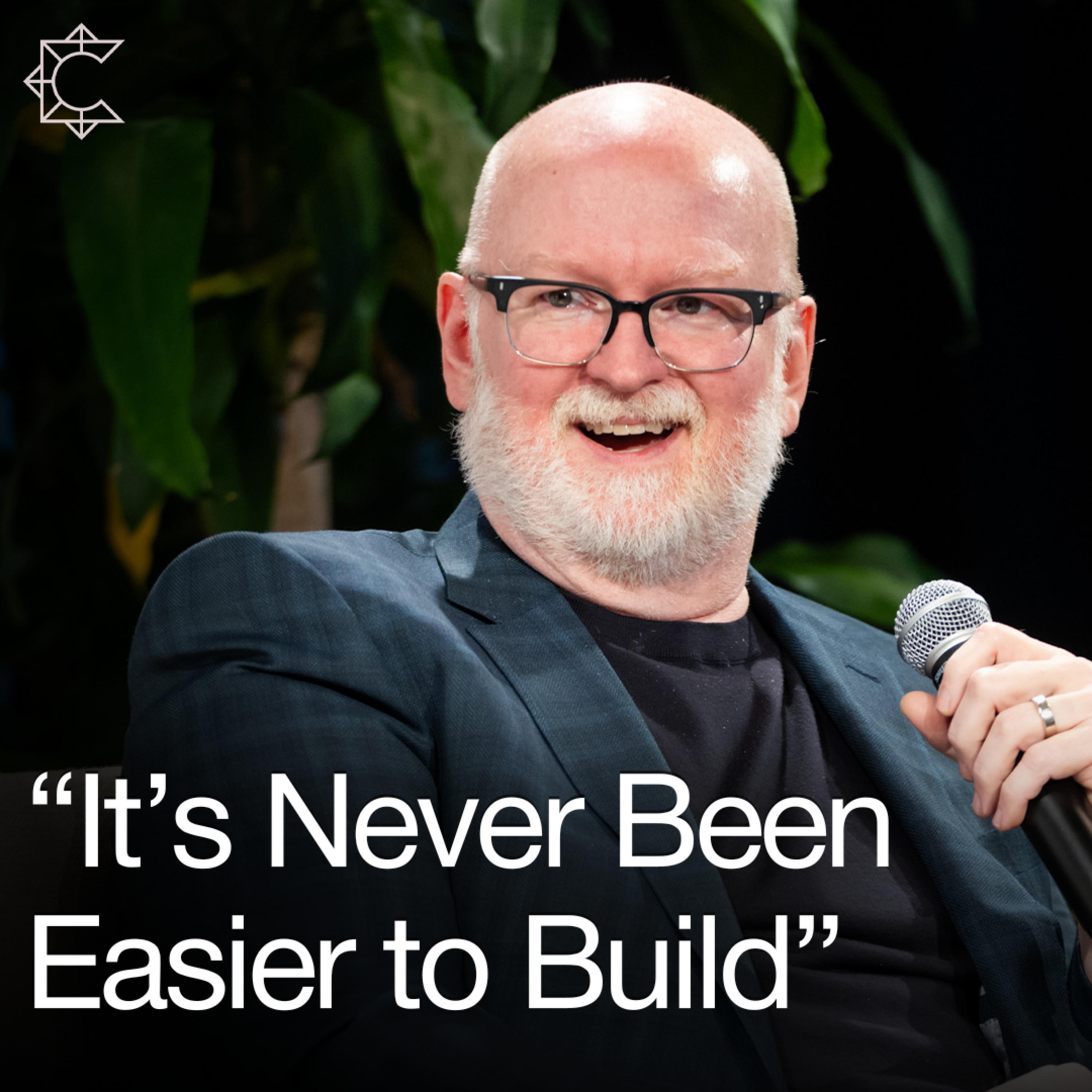
While AI dominates current conversations, Techstars' David Cohen believes Quantum Computing represents a far larger future paradigm shift. He posits that a single quantum computer will eventually surpass the combined power of all AI-driven classical computers. The "killer app" for this new era will be in healthcare, enabling truly personalized medicine.
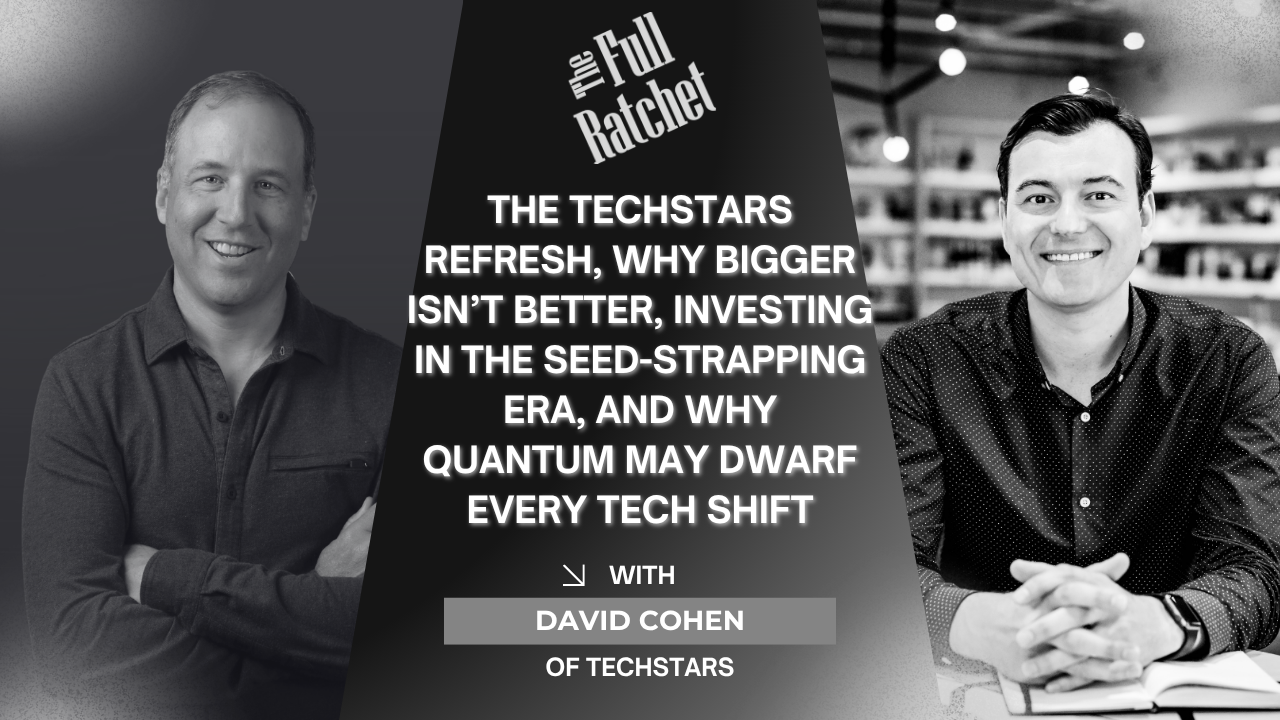
Despite hype around its potential to solve famously complex problems like the "traveling salesman," experts in the field caution that the number of actual, practical problems quantum computing can currently solve is extremely small. The gap between its theoretical power and tangible business application remains vast, making its near-term commercial impact questionable.

Critics question whether deep tech startups are doing "novel science." However, the strategic goal is often not a new discovery, but making a proven but abandoned technology (like nuclear fission) economically viable and scalable again. This demonstrates that for reindustrialization, effective execution on proven tech can be more valuable than chasing purely scientific breakthroughs.