Get your free personalized podcast brief
We scan new podcasts and send you the top 5 insights daily.
Microsoft is removing underused and "functionally useless" Copilot features from consumer products like Windows and Xbox. This is a strategic retreat to cut compute expenses on free products, which helps protect the gross margins of its cloud unit, already strained by costly paid services like GitHub Copilot.

Related Insights
AI's high computational cost (COGS) threatens SaaS margins. Nadella explains that just as the cloud expanded the market for computing far beyond the original server-license model, AI will create entirely new categories and user bases, offsetting the higher costs.
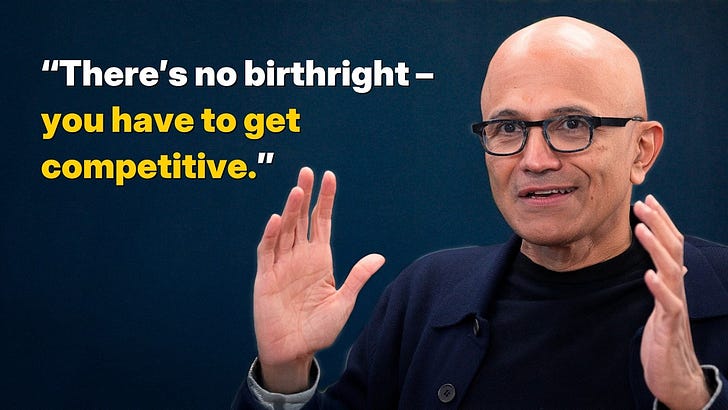
Widespread user complaints suggest Microsoft's Copilot is underperforming, yet the company continues to bundle it and raise prices. This is a classic incumbent strategy: leveraging a locked-in customer base to extract value from a subpar product rather than competing on quality and user experience, creating an opening for more agile competitors.

Despite its early partnership with OpenAI, Microsoft is falling behind in the AI race because of a failure to ship compelling products. Weak paid conversion for its flagship Copilot assistant demonstrates that access to top-tier models does not guarantee market success without strong product execution.
Microsoft is halting hiring in key units like Azure Cloud and sales, not due to poor performance, but to improve gross margins before its fiscal year-end. This reflects intense investor pressure for cost control on even successful divisions, while still hiring for strategic AI initiatives like Copilot.
Microsoft CEO Satya Nadella's move to personally oversee Copilot suggests the AI assistant is severely underperforming against competitors like ChatGPT. The restructuring aims to get the critical product "real serious about co-pilot real quick" by bringing it closer to the CEO.

Microsoft restructured its AI division by combining its consumer and commercial Co-pilot teams under a single executive reporting to the CEO. This move directly addresses customer confusion caused by multiple, misaligned product versions and signals an admission that the previous fragmented approach failed.

Satya Nadella reveals that Microsoft prioritizes building a flexible, "fungible" cloud infrastructure over catering to every demand of its largest AI customer, OpenAI. This involves strategically denying requests for massive, dedicated data centers to ensure capacity remains balanced for other customers and Microsoft's own high-margin products.

Despite heavy promotion, enterprise customers report significant flaws in Microsoft's Copilot. CIOs cite examples of the AI confidently fabricating security data or producing summaries longer than the original document. This feedback highlights a critical gap between marketing hype and the product's current capabilities for sophisticated business use cases.
Before investing in new third-party AI tools, organizations should maximize their existing Microsoft stack. Using Copilot reduces software bloat, protects intellectual property by keeping data in-house, and leverages the integrated nature of Microsoft 365 for tasks like call analysis from Teams recordings.

Microsoft GitHub's dramatic shift to consumption-based pricing for CoPilot, with some model costs increasing 27-fold, is the most direct evidence of the AI industry's unsustainable subsidy model. It reveals the true, previously hidden, compute cost of advanced agentic workflows that companies must now pay.