Get your free personalized podcast brief
We scan new podcasts and send you the top 5 insights daily.
Simply "scaling up" (adding more GPUs to one model instance) hits a performance ceiling due to hardware and algorithmic limits. True large-scale inference requires "scaling out" (duplicating instances), creating a new systems problem of managing and optimizing across a distributed fleet.
Related Insights
A 10x increase in compute may only yield a one-tier improvement in model performance. This appears inefficient but can be the difference between a useless "6-year-old" intelligence and a highly valuable "16-year-old" intelligence, unlocking entirely new economic applications.
![Dylan Patel - Inside the Trillion-Dollar AI Buildout - [Invest Like the Best, EP.442] thumbnail](https://megaphone.imgix.net/podcasts/799253cc-9de9-11f0-8661-ab7b8e3cb4c1/image/d41d3a6f422989dc957ef10da7ad4551.jpg?ixlib=rails-4.3.1&max-w=3000&max-h=3000&fit=crop&auto=format,compress)
The original playbook of simply scaling parameters and data is now obsolete. Top AI labs have pivoted to heavily designed post-training pipelines, retrieval, tool use, and agent training, acknowledging that raw scaling is insufficient to solve real-world problems.

The relationship between computing power and AI model capability is not linear. According to established 'scaling laws,' a tenfold increase in the compute used for training large language models (LLMs) results in roughly a doubling of the model's capabilities, highlighting the immense resources required for incremental progress.

Over two-thirds of reasoning models' performance gains came from massively increasing their 'thinking time' (inference scaling). This was a one-time jump from a zero baseline. Further gains are prohibitively expensive due to compute limitations, meaning this is not a repeatable source of progress.

The plateauing performance-per-watt of GPUs suggests that simply scaling current matrix multiplication-heavy architectures is unsustainable. This hardware limitation may necessitate research into new computational primitives and neural network designs built for large-scale distributed systems, not single devices.

While AI inference can be decentralized, training the most powerful models demands extreme centralization of compute. The necessity for high-bandwidth, low-latency communication between GPUs means the best models are trained by concentrating hardware in the smallest possible physical space, a direct contradiction to decentralized ideals.

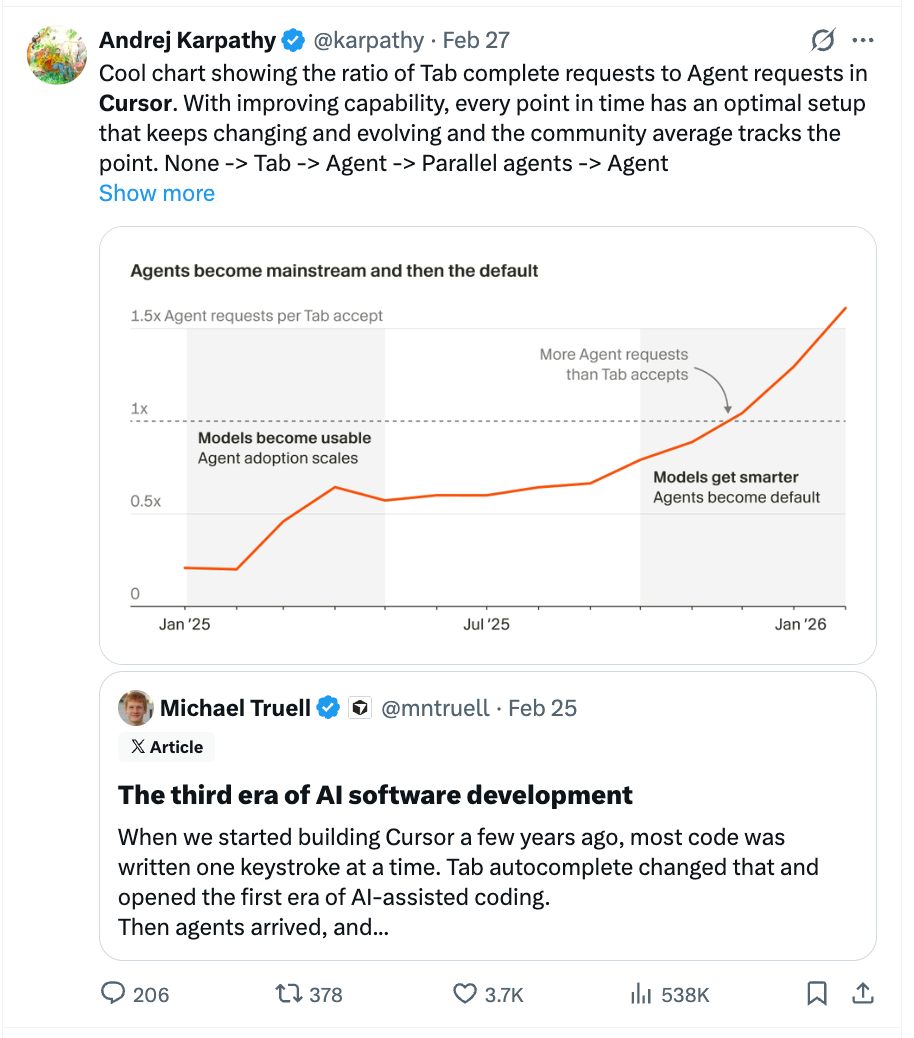
The focus in AI engineering is shifting from making a single agent faster (latency) to running many agents in parallel (throughput). This "wider pipe" approach gets more total work done but will stress-test existing infrastructure like CI/CD, which wasn't built for this volume.
The current focus on building massive, centralized AI training clusters represents the 'mainframe' era of AI. The next three years will see a shift toward a distributed model, similar to computing's move from mainframes to PCs. This involves pushing smaller, efficient inference models out to a wide array of devices.

While AI training requires massive, centralized data centers, the growth of inference workloads is creating a need for a new architecture. This involves smaller (e.g., 5 megawatt), decentralized clusters located closer to users to reduce latency. This shift impacts everything from data center design to the software required to manage these distributed fleets.

Contrary to the idea that infrastructure problems get commoditized, AI inference is growing more complex. This is driven by three factors: (1) increasing model scale (multi-trillion parameters), (2) greater diversity in model architectures and hardware, and (3) the shift to agentic systems that require managing long-lived, unpredictable state.