Get your free personalized podcast brief
We scan new podcasts and send you the top 5 insights daily.
For years, clinicians have been forced to work around clunky technology like EMRs. The next generation of successful AI tools will reverse this dynamic by being designed around how people actually work—accounting for interruptions, competing priorities, and handoffs—rather than forcing humans to adapt to the software.

Related Insights
Smart organizations don't ask 'Where can we deploy AI?'. Instead, they ask 'Where is our work breaking down today?' They identify areas of friction—like patient wait times or administrative burdens—and apply AI as a specific solution rather than deploying technology in hopes of finding value.
Instead of merely 'sprinkling' AI into existing systems for marginal gains, the transformative approach is to build an AI co-pilot that anticipates and automates a user's entire workflow. This turns the individual, not the software, into the platform, fundamentally changing their operational capacity.

Being patient-centered is necessary but insufficient for adoption. Technology in healthcare must be seamlessly embedded into a physician's existing, time-constrained workflow. Great tech that adds friction will be ignored, regardless of its potential patient benefit.

The most effective AI strategy focuses on 'micro workflows'—small, discrete tasks like summarizing patient data. By optimizing these countless small steps, AI can make decision-makers 'a hundred-fold more productive,' delivering massive cumulative value without relying on a single, high-risk autonomous solution.

An effective AI strategy in healthcare is not limited to consumer-facing assistants. A critical focus is building tools to augment the clinicians themselves. An AI 'assistant' for doctors to surface information and guide decisions scales expertise and improves care quality from the inside out.

User workflows rarely exist in a single application; they span tools like Slack, calendars, and documents. A truly helpful AI must operate across these tools, creating a unified "desired path" that reflects how people actually work, rather than being confined by app boundaries.

Unlike previous technologies that integrated into existing workflows, AI agents require us to fundamentally re-engineer our work processes to make them effective. Early adopters who adapt their operations to how agents "think" will gain compounding advantages over competitors.
Traditional automation focuses on discrete tasks, while Agentic AI represents a paradigm shift toward orchestrating entire end-to-end processes. It understands objectives, interacts with multiple systems, and coordinates actions across teams, moving from simply executing a task to driving an entire workflow forward.

To avoid the "alert fatigue" common in medical software, Abridge's product philosophy is for its AI to be proactive, not reactive. It works seamlessly in the background to prepare clinicians before visits, rather than interrupting them with constant alerts during patient conversations, making the experience helpful but unobtrusive.
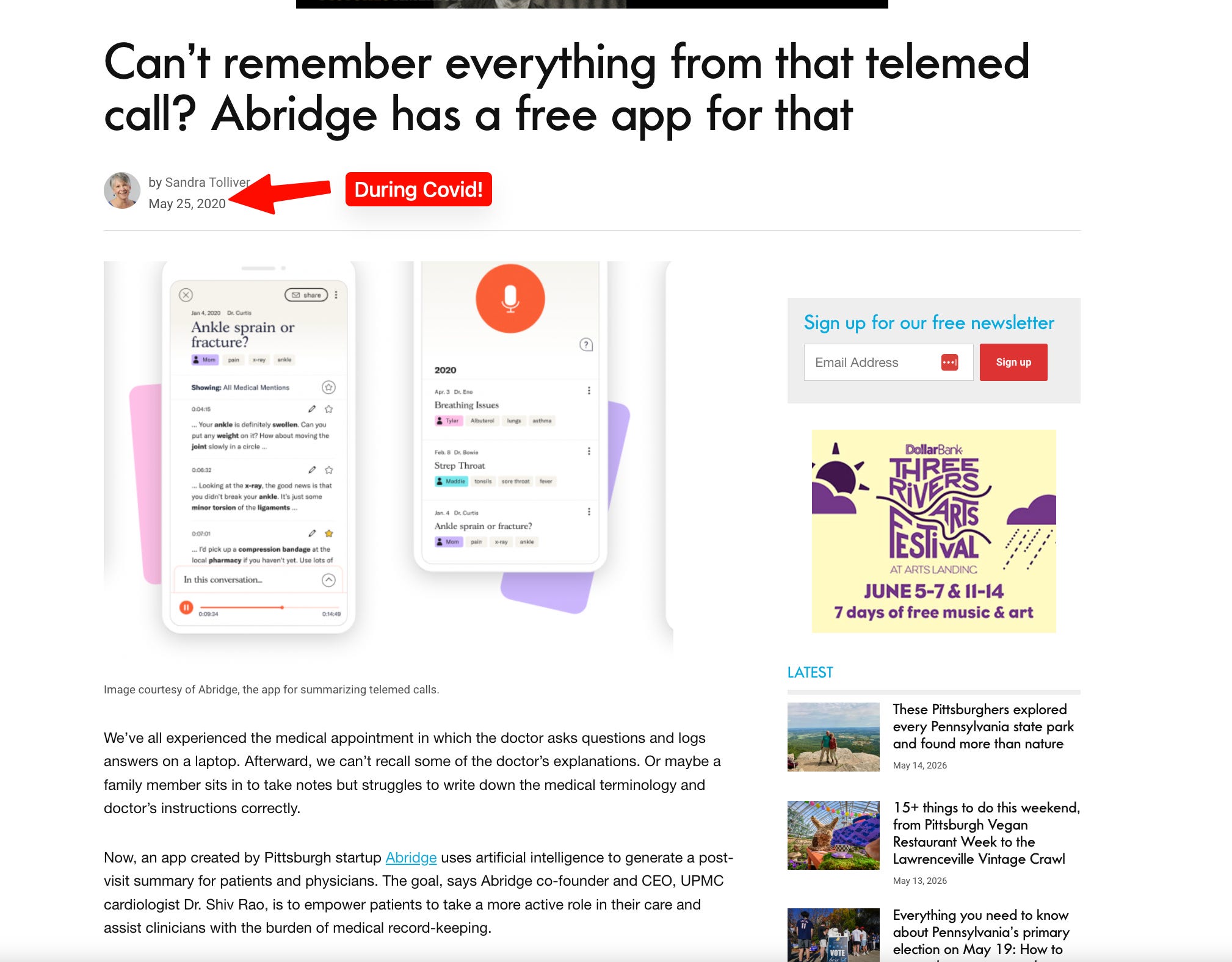
Instead of replacing clinicians, AI's promise lies in offloading work to virtual assistants. These agents will prepare pre-visit summaries, ask patients questions beforehand, and manage post-visit follow-ups like checking on prescriptions and lab tests, acting as a force multiplier for the human care team.