Get your free personalized podcast brief
We scan new podcasts and send you the top 5 insights daily.
Developing with AI agents on your local machine creates bottlenecks and coordination nightmares. Cloud-based virtual machines (VMs) allow you to run numerous agents in parallel without code collision, drastically increasing your shipping velocity and making local development a relic of the past.

Related Insights
Tools like Git were designed for human-paced development. AI agents, which can make thousands of changes in parallel, require a new infrastructure layer—real-time repositories, coordination mechanisms, and shared memory—that traditional systems cannot support.

Running multiple, complex AI coding agents simultaneously is computationally prohibitive on local machines. Stripe's success relies on their ability to spin up numerous isolated cloud development environments in parallel, a crucial investment for any team serious about agentic engineering.

Cursor discovered that agents need more than just code access. Providing a full VM environment—a "brain in a box" where they can see pixels, run code, and use dev tools like a human—was the step-change needed to tackle entire features, not just minor edits.
Instead of using local machines like Mac Minis, host client agents in isolated cloud virtual machines (e.g., via Orgo). This provides a secure, sandboxed environment and allows you (and your own management agent) to remotely access, debug, and update all client agents from a single platform, making fulfillment vastly more efficient.
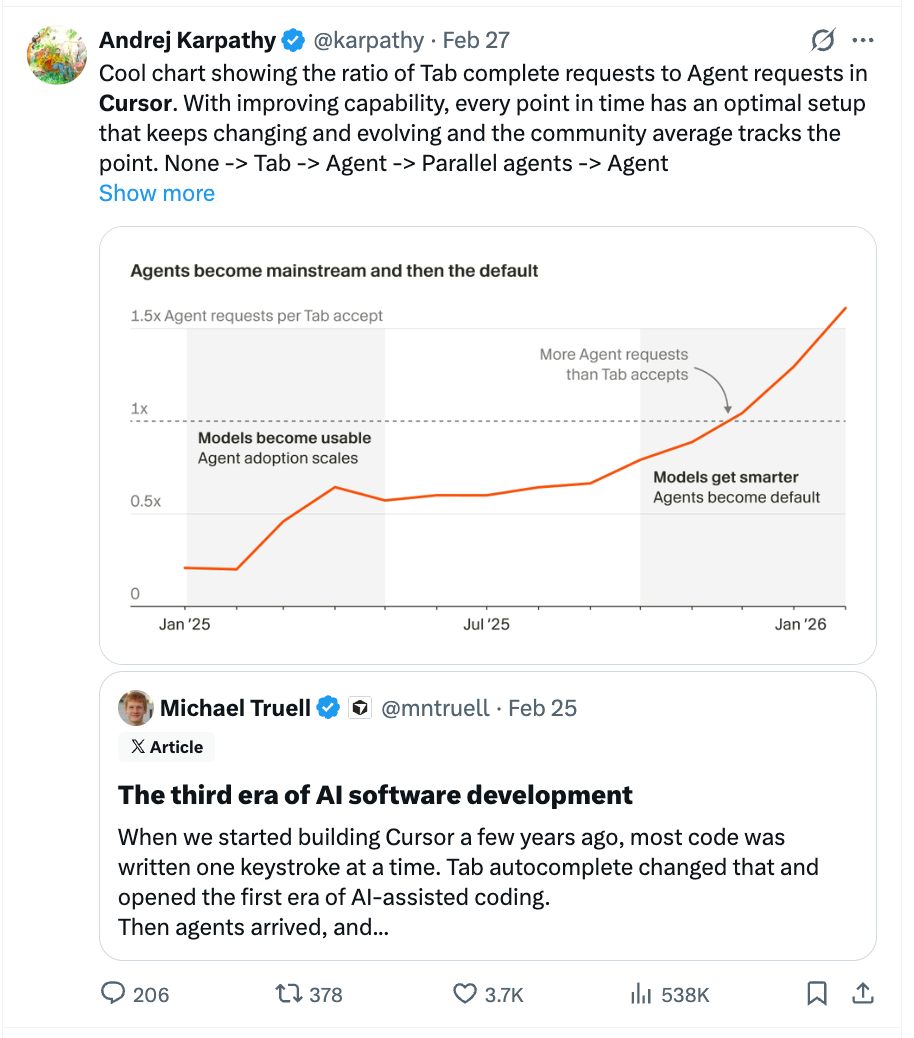
The focus in AI engineering is shifting from making a single agent faster (latency) to running many agents in parallel (throughput). This "wider pipe" approach gets more total work done but will stress-test existing infrastructure like CI/CD, which wasn't built for this volume.
While cloud hosting for AI agents seems cheap and easy, a local machine like a Mac Mini offers key advantages. It provides direct control over the agent's environment, easy access to local tools, and the ability to observe its actions in real-time, which dramatically accelerates your learning and ability to use it effectively.
The evolution from AI autocomplete to chat is reaching its next phase: parallel agents. Replit's CEO Amjad Masad argues the next major productivity gain will come not from a single, better agent, but from environments where a developer manages tens of agents working simultaneously on different features.

Databricks co-founder Reynold Xin describes the pain of running long agentic coding sessions locally as going "back to the dark ages," requiring tethered laptops to remain online. This personal frustration was a key driver for building persistent cloud sandboxes into their Omnigens platform.

The rise of AI agents drives demand for a new computing primitive: secure, small-footprint virtual machines that can start in milliseconds, execute a task, persist state, and then sleep. This optimizes CPU usage for the high-volume, short-burst workflows characteristic of agents.

While local coding agents have product-market fit today, OpenAI's Michael Bolin argues the long-term trend is remote agents. To achieve true automation—like having an agent autonomously tackle every new bug ticket—workloads must run in the cloud, unconstrained by a developer's personal machine.