Get your free personalized podcast brief
We scan new podcasts and send you the top 5 insights daily.
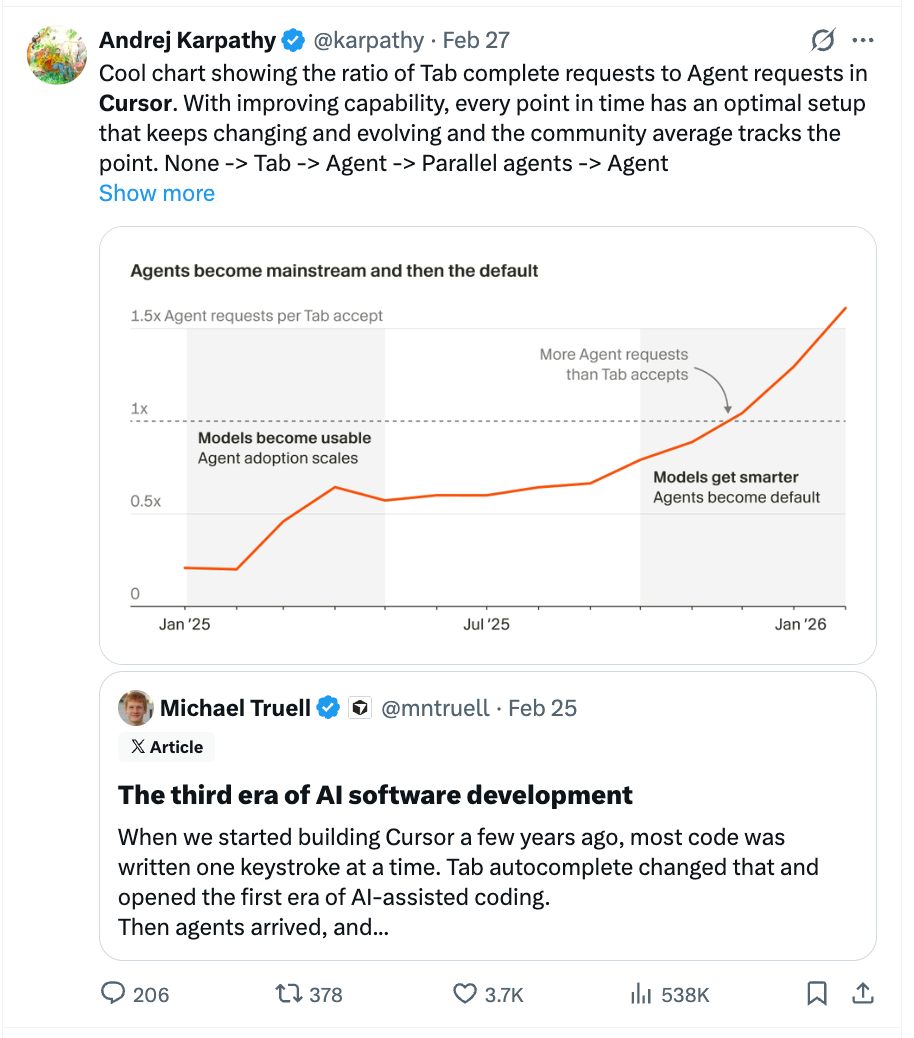
Cursor discovered that agents need more than just code access. Providing a full VM environment—a "brain in a box" where they can see pixels, run code, and use dev tools like a human—was the step-change needed to tackle entire features, not just minor edits.
Related Insights
The power of tools like Claude Code comes from giving the AI access to fundamental command-line tools (e.g., `bash`, `grep`). This allows the AI to compose novel solutions and lets product teams define new features using simple English prompts rather than hard-coded logic.

The most significant productivity gains come from applying AI to every stage of development, including research, planning, product marketing, and status updates. Limiting AI to just code generation misses the larger opportunity to automate the entire engineering process.
As AI generates more code than humans can review, the validation bottleneck emerges. The solution is providing agents with dedicated, sandboxed environments to run tests and verify functionality before a human sees the code, shifting review from process to outcome.

The term 'Claude Code' is a misnomer. Advanced users see these tools not just for coding, but as a generalized 'cloud computer.' By giving an agent access to files, terminals, and browsers, it becomes a versatile tool capable of any task, from program management to data analysis.

A new software paradigm, "agent-native architecture," treats AI as a core component, not an add-on. This progresses in levels: the agent can do any UI action, trigger any backend code, and finally, perform any developer task like writing and deploying new code, enabling user-driven app customization.
Tools like Claude Code offer superior capabilities beyond standard chatbots. They can access local file systems, enabling them to read and write files, maintain persistent memory, and execute complex, multi-step "recipes" autonomously, acting as a true virtual assistant rather than a simple text generator.

The true capability of AI agents comes not just from the language model, but from having a full computing environment at their disposal. Vercel's internal data agent, D0, succeeds because it can write and run Python code, query Snowflake, and search the web within a sandbox environment.

Desktop-based AI agents like Claude Co-Work, which can see your screen and local files, are a game-changer. They enable non-engineers to tackle complex projects like building production apps with single sign-on by providing real-time assistance and debugging.
Cursor's founder predicts AI developer tools will bifurcate into two modes: a fast, "in-the-loop" copilot for pair programming, and a slower, asynchronous "agent" that completes entire tasks with perfect accuracy. This requires building products optimized for both speed and correctness.

As AI agents evolve from information retrieval to active work (coding, QA testing, running simulations), they require dedicated, sandboxed computational environments. This creates a new infrastructure layer where every agent is provisioned its own 'computer,' moving far beyond simple API calls and creating a massive market opportunity.
