Get your free personalized podcast brief
We scan new podcasts and send you the top 5 insights daily.
Running multiple, complex AI coding agents simultaneously is computationally prohibitive on local machines. Stripe's success relies on their ability to spin up numerous isolated cloud development environments in parallel, a crucial investment for any team serious about agentic engineering.

Related Insights
Tools like Git were designed for human-paced development. AI agents, which can make thousands of changes in parallel, require a new infrastructure layer—real-time repositories, coordination mechanisms, and shared memory—that traditional systems cannot support.

As AI generates more code than humans can review, the validation bottleneck emerges. The solution is providing agents with dedicated, sandboxed environments to run tests and verify functionality before a human sees the code, shifting review from process to outcome.
Cursor discovered that agents need more than just code access. Providing a full VM environment—a "brain in a box" where they can see pixels, run code, and use dev tools like a human—was the step-change needed to tackle entire features, not just minor edits.
For a coding agent to be genuinely autonomous, it cannot just run in a user's local workspace. Google's Jules agent is designed with its own dedicated cloud environment. This architecture allows it to execute complex, multi-day tasks independently, a key differentiator from agents that require a user's machine to be active.
![⚡ [AIE CODE Preview] Inside Google Labs: Building The Gemini Coding Agent — Jed Borovik, Jules thumbnail](https://assets.flightcast.com/V2Uploads/nvaja2542wefzb8rjg5f519m/01K4D8FB4MNA071BM5ZDSMH34N/square.jpg)
The focus in AI engineering is shifting from making a single agent faster (latency) to running many agents in parallel (throughput). This "wider pipe" approach gets more total work done but will stress-test existing infrastructure like CI/CD, which wasn't built for this volume.
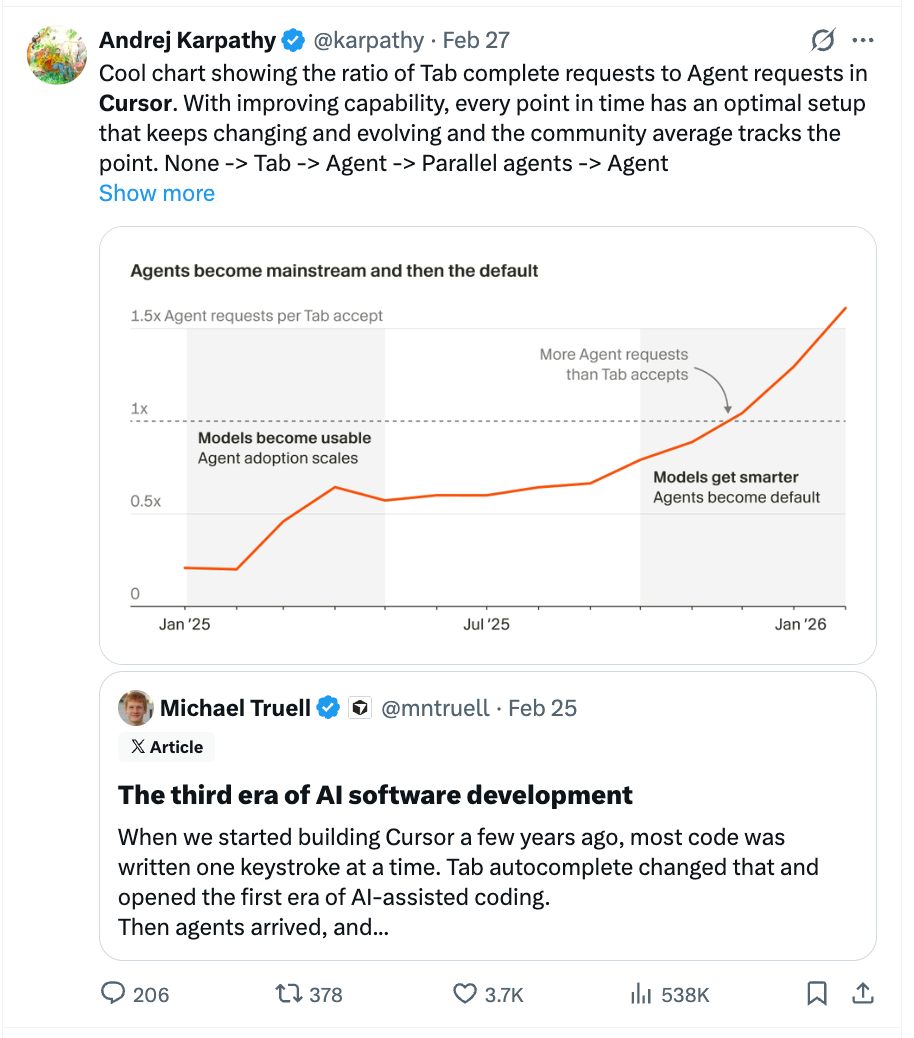
The evolution from AI autocomplete to chat is reaching its next phase: parallel agents. Replit's CEO Amjad Masad argues the next major productivity gain will come not from a single, better agent, but from environments where a developer manages tens of agents working simultaneously on different features.

The agent development process can be significantly sped up by running multiple tasks concurrently. While one agent is engineering a prompt, other processes can be simultaneously scraping websites for a RAG database and conducting deep research on separate platforms. This parallel workflow is key to building complex systems quickly.

While local coding agents have product-market fit today, OpenAI's Michael Bolin argues the long-term trend is remote agents. To achieve true automation—like having an agent autonomously tackle every new bug ticket—workloads must run in the cloud, unconstrained by a developer's personal machine.

The true capability of AI agents comes not just from the language model, but from having a full computing environment at their disposal. Vercel's internal data agent, D0, succeeds because it can write and run Python code, query Snowflake, and search the web within a sandbox environment.

As AI agents evolve from information retrieval to active work (coding, QA testing, running simulations), they require dedicated, sandboxed computational environments. This creates a new infrastructure layer where every agent is provisioned its own 'computer,' moving far beyond simple API calls and creating a massive market opportunity.
