Get your free personalized podcast brief
We scan new podcasts and send you the top 5 insights daily.
When sharing an internal app built with ChatGPT Sites, authentication isn't centralized through shared API keys. Instead, it leverages 'bring your own plugin' architecture where each team member brings their own authenticated connectors (e.g., Slack, Notion). Visitors view the same site template, but content dynamically scopes to their identity and team permissions, making it ideal for teams handling sensitive data.

Related Insights
To use AI agents securely, avoid granting them full access to your sensitive data. Instead, create a separate, partitioned environment—like its own email or file storage account. You can then collaborate by sharing specific information on a task-by-task basis, just as you would with a new human colleague.

Although initially conceived as an easy deployment layer for Codex-generated frontends to bypass local DevOps, ChatGPT Sites has expanded into infrastructure. It incorporates native components like D1 data storage and R2 buckets, and can actually host Model Context Protocol (MCP) plugins, creating a virtuous workflow loop where Sites hosts both the backend plugin architecture and the consuming site.
Unlike tools requiring separate authentication for each project, Perplexity Computer's apps reuse its core connectors. An app built to parse your email and Slack is already authenticated, deploying instantly without the repeated setup friction common in other AI development environments.

Unlike model gateways managing simple API keys, tool (MCP) gateways handle greater complexity. They must interface with diverse authentication methods for different tools (e.g., Slack, Gmail) and manage granular read/write permissions to prevent autonomous agents from taking unintended actions with sensitive data.

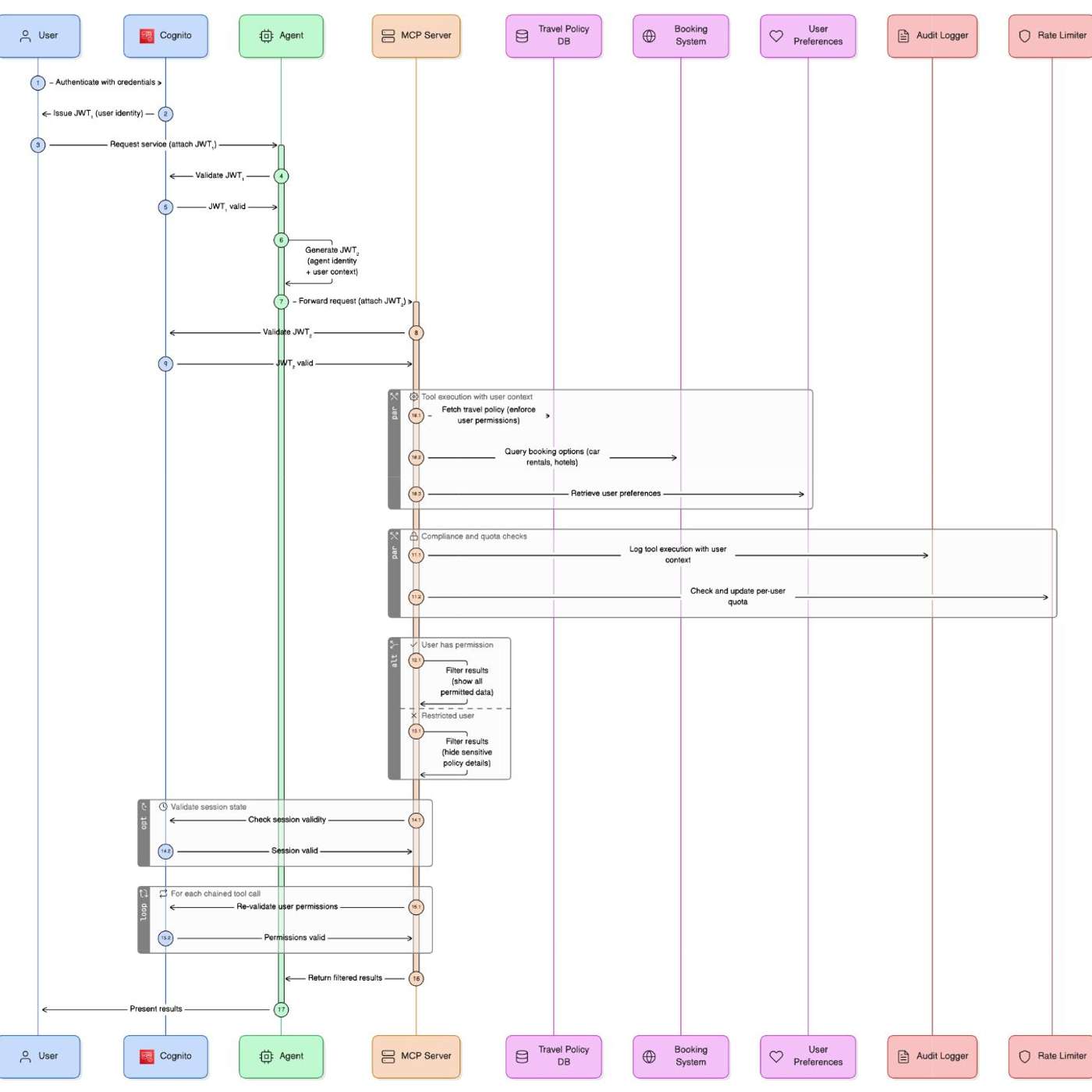
A single AI agent can provide personalized and secure responses by dynamically adopting the data access permissions of the person querying it. This ensures users only see data they are authorized to view, maintaining granular governance without separate agent instances.

To maintain security across multiple services, a JWT propagation pattern is key. This creates a secure chain of trust where an AI agent's permissions are never inferred from its responses. Instead, the user's identity and permissions are cryptographically verified at every step of the entire request chain, ensuring robust security.
Instead of building individual integrations, use a tool like Composeo. It provides a single connector that gives an AI agent access to thousands of apps like Gmail, Slack, and Notion. This dramatically simplifies development by handling authentication and tool-calling for a wide range of services through one unified interface.

ChatGPT's 'log in with ChatGPT' strategy will create a powerful compounding advantage. It lets users carry their 'memory' to third-party apps, giving developers personalized context and potentially reducing inference costs, which deeply entrenches ChatGPT as the core AI identity layer for the web.

A critical security decision is whose access credentials a team agent uses. The safest method is for the agent to inherit the permissions of the person interacting with it. This prevents it from exposing sensitive data that the creator can see to a junior team member who cannot.

Instead of building complex new control layers for AI, the emerging best practice is to treat each agent as a separate entity. This means giving them their own accounts, API keys, and permissions, mirroring how you would onboard a new human employee to manage access and security.