Get your free personalized podcast brief
We scan new podcasts and send you the top 5 insights daily.
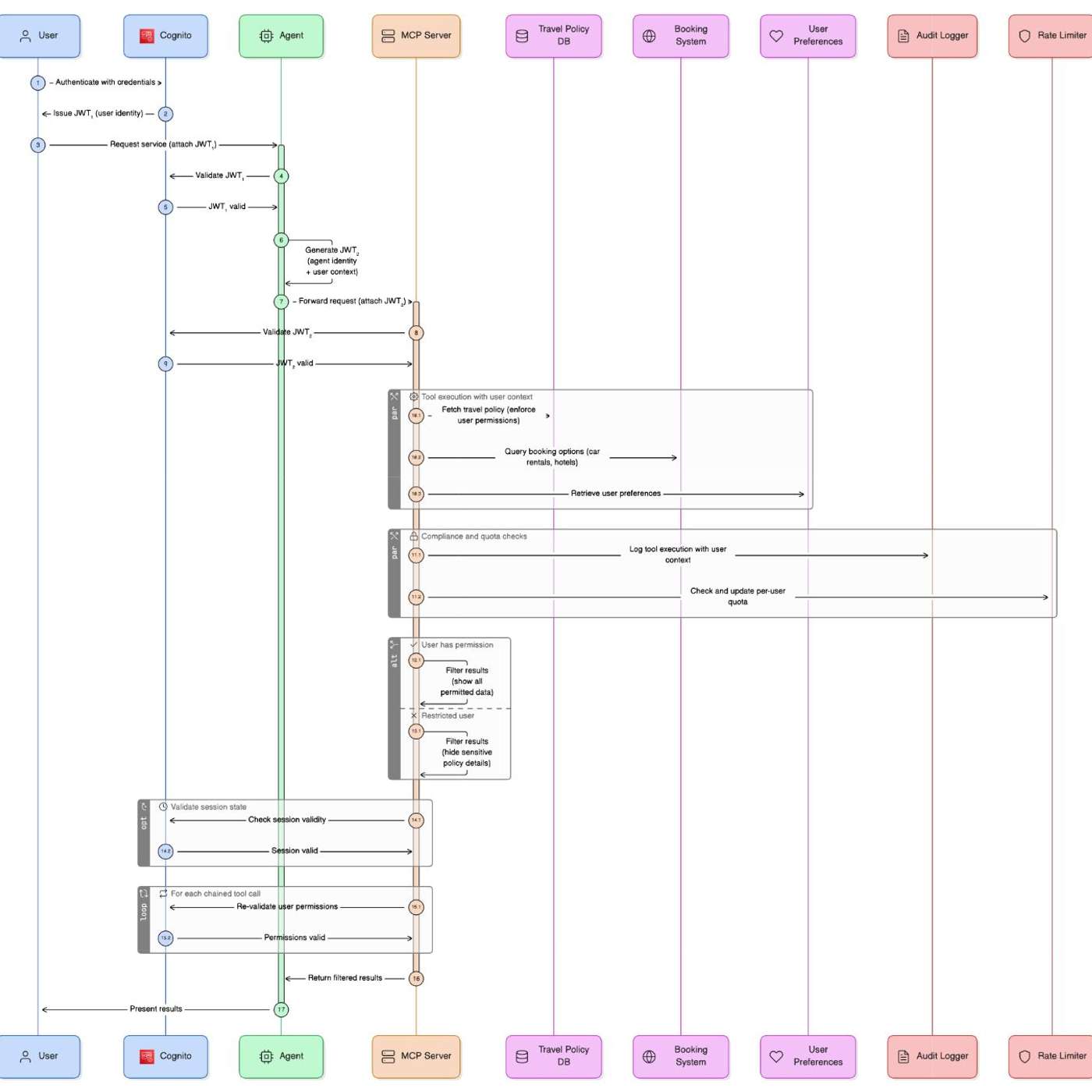
To maintain security across multiple services, a JWT propagation pattern is key. This creates a secure chain of trust where an AI agent's permissions are never inferred from its responses. Instead, the user's identity and permissions are cryptographically verified at every step of the entire request chain, ensuring robust security.
Related Insights
Frameworks from firms like KPMG and AWS emphasize that AI agents must be treated as entities with identities and permissions. A strong IAM foundation is a critical control layer to prevent agents from accessing or unintentionally leaking sensitive information, reflecting a broader shift to treat agents like any other privileged user in an IT ecosystem.

Enterprises should model AI agent identity in two layers. A "Stable Agent Principle" acts like a permanent user account for governance, while a "Temporal Runtime Identity" acts like a temporary session for specific actions. This prevents overwhelming identity systems while ensuring full auditability and accountability for every agent action.

A key bottleneck preventing AI agents from performing meaningful tasks is the lack of secure access to user credentials. Companies like 1Password are building a foundational "trust layer" that allows users to authorize agents on-demand while maintaining end-to-end encryption. This secure credentialing infrastructure is a critical unlock for the entire agentic AI economy.

The most advanced security posture for AI agents involves moving beyond easily compromised API keys. It requires hardware-bound credentials, where an agent's identity is cryptographically tied to a physical Hardware Security Module (HSM) or Trusted Platform Module (TPM), making identity spoofing exceptionally difficult.

An AI agent cannot simply use a human's credentials. It requires its own identity, permissions, and access controls for security and traceability. This means SaaS companies will likely charge for agent seats, creating a significant new revenue stream.

Current identity standards like OIDC are insufficient for AI agents. The future requires a "three-legged stool" identity combining a service account (the agent's identity), owner role claims, and "on-behalf-of" claims inherited from the user.

A single AI agent can provide personalized and secure responses by dynamically adopting the data access permissions of the person querying it. This ensures users only see data they are authorized to view, maintaining granular governance without separate agent instances.

Teleport's decision to build a single identity layer for humans, machines, and workloads prepared them for the AI wave. This architecture became critical for containing non-deterministic AI agents, as enforcing security policies requires reasoning about all identity types simultaneously.

The rise of autonomous software agents like Cognition's "Devin" introduces a new, critical security layer: agent identity. Organizations must decide if agents have their own unique identities or inherit them from the deploying user. This is fundamental for creating auditable logs and securing their actions.

Instead of building complex new control layers for AI, the emerging best practice is to treat each agent as a separate entity. This means giving them their own accounts, API keys, and permissions, mirroring how you would onboard a new human employee to manage access and security.