Get your free personalized podcast brief
We scan new podcasts and send you the top 5 insights daily.
Unlike model gateways managing simple API keys, tool (MCP) gateways handle greater complexity. They must interface with diverse authentication methods for different tools (e.g., Slack, Gmail) and manage granular read/write permissions to prevent autonomous agents from taking unintended actions with sensitive data.

Related Insights
A comprehensive AI management system requires more than just an LLM router. It needs three distinct gateways: a Model Gateway for controlling LLM access, an MCP Gateway for secure tool and data interaction, and an Agent Gateway to govern communication between different autonomous agents and provide a "kill switch."
Frameworks from firms like KPMG and AWS emphasize that AI agents must be treated as entities with identities and permissions. A strong IAM foundation is a critical control layer to prevent agents from accessing or unintentionally leaking sensitive information, reflecting a broader shift to treat agents like any other privileged user in an IT ecosystem.
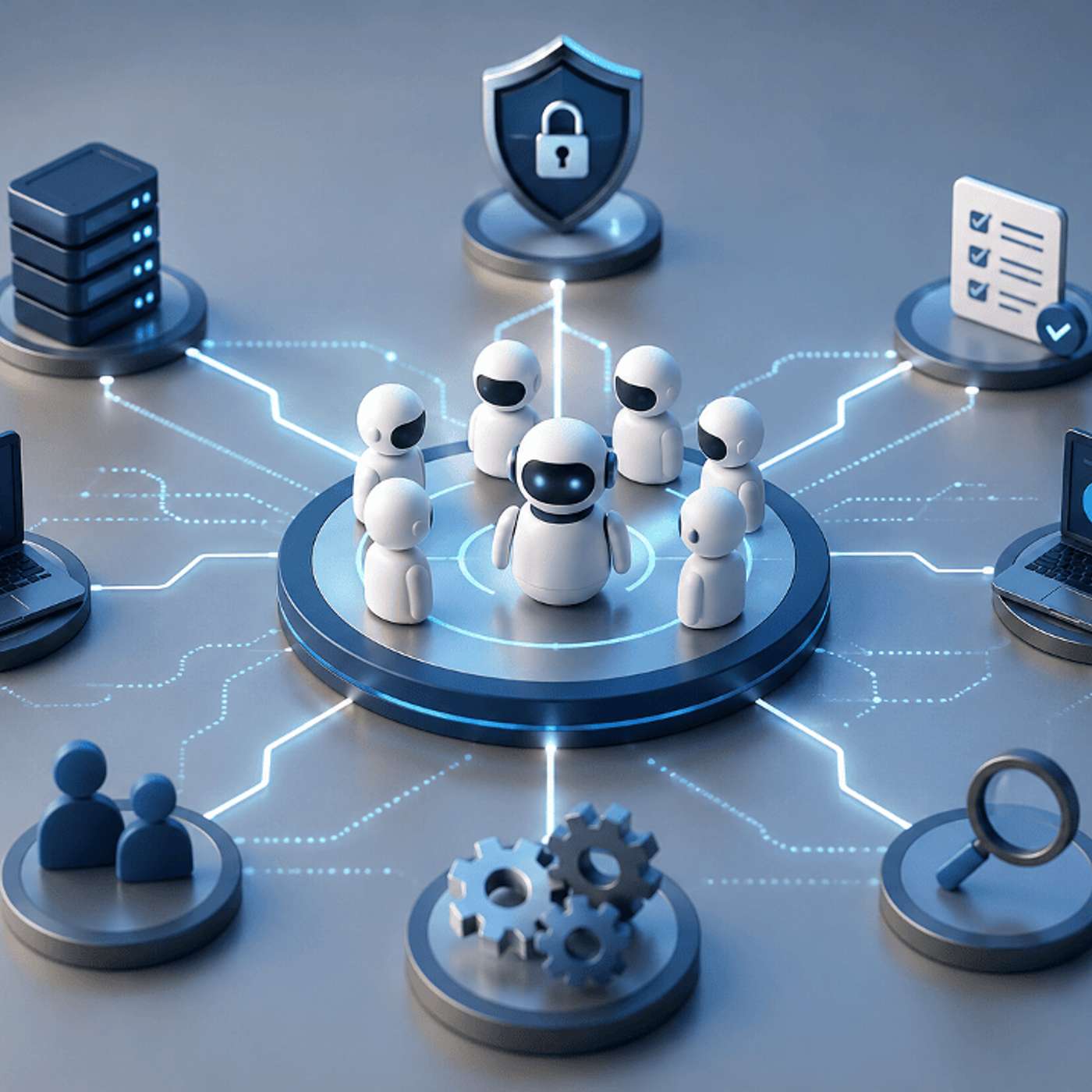
Standard Role-Based Access Control (RBAC) is inadequate for dynamic AI agents. Cisco advocates for 'T-back': Tool, Task, and Transaction-based access control. This model grants agents ephemeral, minimum-necessary privileges only for a specific action, significantly enhancing security in autonomous systems.

Current AI tools are in "easy mode" because they operate with the user's direct authentication and permissions. The much harder, yet-to-be-solved problem is "hard mode": autonomous agents that need their own scoped access to enterprise resources without dramatically increasing security risks.
Trying to secure AI agents by restricting which tools are exposed in the Model Context Protocol (MCP) is the wrong approach. Security should be implemented at the API layer itself using robust, granular permissions like OAuth scopes. Treat the AI agent as any other third-party application accessing your API.

Traditional identity models like SAML and OAuth are insufficient for agents. Agent access must be hyper-ephemeral and contextual, granted dynamically based on a specific task. Instead of static roles, agents need temporary permissions to access specific resources only for the duration of an approved task.

Notion sees value in both agent protocols. CLIs are powerful because agents can debug and extend their own tools within the same terminal environment. However, MCPs are better for narrow use cases requiring a strong, simple permission model where the agent can only call predefined tools.

While starting with a vertically integrated system is fine, enterprises inevitably need two key components: an LLM Gateway to manage and route traffic to various models, and an MCP Gateway to securely connect those models to real-world systems.
Unlike static guardrails, Google's CAMEL framework analyzes a user's prompt to determine the minimum permissions needed. For a request to 'summarize my emails,' it grants read-only access, preventing a malicious email from triggering an unauthorized 'send' action. It's a more robust, context-aware security model.

The CEO of WorkOS describes AI agents as 'crazy hyperactive interns' that can access all systems and wreak havoc at machine speed. This makes agent-specific security—focusing on authentication, permissions, and safeguards against prompt injection—a massive and urgent challenge for the industry.
