Get your free personalized podcast brief
We scan new podcasts and send you the top 5 insights daily.
Although currently complex and risky, open-source AI agent frameworks like OpenClaw are demonstrating the potential for autonomous systems to run entire business functions. This provides a clear window into how the future of work and organizational structures will be radically transformed.

Related Insights
Jensen Huang frames the open-source agent framework OpenClaw not merely as a tool, but as the fundamental blueprint for a new computing paradigm. It defines a personal AI computer with its own memory system, skills (APIs), resource management, and scheduling, representing the "operating system of modern computing."

The rapid succession of Claude's agent-like upgrades is a direct response to the capabilities demonstrated by the open-source project OpenClaw. This trend, termed 'Clawification,' highlights how the open-source community is now setting the pace for product development at major AI labs like Anthropic.

OpenClaw's viral developer adoption demonstrates a massive demand for truly autonomous AI agents, even if it means breaking safety guardrails. This grassroots movement has forced major AI labs to embrace the trend, as the desire for capability outweighs initial safety concerns.
The current wave of AI, particularly agentic technology, is not just another incremental improvement. It's a confluence of major technological shifts, enabling automation at a rate of 5-10% per week, leading to exponential increases in productivity that dwarf prior innovations like cloud or mobile.
The rise of autonomous agents like OpenClaw dictates that the future of software is API-first. This architecture is necessary for agents to perform tasks programmatically. Crucially, it must also support human interaction for verification, collaboration, and oversight, creating a hybrid workflow between people and AI agents.

The future of software isn't just AI-powered features. It's a fundamental shift from tools that assist humans to autonomous agents that perform tasks. Human roles will evolve from *doing* the work to *orchestrating* thousands of these agents.

OpenClaw is unlikely to achieve mainstream adoption, but its underlying architecture for autonomous, long-running tasks is a fundamental unlock. This "OpenClaw-style" capability will be integrated into focused consumer and business products, enabling a new wave of agentic software, rather than succeeding as a standalone horizontal tool.

It is now feasible to create a fully autonomous enterprise, such as a news aggregation website, using AI agents. These agents can handle all operational tasks from development and content sourcing to SEO and article cross-linking, without any human coding required.

Clawdbot, an open-source project, has rapidly achieved broad, agentic capabilities that large AI labs (like Anthropic with its 'Cowork' feature) are slower to release due to safety, liability, and bureaucratic constraints.
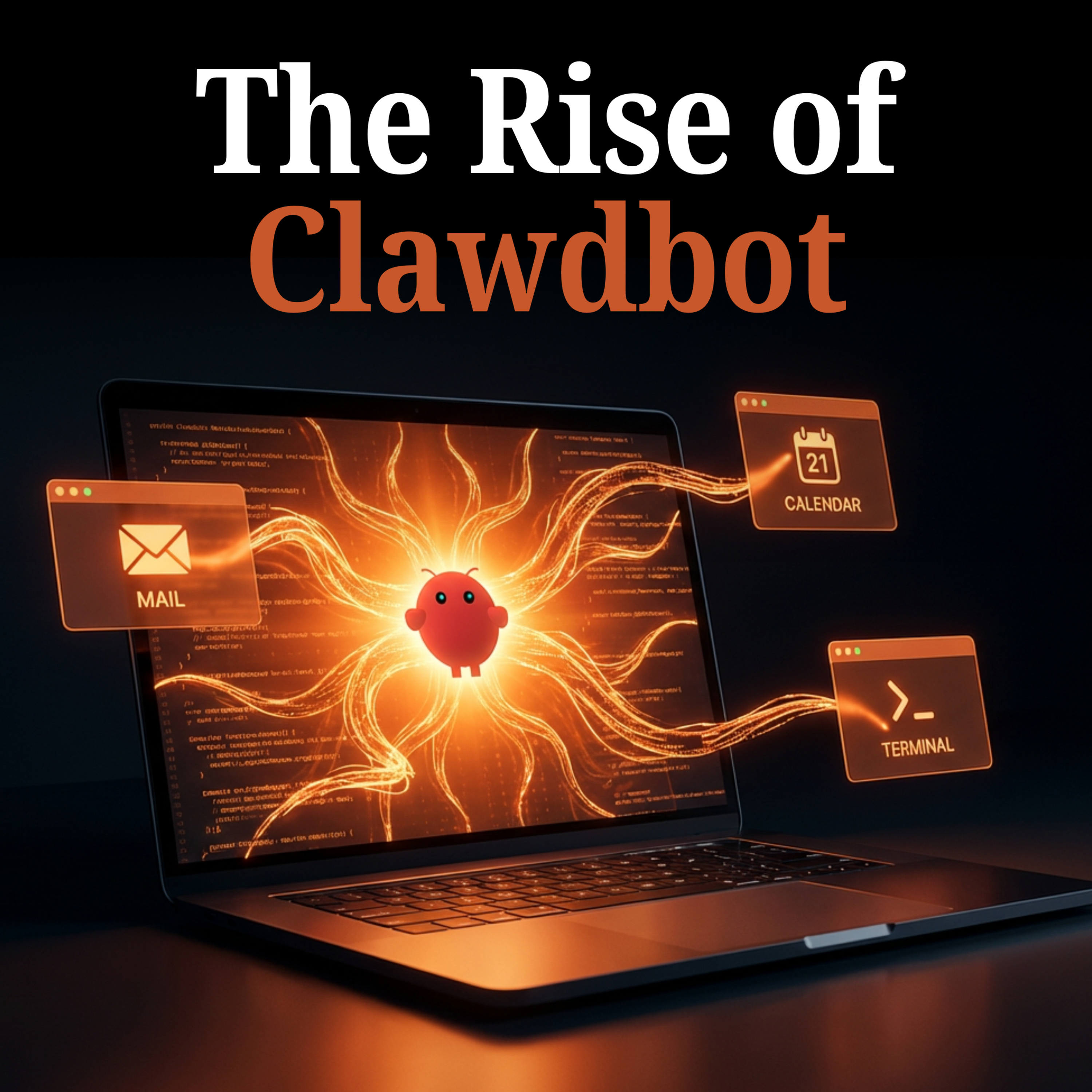
A single person can direct AI agents to conceptualize, code, and operate an entire business. This represents a new paradigm of a "fully autonomous enterprise," where AI handles everything from development to strategic planning, potentially creating a one-person, six-figure company.