Get your free personalized podcast brief
We scan new podcasts and send you the top 5 insights daily.
A new economic layer is forming in the low-altitude airspace above urban areas. This "1,000-foot economy" includes drone delivery for retail and medical supplies (Walmart, Zipline) and passenger air taxis (Joby), signaling a shift in infrastructure investment from ground-level to the sky.

Related Insights
SpaceX acts like a container ship, dropping satellites into a general orbit. This creates a massive business opportunity for an entire ecosystem of 'last-mile' services, including orbital transport to specific planes ('FedEx of space'), debris removal ('Allied Waste of space'), and in-space power generation.

By coining the term 'low altitude economy,' China is signaling a deliberate, top-down industrial strategy to own the market for autonomous flying vehicles (EVTOLs) and delivery drones. This isn't just about a single company; it's about creating and regulating a new economic sector to establish a global manufacturing and operational lead.

While electric air taxis are faster than cars, their key competitive advantage over helicopters is their low noise level. This allows them to operate in densely populated urban areas where noisy helicopters are banned, dramatically expanding the potential market for point-to-point air travel.
China's massive investment in space-based data centers seems counterintuitive, as it faces fewer regulatory hurdles for building on land than the US. This suggests a long-term strategic play to get ahead of future terrestrial constraints on land use, energy consumption, and cooling, effectively "skating where the puck is going" for global infrastructure.

For serious cargo delivery, tilt-rotor hybrid drones are more effective than simple quadcopters. They combine the convenience of vertical takeoff with the energy efficiency of fixed-wing flight, enabling longer ranges (60+ miles) and heavier payloads (40+ lbs).

Zipline's CEO reveals the aircraft is a small part of their solution. The real challenge and value lie in the vertically integrated network: ground infrastructure, traffic management, regulatory approval, and customer-facing apps.
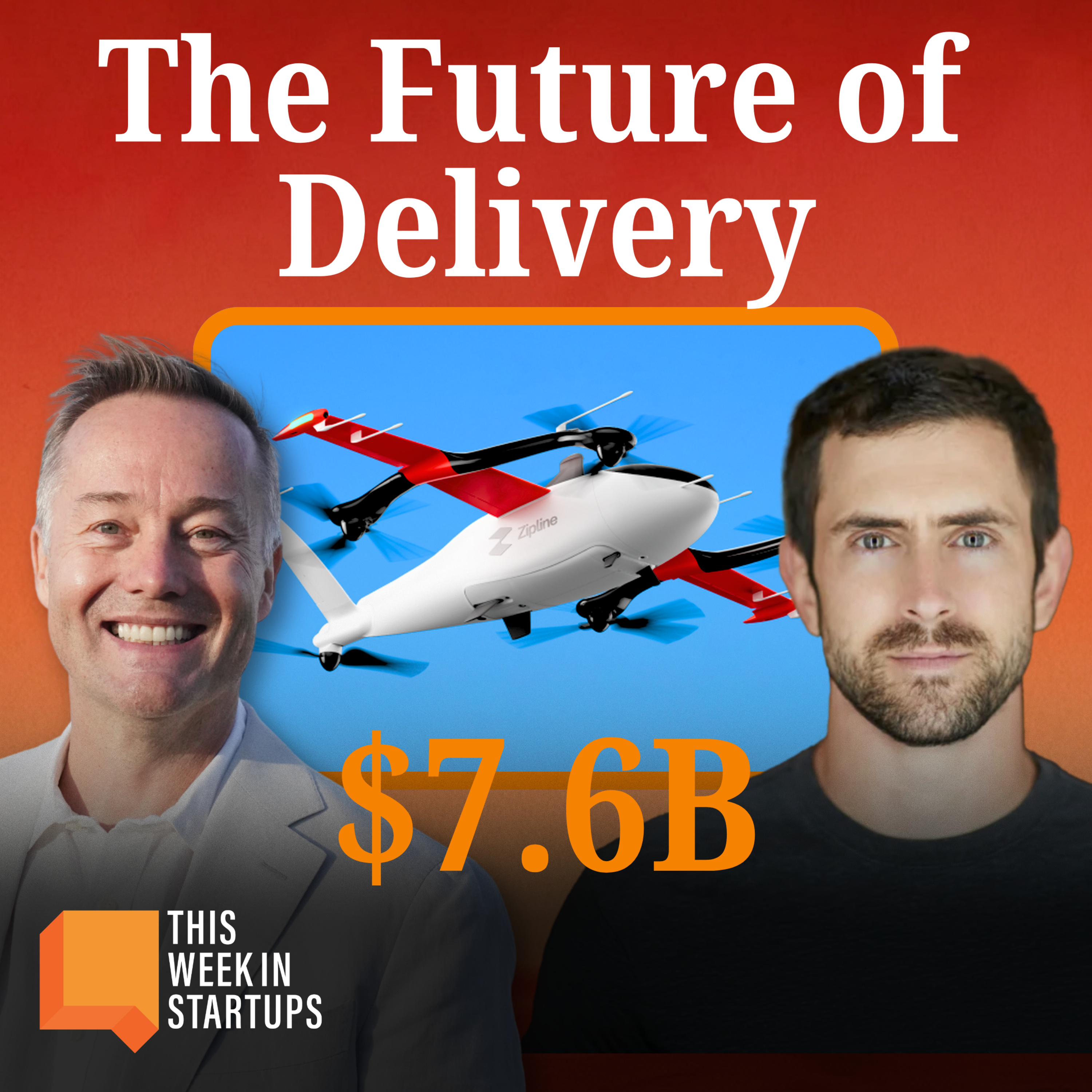
Instead of competing with giants like FedEx and DHL, some drone companies are offering them a white-labeled, fully integrated autonomous delivery system. This B2B model allows logistics operators to adopt drone technology without building it from scratch, treating it as an addition to their existing fleet.
Autonomous commerce will be a multimodal ecosystem using drones, sidewalk bots, and AVs. This creates a massive integration problem for retailers. The winning strategy is not building one vehicle, but creating the universal orchestration layer that allows retailers to manage all autonomous delivery form factors seamlessly.

While helicopters offer similar short-hop travel in cities like New York, they are exceedingly loud, limiting where they can operate. Joby's electric flying machines are nearly silent, which is the game-changing feature that will enable widespread deployment in urban settings.

Drone delivery startup Iona is targeting the 99% of the world with low population density, where traditional van-based logistics are inefficient. Their vision is to create a 'physical internet' that makes obtaining physical goods as easy as accessing information online.