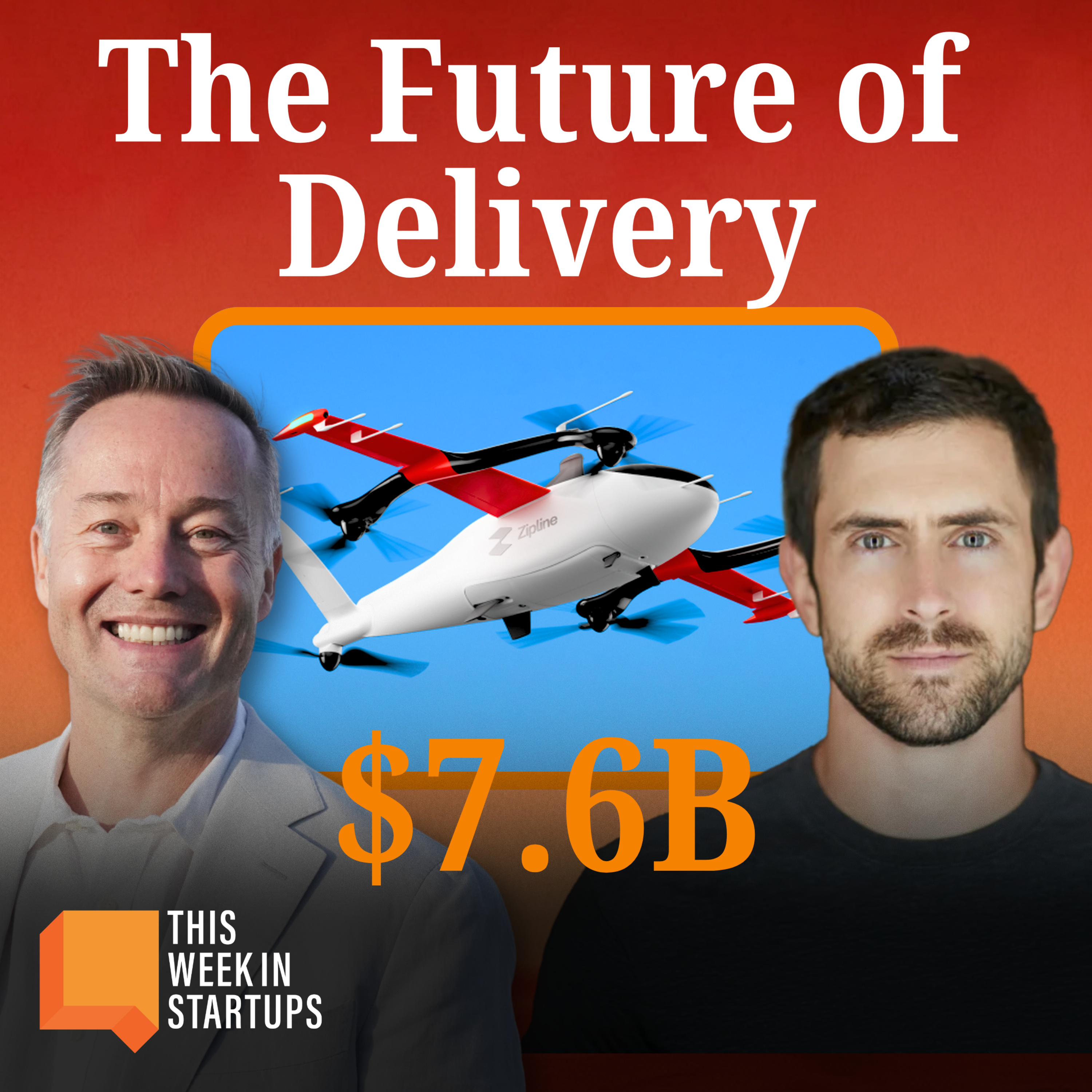
Zipline abstracts away all operational complexity (FAA regulations, maintenance, flight ops) and pitches a simple, powerful outcome to partners like Walmart: an instant delivery portal installed in their wall.
Zipline's CEO argues the US can't compete with China's scale on simple drones. The winning strategy is to innovate on complex, state-of-the-art aircraft where America leads, and then scale that manufacturing advantage.
To overcome US regulations banning autonomous flight, Zipline found a life-saving use case (blood delivery) so critical that a foreign government would create a legal framework, allowing them to scale and prove their technology.
Zipline's CEO reveals the aircraft is a small part of their solution. The real challenge and value lie in the vertically integrated network: ground infrastructure, traffic management, regulatory approval, and customer-facing apps.
Zipline is quadrupling its factory to produce 20,000 drones annually, a necessity to service a 15% week-over-week growth curve. This highlights a unique hardware scaling challenge driven by software-like demand.
Zipline's CEO argues that gaining public acceptance requires new technology to be superior in every way, including being quieter and less intrusive than the alternative (cars), not just faster or cleaner.
Zipline counters safety concerns by highlighting its zero-incident record over 135M miles, contrasting it with the hundreds of crashes and multiple fatalities cars would have over the same distance. This reframes drones as a safer alternative.
The inefficiency of using a 4,000-pound gas vehicle for a 5-pound delivery ensures drone delivery will eventually be far cheaper. This physics-based argument underpins the entire business model's long-term economic viability.