Get your free personalized podcast brief
We scan new podcasts and send you the top 5 insights daily.
The power of Clawdbot validates the "AI overhang" theory: underlying models are far more capable than standard interfaces suggest. By giving an LLM persistent memory and direct computer control, these agentic frameworks "unleash" latent abilities that were previously constrained by a simple chat window.

Related Insights
The rapid adoption of features like remote control and scheduled tasks by Anthropic, Perplexity, and Notion is not about copying the open-source OpenClaw project. Instead, it marks the industry's recognition of a new set of fundamental "primitives" for agentic AI: persistent, remotely accessible, and autonomous operation. These are becoming the new standard for AI interaction.

The significant leap in LLMs isn't just better text generation, but their ability to autonomously execute complex, sequential tasks. This 'agentic behavior' allows them to handle multi-step processes like scientific validation workflows, a capability earlier models lacked, moving them beyond single-command execution.

The LLM itself only creates the opportunity for agentic behavior. The actual business value is unlocked when an agent is given runtime access to high-value data and tools, allowing it to perform actions and complete tasks. Without this runtime context, agents are merely sophisticated Q&A bots querying old data.

Tools like ChatGPT are AI models you converse with, requiring constant input for each step. Autonomous agents like OpenClaw represent a fundamental shift where users delegate outcomes, not just tasks. The AI works autonomously to manage calendars, send emails, or check-in for flights without step-by-step human guidance.

The best UI for an AI tool is a direct function of the underlying model's power. A more capable model unlocks more autonomous 'form factors.' For example, the sudden rise of CLI agents was only possible once models like Claude 3 became capable enough to reliably handle multi-step tasks.

Clawdbot, an open-source project, has rapidly achieved broad, agentic capabilities that large AI labs (like Anthropic with its 'Cowork' feature) are slower to release due to safety, liability, and bureaucratic constraints.
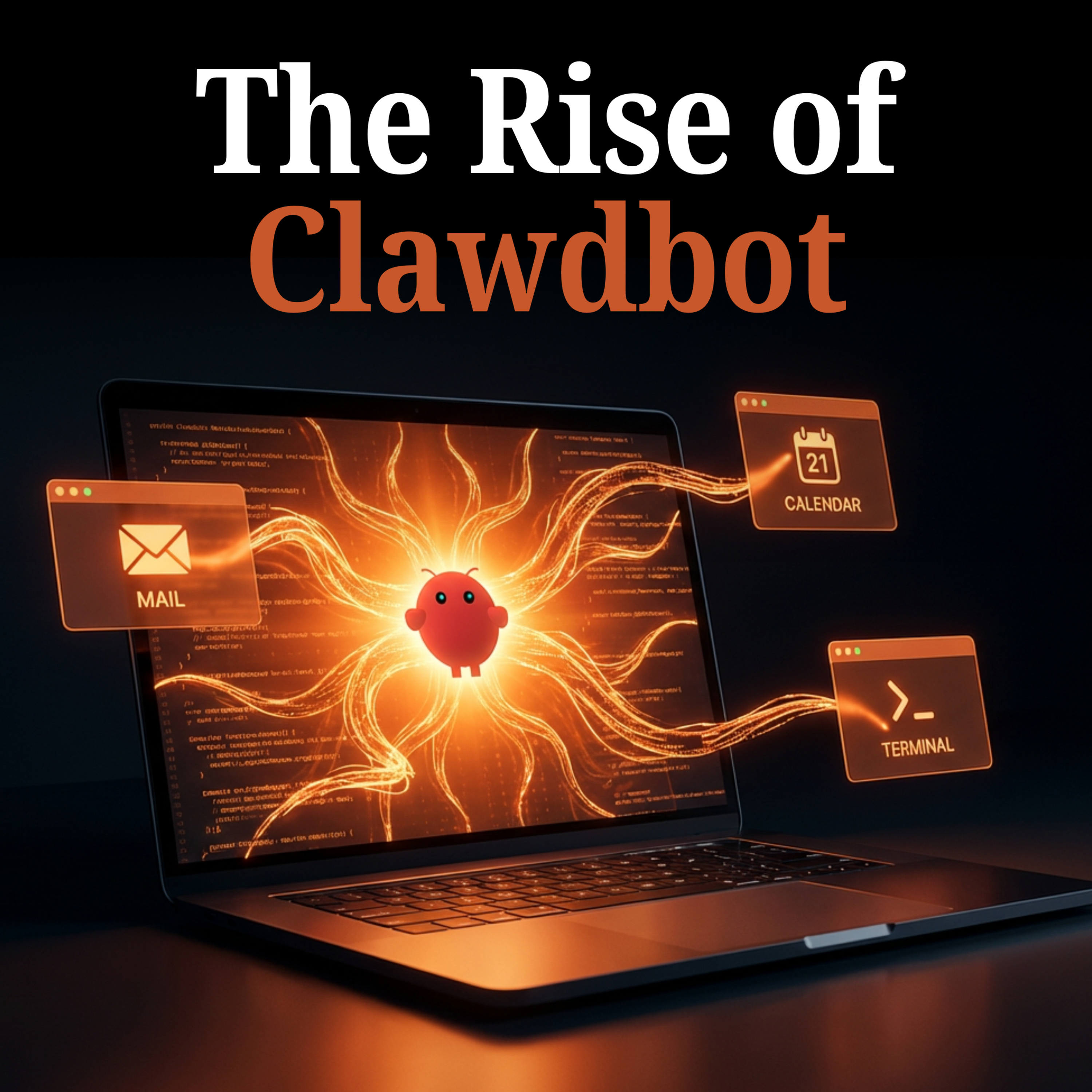
The perceived limits of today's AI are not inherent to the models themselves but to our failure to build the right "agentic scaffold" around them. There's a "model capability overhang" where much more potential can be unlocked with better prompting, context engineering, and tool integrations.
Tools like Claude Code offer superior capabilities beyond standard chatbots. They can access local file systems, enabling them to read and write files, maintain persistent memory, and execute complex, multi-step "recipes" autonomously, acting as a true virtual assistant rather than a simple text generator.

Unlike static tools, agents like Clawdbot can autonomously write and integrate new code. When faced with a new challenge, such as needing a voice interface or GUI control, it can build the required functionality itself, compounding its abilities over time.
The next evolution of enterprise AI isn't conversational chatbots but "agentic" systems that act as augmented digital labor. These agents perform complex, multi-step tasks from natural language commands, such as creating a training quiz from a 700-page technical document.
