Get your free personalized podcast brief
We scan new podcasts and send you the top 5 insights daily.
Instead of evaluating the subjective legitimacy of an underlying asset, protocol safety hinges on strict mathematical thresholds. Imposing constraints like a 1% price mutation ceiling between consecutive oracle updates prevents high-leverage liquidations from disrupting the deterministic state engine.

Related Insights
Traditional financial compliance depends on periodic reporting and trusted inspections of bank ledgers to confirm solvency. Public blockchains turn solvency into an inherent mathematical property, allowing continuous, real-time proof that combined user balances match the collateral in reserve.
Blockchains are more than just ledgers; they are operating systems with unique properties. Their code is tamper-resistant, and every input and output is perfectly auditable in real-time on a public ledger. These features provide unparalleled integrity assurances, crucial for financial systems and the emerging AI-driven economy.

Operating continuous 24/7/365 exchanges creates single points of failure across matching engines, clearing systems, and third-party vendors. A decentralized blockchain protocol allows independent validators to maintain a shared state and sustain standard throughput even if multiple nodes fail.
While AI can generate code, the stakes on blockchain are too high for bugs, as they lead to direct financial loss. The solution is formal verification, using mathematical proofs to guarantee smart contract correctness. This provides a safety net, enabling users and AI to confidently build and interact with financial applications.

Instead of relying on legal service level agreements (SLAs), Bittensor subnets use validators that programmatically check miner performance. They can use ZK proofs to verify an AI model's output, ensuring quality and honesty without trust.

To deploy LLMs in high-stakes environments like finance, combine them with deterministic checks. For example, use a traditional algorithm to calculate cash flow and only surface the LLM's answer if it falls within an acceptable range. This prevents hallucinations and ensures reliability.

Modern consensus protocols achieve high speed by optimizing for the common "peacetime" case where there are no failures, using a fast path with minimal message delays. They maintain a slower, more robust "wartime" mode that activates only when the system is under attack, providing a hybrid of efficiency and security.

The language and benchmarks for state-of-the-art blockchain protocols are now deeply rooted in academic theory. Concepts like "optimal fault tolerance in partial synchrony," once confined to research papers, have become table stakes for new protocols, demonstrating a significant narrowing of the gap between theory and practice.
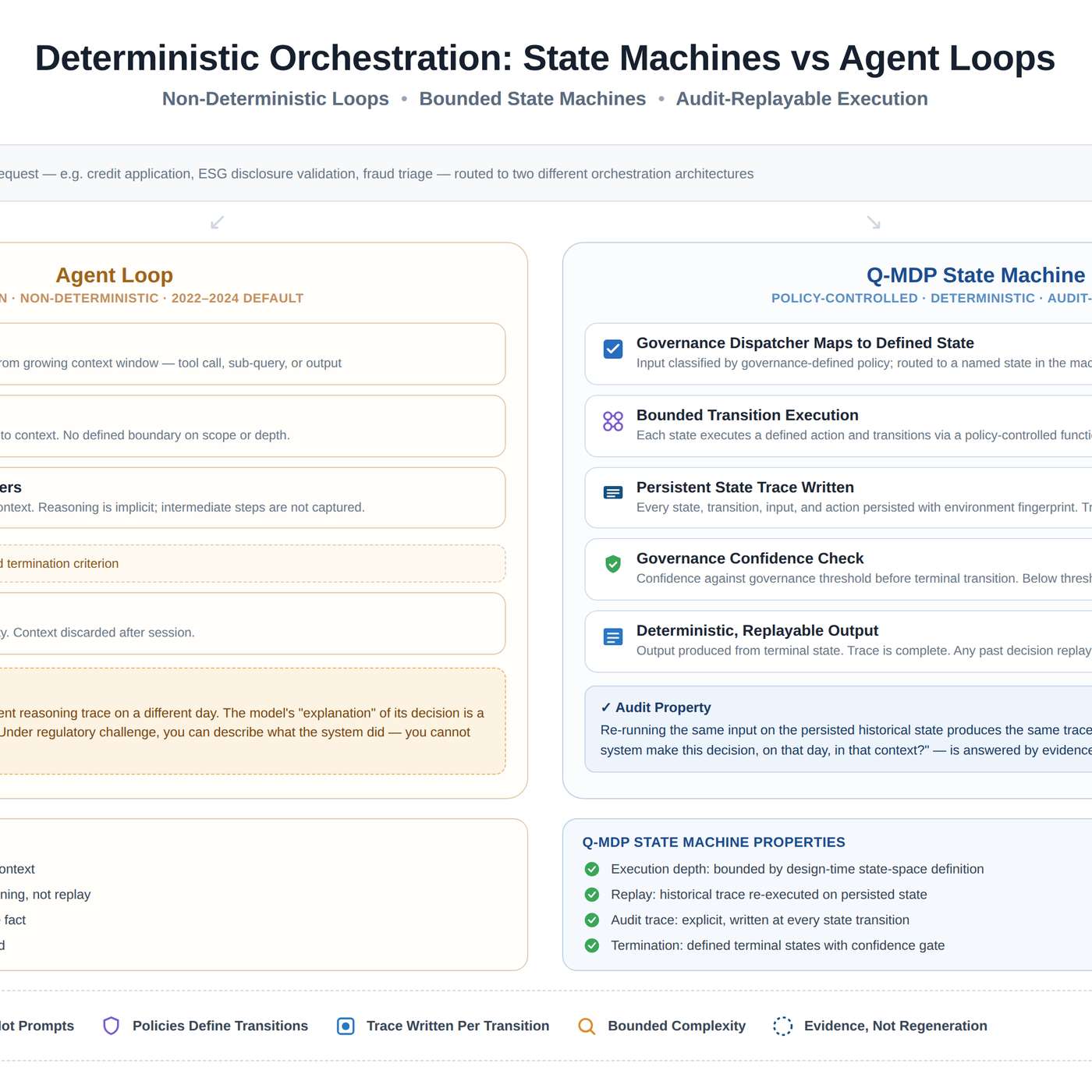
Building with deterministic state machines makes every decision inspectable and every trajectory reproducible. This provides a structural advantage, creating an audit defense capability from day one, which prevents costly retrofitting when regulatory pressure inevitably arrives.
To prevent hallucination contagion, borrow the 'circuit breaker' pattern from microservices. Force every agent's output through a validation proxy that treats it as an unverified proposal. If the proxy detects an anomaly, it 'trips the circuit,' instantly quarantining the failing agent and locking the shared state to prevent corruption from spreading.
