Get your free personalized podcast brief
We scan new podcasts and send you the top 5 insights daily.
Traditional financial compliance depends on periodic reporting and trusted inspections of bank ledgers to confirm solvency. Public blockchains turn solvency into an inherent mathematical property, allowing continuous, real-time proof that combined user balances match the collateral in reserve.

Related Insights
Blockchains are more than just ledgers; they are operating systems with unique properties. Their code is tamper-resistant, and every input and output is perfectly auditable in real-time on a public ledger. These features provide unparalleled integrity assurances, crucial for financial systems and the emerging AI-driven economy.

A complete shift of financial assets to blockchain is imminent. This won't happen on transparent chains like Ethereum, but on purpose-built networks like Canton. The key enabler is configurable privacy, a feature that allows financial institutions to transact without broadcasting their proprietary positions to the entire world.
Unlike competitors using crypto to operate outside regulatory frameworks, Kalshi's CEO views on-chain technology as a tool to enhance a regulated system. He envisions using it for clearing to improve immutability and transparency, enabling a permissionless ecosystem built upon a compliant foundation.
For blockchain to be adopted by mainstream institutions, the "censorship-resistant" ethos of early crypto must evolve. Circle's ARK blockchain uses a known set of validators composed of major financial firms. This ensures high standards for compliance, security, and reliability that anonymous networks cannot provide.
Operating continuous 24/7/365 exchanges creates single points of failure across matching engines, clearing systems, and third-party vendors. A decentralized blockchain protocol allows independent validators to maintain a shared state and sustain standard throughput even if multiple nodes fail.
Instead of evaluating the subjective legitimacy of an underlying asset, protocol safety hinges on strict mathematical thresholds. Imposing constraints like a 1% price mutation ceiling between consecutive oracle updates prevents high-leverage liquidations from disrupting the deterministic state engine.
While AI can generate code, the stakes on blockchain are too high for bugs, as they lead to direct financial loss. The solution is formal verification, using mathematical proofs to guarantee smart contract correctness. This provides a safety net, enabling users and AI to confidently build and interact with financial applications.

As AI makes digital content and transactions nearly free to create, trust evaporates. Crypto primitives like blockchains offer a solution by providing verifiable identity, provenance (chain of custody), and reliable on-chain data, which is crucial for both humans and AI agents to operate safely.

B2B financial agreements like SLAs, billing rules, and return terms remain trapped across disjointed enterprise PDFs and applications. While LLMs excel at reasoning, financial settlement requires deterministic execution, necessitating a ledger system where contract instructions directly govern live ledger balances without human intermediaries.

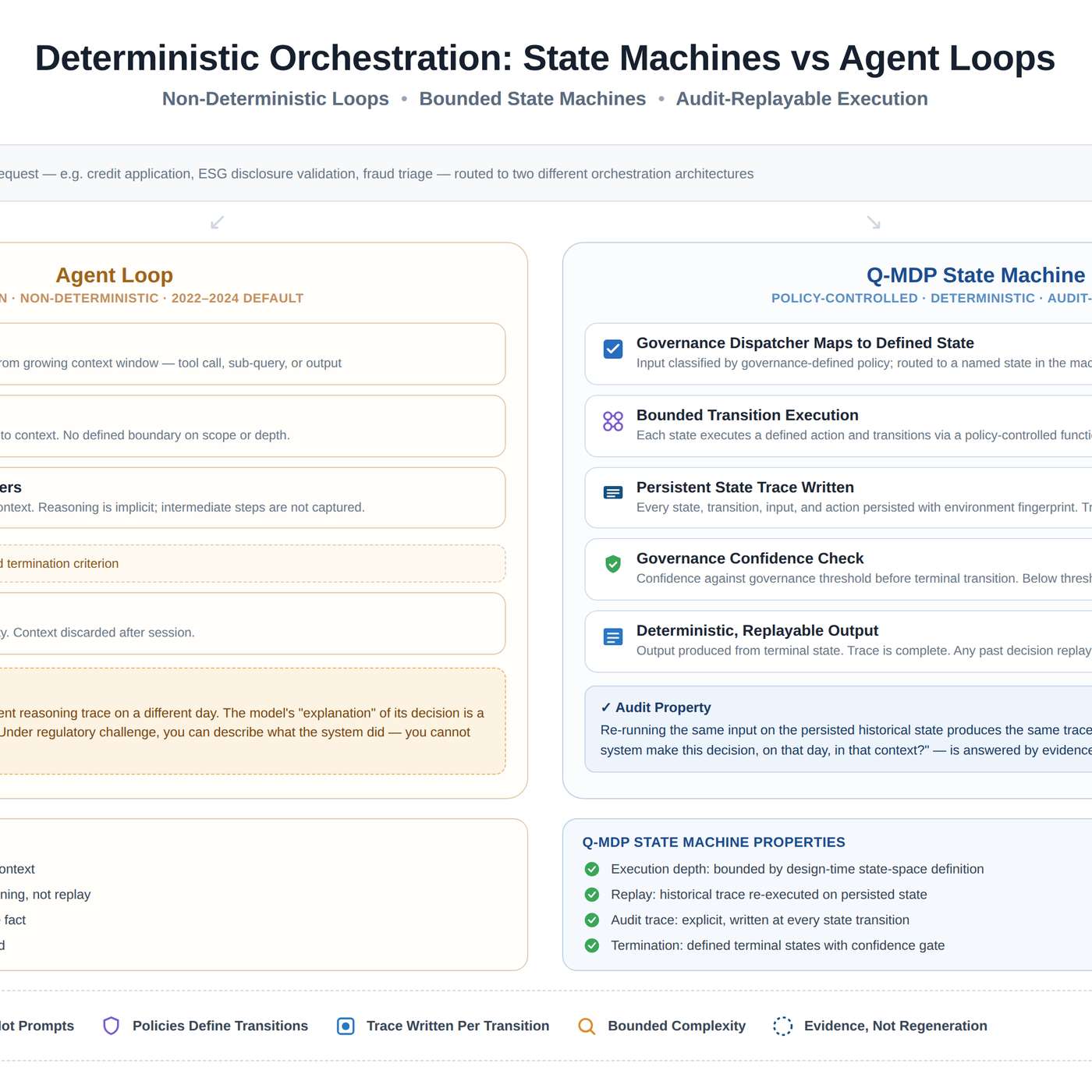
Building with deterministic state machines makes every decision inspectable and every trajectory reproducible. This provides a structural advantage, creating an audit defense capability from day one, which prevents costly retrofitting when regulatory pressure inevitably arrives.