Get your free personalized podcast brief
We scan new podcasts and send you the top 5 insights daily.
While ChatGPT and Gemini chase mass adoption, Claude focuses on a "hyper-technical" user base. Features like Artifacts and Skills, while too complex for casual consumers, create a deep moat with engineers and prosumers who are willing to invest time in building complex workflows.

Related Insights
Instead of competing with OpenAI's mass-market ChatGPT, Anthropic focuses on the enterprise market. By prioritizing safety, reliability, and governance, it targets regulated industries like finance, legal, and healthcare, creating a defensible B2B niche as the "enterprise safety and reliability leader."

An effective AI development workflow involves treating models as a team of specialists. Use Claude as the reliable 'workhorse' for building an application from the ground up, while leveraging models like Gemini or GPT-4 as 'advisory models' for creative input and alternative problem-solving perspectives.

Instead of trying to convert skeptics, AMP focuses exclusively on users already at the frontier of AI adoption. They believe that building for someone who doesn't know how to prompt well forces them to build simplistic features and fall behind the pace of innovation.

Dominant models like ChatGPT can be beaten by specialized "pro tools." An app for "deepest research" that queries multiple AIs and highlights their disagreements creates a superior, dedicated experience for a high-value task, just as ChatGPT's chat interface outmaneuvered Google search.
Codex exposes every command and step, giving engineers granular control. Claude Code abstracts away complexity with a simpler UI, guessing user intent more often. This reflects a fundamental design difference: precision for technical users versus ease-of-use for non-technical ones.
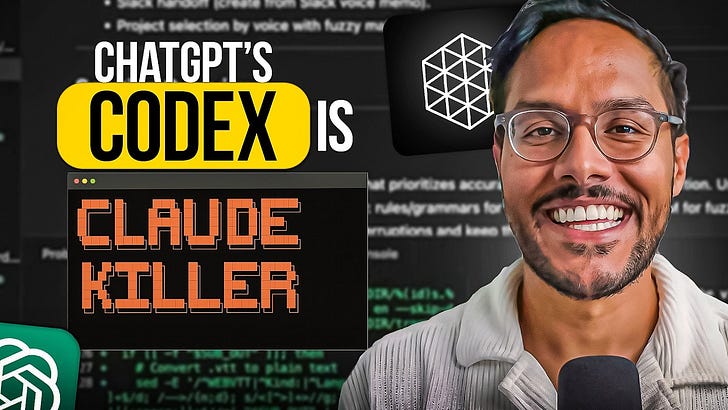
For professional coding tasks, GPT-5 and Claude are the two leading models with distinct 'personalities'—Claude is 'friendlier' while GPT-5 is more thorough but slower. Gemini is a capable model but its poor integration into Google’s consumer products significantly diminishes its current utility for developers.
Craig Hewitt argues ChatGPT is a consumer product. For serious business tasks, agentic AI tools like Manus (built on Claude) are superior, offering web browsing, data aggregation, and code generation that go far beyond a simple chat interface.

Anthropic's goal for Claude is to be a "virtual coworker," not just a personalized chatbot. This means deep integration into team workflows like Slack and meetings, allowing it to act as a true team member. This framing explains why superficial personalization features have failed to create user lock-in; the real value lies in contextual, collaborative integration.

While OpenAI battles Google for consumer attention, Anthropic is capturing the lucrative enterprise market. Its strategy focuses on API spend and developer-centric tools, which are more reliable and scalable revenue generators than consumer chatbot subscriptions facing increasing free competition.

Unlike Claude Projects or OpenAI's Custom GPTs which apply a general context to all chats, Claude Skills are task-specific instruction sets that can be dynamically called upon within any conversation. This allows for reusable, on-demand workflows without being locked into a specific project's context.