Get your free personalized podcast brief
We scan new podcasts and send you the top 5 insights daily.
The ChatGPT app platform is not yet a public marketplace; only pre-approved launch partners can publish. Developers building an app today are making a strategic, high-risk bet on the future existence and success of an open app store. You can build and test, but you cannot yet reach a public audience.
Related Insights
The barrier to entry for building on the ChatGPT platform is remarkably low. Using modern AI-assisted coding tools, a solo developer or small team can realistically build and ship a working Minimum Viable Product for a ChatGPT app in under 30 days. This speed allows for rapid experimentation and iteration on new business ideas.

The key opportunity for solo developers building ChatGPT apps lies in collaborative utilities. Instead of creating simple search or display tools, focus on apps like spreadsheets, to-do lists, or whiteboards where ChatGPT can act as an active partner—filling in data, adding formulas, and generating content directly within your app's interface.
The initial app integrations for ChatGPT lack a compelling "magic moment" and feel similar to Slack's app ecosystem, where connectors exist but are rarely used for complex tasks. This raises questions about whether users will meaningfully engage with another app marketplace.

Unlike the failed GPT Store which required users to actively search for apps, the new model contextually surfaces relevant apps based on user prompts. This passive discovery mechanism is a massive opportunity for developers, as users don't need to leave their natural workflow to find and use new tools.
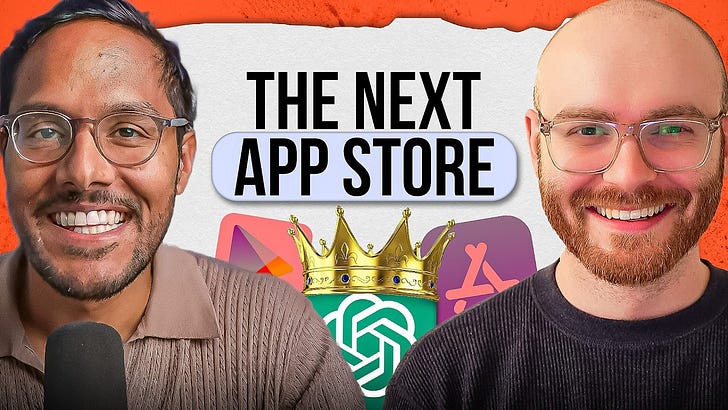
The ChatGPT App Store launch is being compared to the original Apple App Store. Developers who are early and build useful applications for its 800 million weekly active users have the opportunity to create significant businesses, mirroring the success of early mobile app pioneers who capitalized on first-mover advantage.
Beyond its technical capabilities, OpenAI's app ecosystem within ChatGPT functions as a new distribution platform. For founders, this creates a strategic opportunity to build apps that serve as an interface layer to their product, opening a novel and potentially powerful channel for user acquisition and growth.

Developing a ChatGPT app involves an iterative evaluation ('eval') process. This is akin to SEO, where you must test and refine your app's metadata and tool descriptions. The goal is to ensure ChatGPT's model correctly interprets user prompts and triggers your app for relevant queries, which is critical for discovery and usability.
OpenAI's platform strategy, which centralizes app distribution through ChatGPT, mirrors Apple's iOS model. This creates a 'walled garden' that could follow Cory Doctorow's 'inshittification' pattern: initially benefiting users, then locking them in, and finally exploiting them once they cannot easily leave the ecosystem.

Instead of building a consumer-facing ChatGPT app, launch a service business that builds them for Fortune 500s. Large enterprises have the budget but lack the specialized skills to build on the new platform, creating "infinite demand" for capable development and design firms.

Similar to how mobile gave rise to the App Store, AI platforms like OpenAI and Perplexity will create their own ecosystems for discovering and using services. The next wave of winning startups will be those built to distribute through these new agent-based channels, while incumbents may be slow to adapt.