Get your free personalized podcast brief
We scan new podcasts and send you the top 5 insights daily.
In 1921, a New York World series exposing Klan violence, intended to discredit the group, backfired. The publicity made the organization seem exciting and powerful, leading to a massive surge in membership applications and confirming the "any press is good press" maxim for extremist movements.

Related Insights
The Klan used a repeatable playbook to infiltrate local churches. Organizers would march into a service, give a donation to the minister (often a secret member), and receive a public endorsement, effectively converting entire congregations and gaining crucial social proof.
The KKK's massive growth was driven by a sophisticated sales operation where recruiters (Cleagles) earned large commissions on new members' fees. This financial incentive, structured like a modern pyramid scheme, was a primary driver of its national expansion.
Attempts to shut down controversial voices often fail. Instead of disappearing, suppressed ideas can fester and become more extreme, attracting an audience drawn to their defiance and ultimately strengthening their movement.

The KKK's campaign of terror had a quantifiable and devastating impact on elections. In some Georgia counties with Black majorities, the Republican vote for Ulysses S. Grant was reduced from over a thousand to single digits, or even zero. This demonstrates that paramilitary violence was a brutally effective tool for achieving political outcomes.
The Klan's explosive growth was not organic. PR professionals Edward Young Clark and Elizabeth Tyler treated the organization as a product, designing an aggressive sales operation and marketing message that resonated with public anxieties, transforming a failing club into a national force.
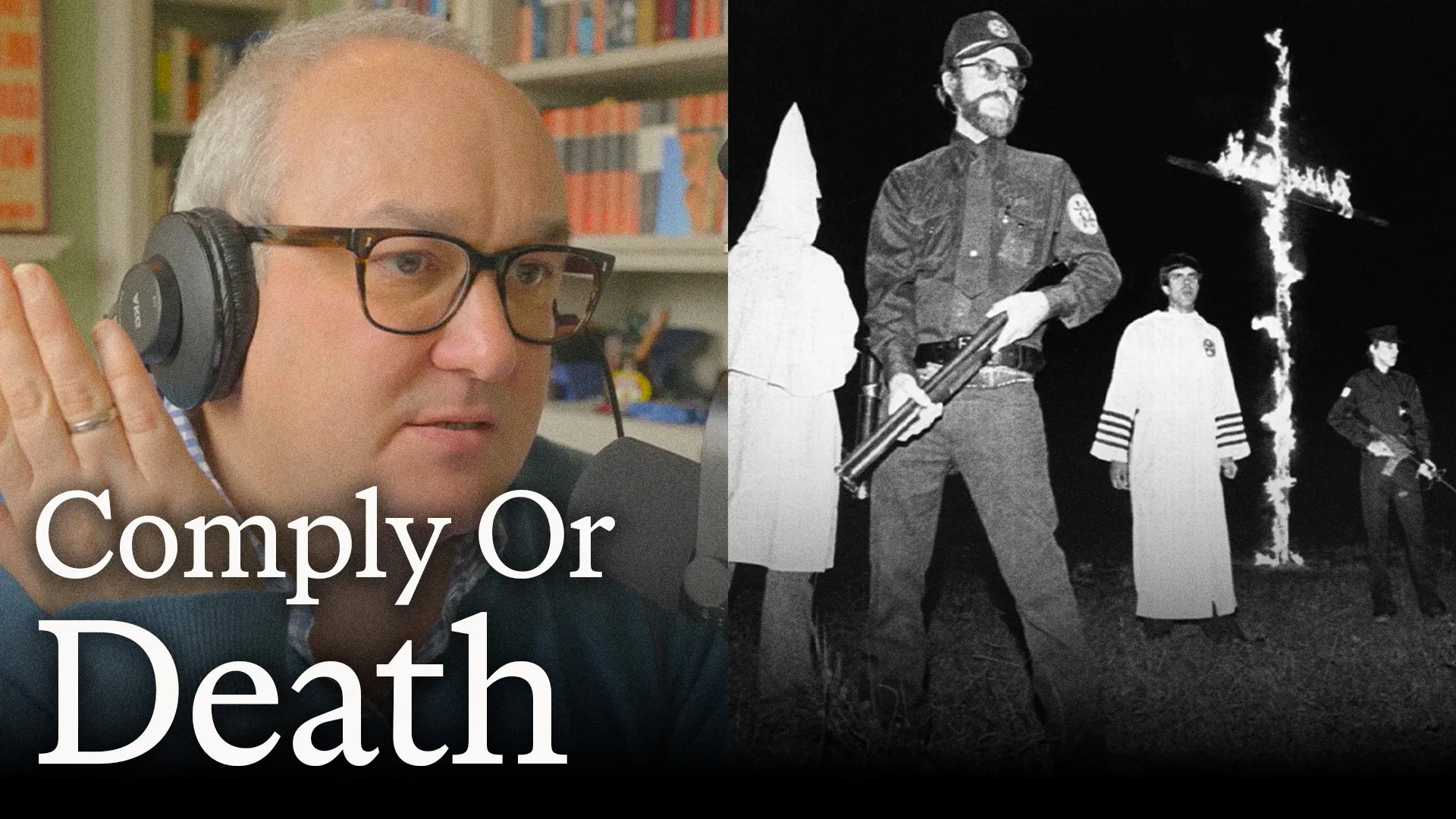
The second KKK's rituals, particularly cross-burning, were not historical practices. They were invented for Thomas Dixon's novel "The Klansman" and popularized by D.W. Griffith's blockbuster film "The Birth of a Nation," demonstrating how mass media can create and legitimize radical aesthetics.
Following its demise, the KKK's violent legacy was completely sanitized by the 'Lost Cause' mythology. Academic historians and popular culture, most notably D.W. Griffith's 1915 film 'The Birth of a Nation', recast the Klan not as racist terrorists but as swashbuckling defenders of civilization, a narrative that enabled its eventual rebirth.
The Klan used a bizarre, fantasy-like hierarchy with titles like "Grand Goblin" and "Exalted Cyclops." This gamified structure provided status and escapism for men in ordinary towns, making a sinister organization feel like an exciting and exclusive club.
Rather than building from scratch, the KKK tapped into pre-existing social networks, particularly the Freemasons. Recruiters specifically targeted Masonic lodges, leveraging their membership lists and offering a familiar structure of ritual, networking, and community.
Contrary to the image of a fringe movement, the Klan was composed of and led by the Southern elite. Eyewitness accounts consistently identified lawyers, doctors, planters, and sheriffs as perpetrators of the violence. This highlights how extremist movements can be driven by the most powerful and 'respectable' members of a society.