Get your free personalized podcast brief
We scan new podcasts and send you the top 5 insights daily.
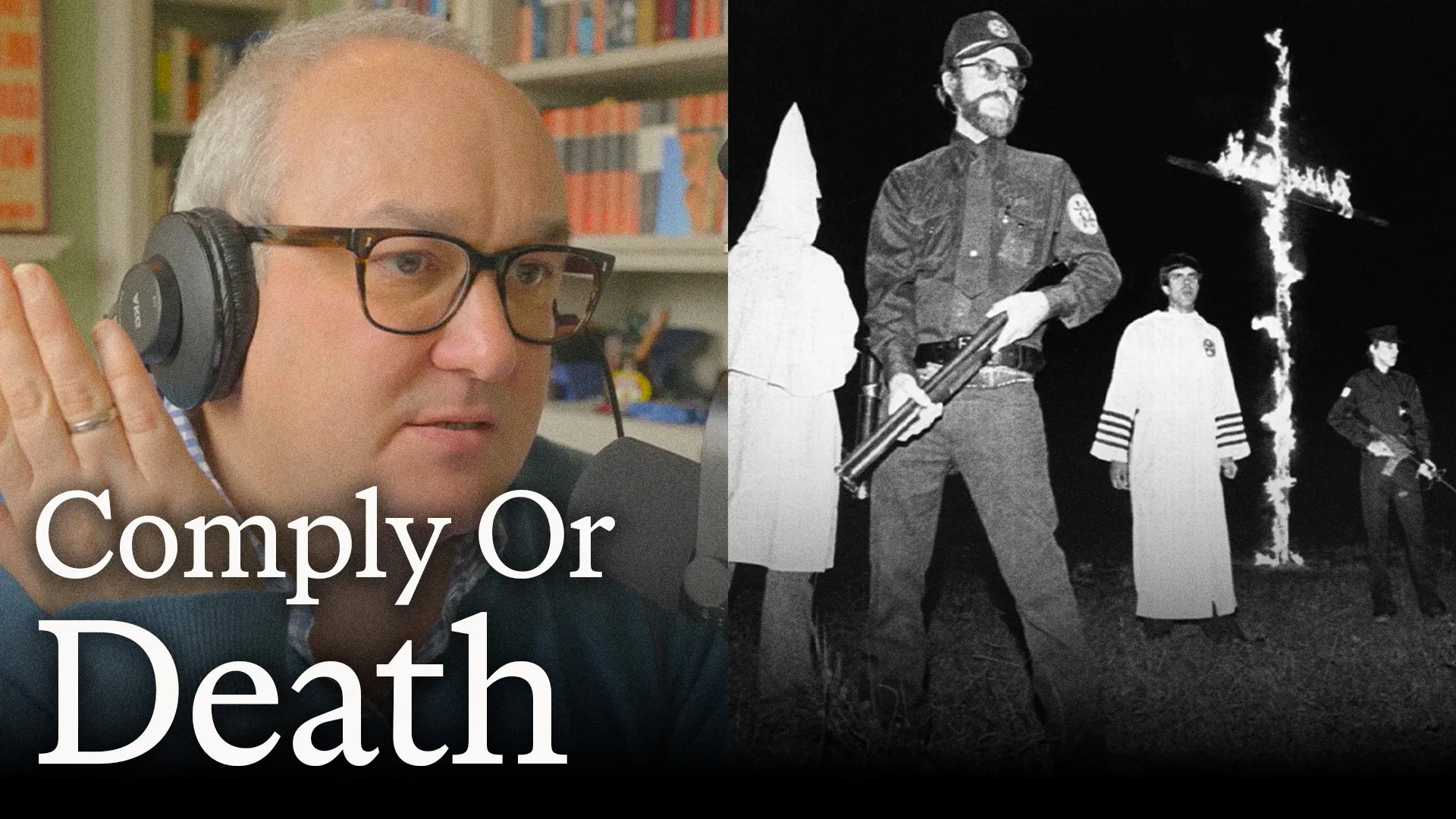
Contrary to the image of a fringe movement, the Klan was composed of and led by the Southern elite. Eyewitness accounts consistently identified lawyers, doctors, planters, and sheriffs as perpetrators of the violence. This highlights how extremist movements can be driven by the most powerful and 'respectable' members of a society.
Related Insights
History’s most shocking atrocities are defined less by their authoritarian leaders and more by the 'giant blob of enablers' who facilitate them. The current political climate demonstrates this, where professionals and politicians abdicate their expertise and principles to avoid conflict, becoming complicit in the process and allowing destructive ideologies to gain power.

During the 1868 presidential election, the Ku Klux Klan operated as an unofficial paramilitary wing for the Democratic Party. Its campaign of violence and intimidation was explicitly designed to suppress the Black Republican vote and advance the Democrats' platform of white supremacy, making terror a key electoral strategy.
The first Ku Klux Klan was not founded as a paramilitary force but as a fraternity-style social club in Pulaski, Tennessee. Its founders were young, well-educated veterans seeking amusement through secret rituals and costumes, only later evolving into a violent political entity.

Klan terrorism was a calculated political strategy. By creating persistent violence and chaos, white Southern Democrats aimed to exhaust the North's will to enforce Reconstruction. They correctly gambled that Northerners would eventually tire of the costly project and withdraw federal power.
Although the first iteration of the Ku Klux Klan was ultimately suppressed by 1872, it had already achieved its primary long-term goals. It successfully destroyed the Republican Party's infrastructure in the South and, crucially, exhausted the North's political will to continue Reconstruction, paving the way for generations of white supremacist rule.
The KKK's campaign of terror had a quantifiable and devastating impact on elections. In some Georgia counties with Black majorities, the Republican vote for Ulysses S. Grant was reduced from over a thousand to single digits, or even zero. This demonstrates that paramilitary violence was a brutally effective tool for achieving political outcomes.
The Klan adopted a bizarre, elaborate hierarchy with fantastical titles. This included a "Grand Wizard" of the Empire, "Grand Dragons" for each state, and ordinary members called "Ghouls." This structure reflected a blend of fraternal ritual, theatricality, and pseudo-chivalric nonsense.
The second Klan, founded in 1915, was by far the largest, with up to five million members. Its power base was not the South but the industrial North and Midwest. While white supremacist, its primary focus was nativist, anti-Semitic, and especially anti-Catholic.
The Klan's terror campaign was a holistic effort to restore pre-war racial hierarchy. Beyond suppressing votes, they targeted Black churches, schools, landowners, and even women who displayed self-respect. This reveals a broader goal: to crush any sign of Black autonomy and re-establish total white supremacy in every aspect of Southern life.
The KKK had three separate incarnations: a post-Civil War paramilitary group (1866), a massive anti-Catholic and nativist movement popular in the North (1915), and a smaller far-right group fighting the Civil Rights movement (1940s). Each had different characteristics and goals.