Get your free personalized podcast brief
We scan new podcasts and send you the top 5 insights daily.
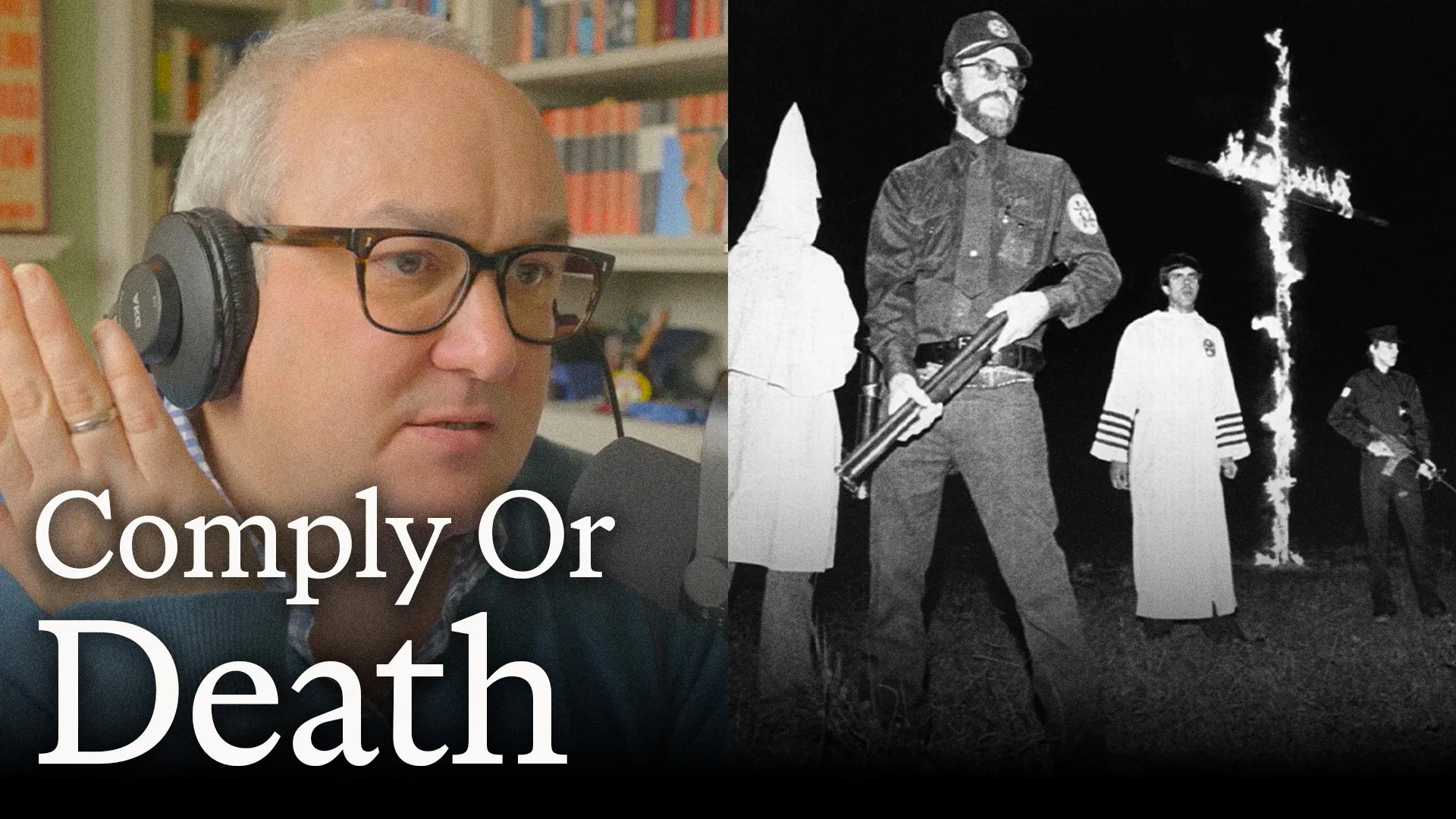
The second KKK's rituals, particularly cross-burning, were not historical practices. They were invented for Thomas Dixon's novel "The Klansman" and popularized by D.W. Griffith's blockbuster film "The Birth of a Nation," demonstrating how mass media can create and legitimize radical aesthetics.

Related Insights
The Klan used a repeatable playbook to infiltrate local churches. Organizers would march into a service, give a donation to the minister (often a secret member), and receive a public endorsement, effectively converting entire congregations and gaining crucial social proof.
In 1921, a New York World series exposing Klan violence, intended to discredit the group, backfired. The publicity made the organization seem exciting and powerful, leading to a massive surge in membership applications and confirming the "any press is good press" maxim for extremist movements.
The Klan adopted a bizarre, elaborate hierarchy with fantastical titles. This included a "Grand Wizard" of the Empire, "Grand Dragons" for each state, and ordinary members called "Ghouls." This structure reflected a blend of fraternal ritual, theatricality, and pseudo-chivalric nonsense.
The second Klan, founded in 1915, was by far the largest, with up to five million members. Its power base was not the South but the industrial North and Midwest. While white supremacist, its primary focus was nativist, anti-Semitic, and especially anti-Catholic.
The Klan's explosive growth was not organic. PR professionals Edward Young Clark and Elizabeth Tyler treated the organization as a product, designing an aggressive sales operation and marketing message that resonated with public anxieties, transforming a failing club into a national force.
Following its demise, the KKK's violent legacy was completely sanitized by the 'Lost Cause' mythology. Academic historians and popular culture, most notably D.W. Griffith's 1915 film 'The Birth of a Nation', recast the Klan not as racist terrorists but as swashbuckling defenders of civilization, a narrative that enabled its eventual rebirth.
While committed to white supremacy, the second Klan's main targets were white Catholics and Jews, whom they considered a greater menace to "Americanism" than African Americans. This focus fueled its popularity in Northern states with small Black populations.
The Klan used a bizarre, fantasy-like hierarchy with titles like "Grand Goblin" and "Exalted Cyclops." This gamified structure provided status and escapism for men in ordinary towns, making a sinister organization feel like an exciting and exclusive club.
Contrary to popular imagery, the original post-Civil War Ku Klux Klan never burned crosses. This iconic act of terror was introduced by the second Klan, founded in 1915, which was inspired by its depiction in the film "The Birth of a Nation."
Contrary to its common image, the second Klan's strongholds were not in the former Confederacy but in future Rust Belt states like Indiana, Ohio, and Oregon. This reflects its primary focus on anti-immigrant and anti-Catholic sentiment rather than post-Civil War racial dynamics.