Get your free personalized podcast brief
We scan new podcasts and send you the top 5 insights daily.
Marimo Pair is not just a code assistant; it's an "agent skill" that enables an AI agent to understand and interact with the Marimo notebook environment. This transforms the relationship into a true pair programming partnership, where the agent can read state, execute code, and even take screenshots on the user's behalf.

Related Insights
Standard coding agents excel at stateless tasks like file I/O but struggle with the iterative, stateful nature of data analysis. Marimo Pair bridges this by giving agents access to the notebook's live runtime. The notebook becomes a shared "working memory," allowing the agent to understand context and values, not just static code.
At Stripe, engineers now collaborate on crafting the perfect prompt to guide AI agents. This new form of teamwork focuses on articulating the problem clearly and providing the right context, rather than co-writing code line-by-line. This can involve other engineers, data sources, or even other agents.
A developer found that when his AI agent interacts directly with coding environments, it produces features with better value and fewer bugs compared to when he manually prompts an AI model himself. This suggests direct 'computer-to-computer' interaction is more effective for development tasks.
Unlike competitors focused on creating autonomous agents, Claude Code is designed as a 'pair programmer.' It emphasizes a collaborative workflow where the human and AI work together through planning and iteration, rather than the human simply delegating a task and awaiting the result.

Because AI agents operate autonomously, developers can now code collaboratively while on calls. They can brainstorm, kick off a feature build, and have it ready for production by the end of the meeting, transforming coding from a solo, heads-down activity to a social one.

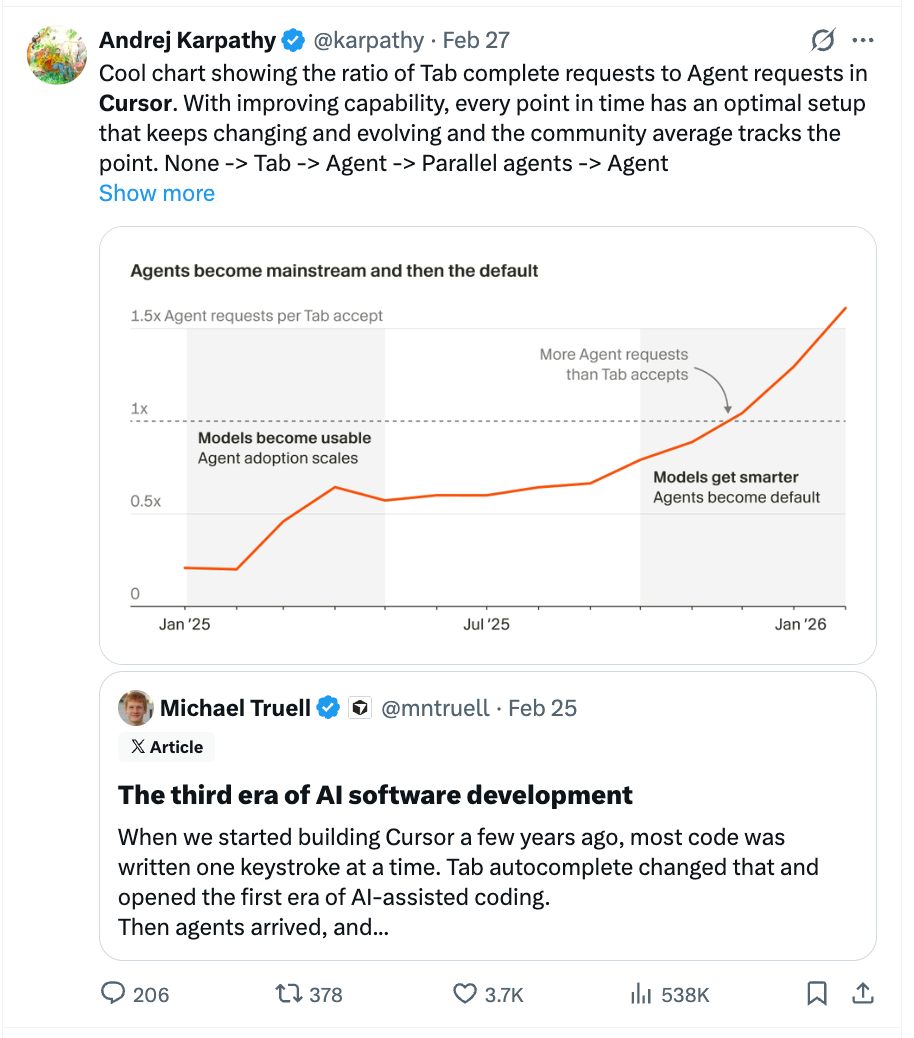
At Cursor, development is increasingly happening in Slack channels. Team members collectively kick off and redirect a cloud agent in a thread, turning development into a collaborative discussion. The IDE becomes a secondary tool, while communication platforms become the primary surface.
The next major advance for AI in software development is not just completing tasks, but deeply understanding entire codebases. This capability aims to "mind meld" the human with the AI, enabling them to collaboratively tackle problems that neither could solve alone.
![[State of Code Evals] After SWE-bench, Code Clash & SOTA Coding Benchmarks recap — John Yang thumbnail](https://assets.flightcast.com/V2Uploads/nvaja2542wefzb8rjg5f519m/01K4D8FB4MNA071BM5ZDSMH34N/square.jpg)
Using AI agents in shared Slack channels transforms coding from a solo activity into a collaborative one. Multiple team members can observe the agent's work, provide corrective feedback in the same thread, and collectively guide the task to completion, fostering shared knowledge.
Apply the collaborative, iterative model of AI pair programming to all knowledge work, including writing, strategy, and planning. This shifts the dynamic from a simple command-and-response tool to a constant thought partner, improving the quality and speed of all your work.

Tools like Claude Code offer superior capabilities beyond standard chatbots. They can access local file systems, enabling them to read and write files, maintain persistent memory, and execute complex, multi-step "recipes" autonomously, acting as a true virtual assistant rather than a simple text generator.
