Get your free personalized podcast brief
We scan new podcasts and send you the top 5 insights daily.
At Stripe, engineers now collaborate on crafting the perfect prompt to guide AI agents. This new form of teamwork focuses on articulating the problem clearly and providing the right context, rather than co-writing code line-by-line. This can involve other engineers, data sources, or even other agents.
Related Insights
Software engineering is evolving from line-by-line coding to managing fleets of AI agents. This new paradigm resembles a sorcerer casting spells, demanding skills in high-level direction, prompt engineering, and oversight, rather than manual implementation.

The next wave of AI productivity won't come from crafting the perfect prompt. Instead, professionals must adopt a manager's mindset: defining outcomes, assembling AI agent teams, providing context, and reviewing their work, transforming everyone into an "agent orchestrator."

Interacting with powerful coding agents requires a new skill: specifying requirements with extreme clarity. The creative process will be driven less by writing code line-by-line and more by crafting unambiguous natural language prompts. This elevates clear specification as a core competency for software engineers.
The ability to effectively communicate with AI models through prompting is becoming a core competency for all roles. Excelling at prompt engineering is a key differentiator, enabling individuals to enhance their creativity, collaboration, and overall effectiveness, regardless of their technical background.

Unlike traditional programming, which demands extreme precision, modern AI agents operate from business-oriented prompts. Given a high-level goal and minimal context (like a single class name), an AI can infer intent and generate a complete, multi-file solution.
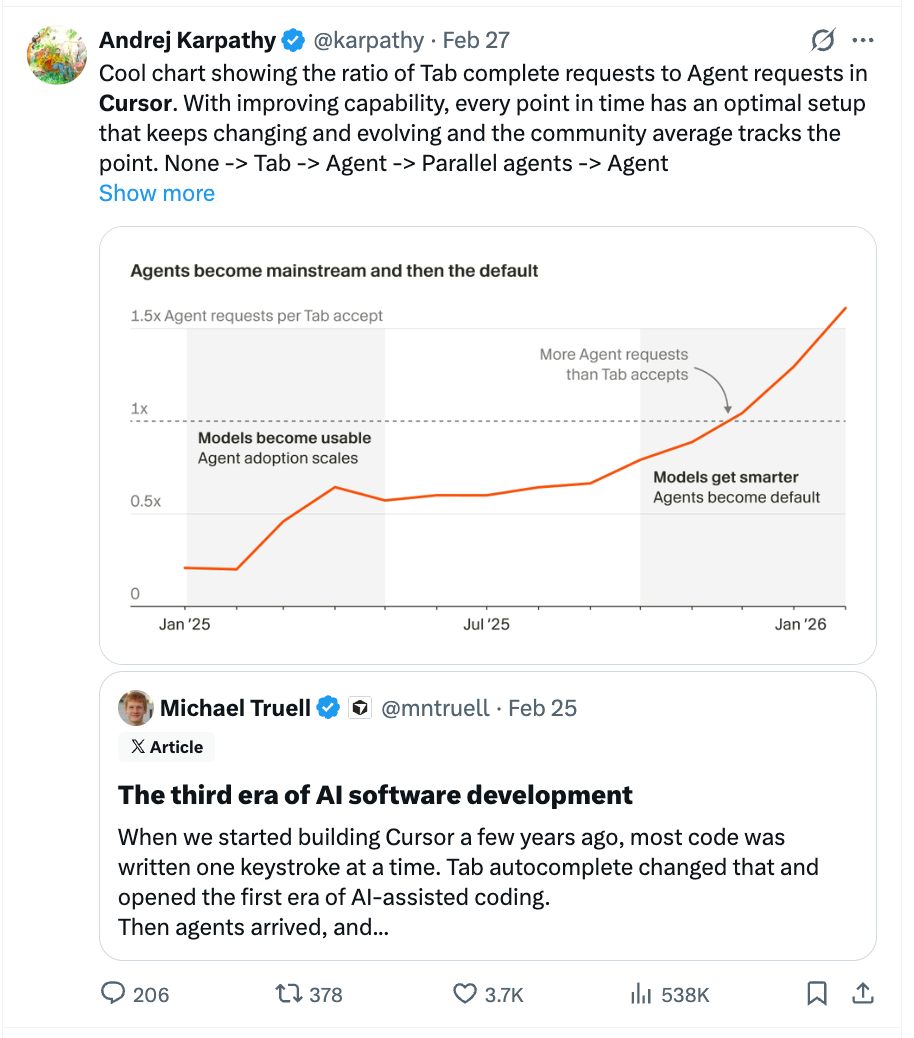
At Cursor, development is increasingly happening in Slack channels. Team members collectively kick off and redirect a cloud agent in a thread, turning development into a collaborative discussion. The IDE becomes a secondary tool, while communication platforms become the primary surface.
Using AI agents in shared Slack channels transforms coding from a solo activity into a collaborative one. Multiple team members can observe the agent's work, provide corrective feedback in the same thread, and collectively guide the task to completion, fostering shared knowledge.
Effective prompt engineering isn't a purely technical skill. It mirrors how we delegate tasks and ask questions to human coworkers. To improve AI collaboration, organizations must first improve interpersonal communication and listening skills among employees.

Today, most AI use is siloed, with individuals prompting alone. The real value is unlocked when AI becomes a team sport, with specialists building systems that are shared, iterated upon, and used collaboratively across the entire organization.
Apply the collaborative, iterative model of AI pair programming to all knowledge work, including writing, strategy, and planning. This shifts the dynamic from a simple command-and-response tool to a constant thought partner, improving the quality and speed of all your work.
