Get your free personalized podcast brief
We scan new podcasts and send you the top 5 insights daily.
Moving agents from OpenClaw to GrokBot was not starting from scratch. It involved using a "rescue bot" to package the entire agent setup (cron jobs, identities, rules) into a secrets-free file. This package could then be uploaded to the new platform, effectively transplanting the agent's "brain."
Related Insights
Despite OpenClaw's power and proactivity, its high maintenance overhead made it impractical. GrokBot's simple, "it just works" user experience was the decisive factor for adoption, highlighting that ease of use can trump raw capability for personal agents.
A powerful capability of autonomous agents is self-replication. A user can instruct an agent to set up a new virtual private server (VPS), transfer its own code, and teach the new instance all of its learned skills and context, effectively cloning itself to scale its operations.

A powerful, meta-level capability of advanced AI agents is their ability to build other agents. One agent can be instructed to spin up a new cloud computer, install the necessary software, and configure it with a specific model, automating the entire setup process.

Agents quickly become outdated. To manage this lifecycle, build specific 'upgrade skills' that facilitate migration to new models. For larger-scale management, deploy 'meta-agents' whose sole job is to monitor other agents, identify outdated ones, and trigger the upgrade process.

Open-source agent frameworks like OpenClaw allow users to retain ownership of their data and context. This enables them to switch between different LLMs (OpenAI, Anthropic, Google) for different tasks, like swapping engines in a car, avoiding the data lock-in promoted by major AI companies.
In architectures like OpenClaw, an agent's state and memory are stored in a file system, not the model itself. This means your agent is its files. You can swap the underlying LLM and the agent retains its identity and capabilities, much like recompiling code for a new chip.
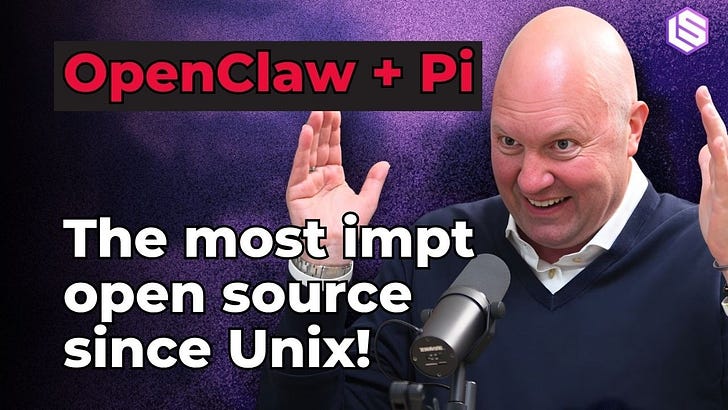
The architectural breakthrough of AI agents is the fusion of LLMs with the classic UNIX mindset. It uses a shell, file system, and cron jobs, making the agent's state (its files) independent of the specific LLM. This allows for model-swapping, migration, and self-modification.
To migrate knowledge to a new AI, prompt your current AI to create an 'information-dense document' detailing everything it knows about you: your preferences, work style, goals, and dislikes. Feed this 'autobiography' into the new AI system to instantly transfer context and get it up to speed.

The operational core of powerful AI agents is a simple, robust combination of time-based triggers (cron jobs) that execute tasks defined in detailed instruction sets (Markdown files, or "skills"). This mental model demystifies agent architecture and makes it more accessible.

For advanced debugging, use a dedicated coding agent to manage your other agents. Claire Vo points Clawed Code at her OpenClaw directory to diagnose issues, fix configurations, or even "transplant" memories and tasks between her different agents, acting as a high-level administrator.
