Get your free personalized podcast brief
We scan new podcasts and send you the top 5 insights daily.
For advanced debugging, use a dedicated coding agent to manage your other agents. Claire Vo points Clawed Code at her OpenClaw directory to diagnose issues, fix configurations, or even "transplant" memories and tasks between her different agents, acting as a high-level administrator.

Related Insights
For stubborn bugs, use an advanced prompting technique: instruct the AI to 'spin up specialized sub-agents,' such as a QA tester and a senior engineer. This forces the model to analyze the problem from multiple perspectives, leading to a more comprehensive diagnosis and solution.

When installing a complex system like OpenClaw, use a standard AI like Claude as a troubleshooter. By providing it with screenshots of errors and a link to the official documentation, the AI can read the docs and provide exact command-line fixes.

Structure your AI automations architecturally. Create specialized sub-agents, each with a discrete 'skill' (e.g., scraping Twitter). Your main OpenClaw agent then acts as an orchestrator, calling these skilled sub-agents as needed. This frees up the main agent and creates a modular, powerful system.
Cursor's "cloud agent diagnosis" command allows a primary agent to spin up specialized sub-agents that use integrations like Datadog to explore logs and diagnose another agent's failure. This creates a multi-agent system where agents act as external debuggers for each other.
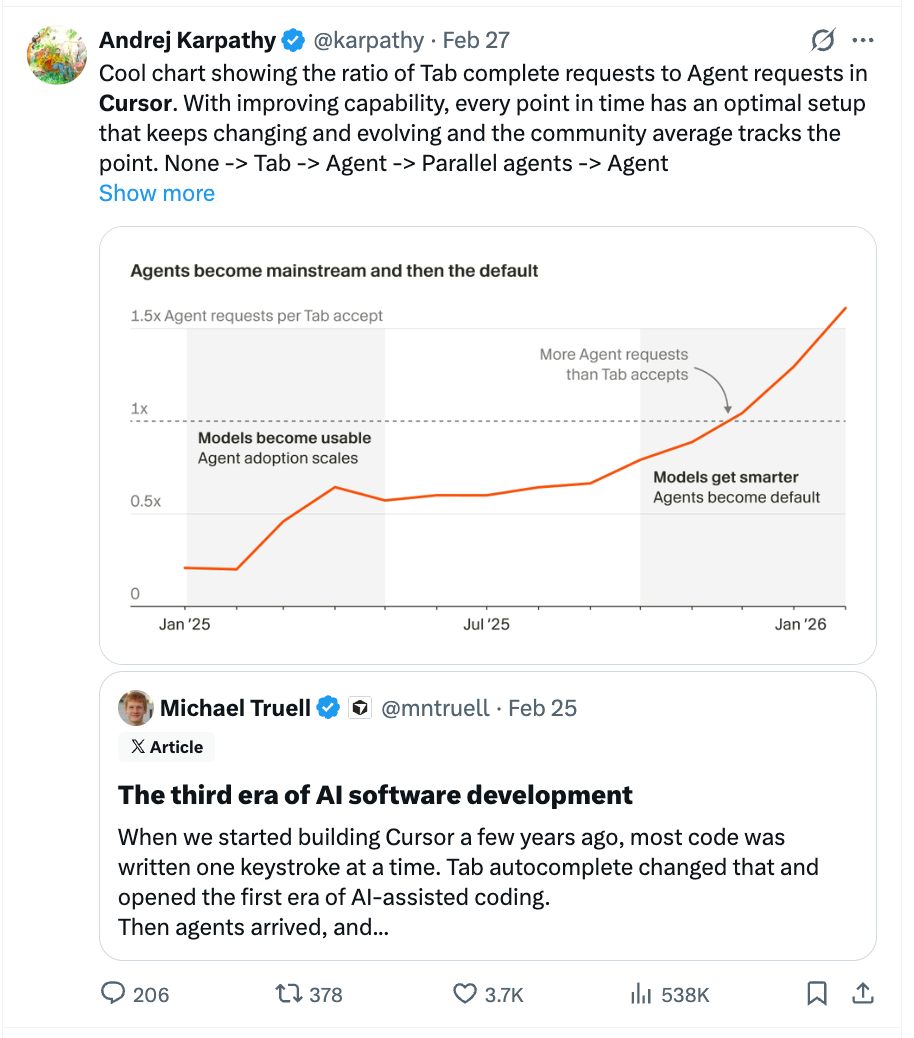
For large projects, use a high-level AI (like Claude's Mac app) as a strategic partner to break down the work and write prompts for a code-execution AI (like Conductor). This 'CTO' AI can then evaluate the generated code, creating a powerful, multi-layered workflow for complex development.
The term 'Claude Code' is a misnomer. Advanced users see these tools not just for coding, but as a generalized 'cloud computer.' By giving an agent access to files, terminals, and browsers, it becomes a versatile tool capable of any task, from program management to data analysis.

Run two different AI coding agents (like Claude Code and OpenAI's Codex) simultaneously. When one agent gets stuck or generates a bug, paste the problem into the other. This "AI Ping Pong" leverages the different models' strengths and provides a "fresh perspective" for faster, more effective debugging.

Instead of using simple, context-unaware cron jobs to keep agents active, designate one agent as a manager. This "chief of staff" agent, possessing full context of your priorities, can intelligently ping and direct other specialized agents, creating a more conscious and coordinated team.

Instead of relying on a single, all-purpose coding agent, the most effective workflow involves using different agents for their specific strengths. For example, using the 'Friday' agent for UI tasks, 'Charlie' for code reviews, and 'Claude Code' for research and backend logic.

When an AI coding agent like Claude Code gets confused, its agentic search can fail. A powerful debugging technique is to print the entire app's code to a single text file and paste it into a fresh LLM instance. This full-context view can help diagnose non-intuitive errors that the agent misses.
