Get your free personalized podcast brief
We scan new podcasts and send you the top 5 insights daily.
To trust an agentic AI, users need to see its work, just as a manager would with a new intern. Design patterns like "stream of thought" (showing the AI reasoning) or "planning mode" (presenting an action plan before executing) make the AI's logic legible and give users a chance to intervene, building crucial trust.

Related Insights
Traditional onboarding asks users for information. A more powerful AI pattern is to take a single piece of data, like a URL or email access, immediately derive context, and show the user what the AI understands about them. This "show, don't tell" approach builds trust and demonstrates value instantly.
Treating AI evaluation like a final exam is a mistake. For critical enterprise systems, evaluations should be embedded at every step of an agent's workflow (e.g., after planning, before action). This is akin to unit testing in classic software development and is essential for building trustworthy, production-ready agents.
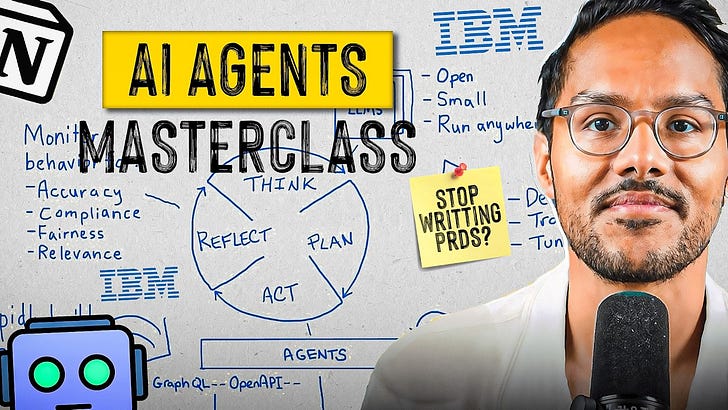
Vercel designer Pranati Perry advises viewing AI models as interns. This mindset shifts the focus from blindly accepting output to actively guiding the AI and reviewing its work. This collaborative approach helps designers build deeper technical understanding rather than just shipping code they don't comprehend.

Treat advanced AI systems not as software with binary outcomes, but as a new employee with a unique persona. They can offer diverse, non-obvious insights and a different "chain of thought," sometimes finding issues even human experts miss and providing complementary perspectives.
AI's unpredictability requires more than just better models. Product teams must work with researchers on training data and specific evaluations for sensitive content. Simultaneously, the UI must clearly differentiate between original and AI-generated content to facilitate effective human oversight.

The most effective AI user experiences are skeuomorphic, emulating real-world human interactions. Design an AI onboarding process like you would hire a personal assistant: start with small tasks, verify their work to build trust, and then grant more autonomy and context over time.
With AI, designers are no longer just guessing user intent to build static interfaces. Their new primary role is to facilitate the interaction between a user and the AI model, helping users communicate their intent, understand the model's response, and build a trusted relationship with the system.
While AI models excel at gathering and synthesizing information ('knowing'), they are not yet reliable at executing actions in the real world ('doing'). True agentic systems require bridging this gap by adding crucial layers of validation and human intervention to ensure tasks are performed correctly and safely.

Designers need to get into code faster not just for prototyping, but because the AI model is an active participant in the user experience. You cannot fully design the user's interaction without directly understanding how this non-human "third party" behaves, responds, and affects the outcome.
Unlike many AI tools that hide the model's reasoning, Spiral displays it by default. This intentional design choice frames the AI as a "writing partner," helping users understand its perspective, spot misunderstandings, and collaborate more effectively, which builds trust in the process.
