Get your free personalized podcast brief
We scan new podcasts and send you the top 5 insights daily.
AI's unpredictability requires more than just better models. Product teams must work with researchers on training data and specific evaluations for sensitive content. Simultaneously, the UI must clearly differentiate between original and AI-generated content to facilitate effective human oversight.

Related Insights
Regardless of an AI's capabilities, the human in the loop is always the final owner of the output. Your responsible AI principles must clearly state that using AI does not remove human agency or accountability for the work's accuracy and quality. This is critical for mitigating legal and reputational risks.
Effective enterprise AI deployment involves running human and AI workflows in parallel. When the AI fails, it generates a data point for fine-tuning. When the human fails, it becomes a training moment for the employee. This "tandem system" creates a continuous feedback loop for both the model and the workforce.

Instead of waiting for AI models to be perfect, design your application from the start to allow for human correction. This pragmatic approach acknowledges AI's inherent uncertainty and allows you to deliver value sooner by leveraging human oversight to handle edge cases.

To trust an agentic AI, users need to see its work, just as a manager would with a new intern. Design patterns like "stream of thought" (showing the AI reasoning) or "planning mode" (presenting an action plan before executing) make the AI's logic legible and give users a chance to intervene, building crucial trust.

Treating AI evaluation like a final exam is a mistake. For critical enterprise systems, evaluations should be embedded at every step of an agent's workflow (e.g., after planning, before action). This is akin to unit testing in classic software development and is essential for building trustworthy, production-ready agents.
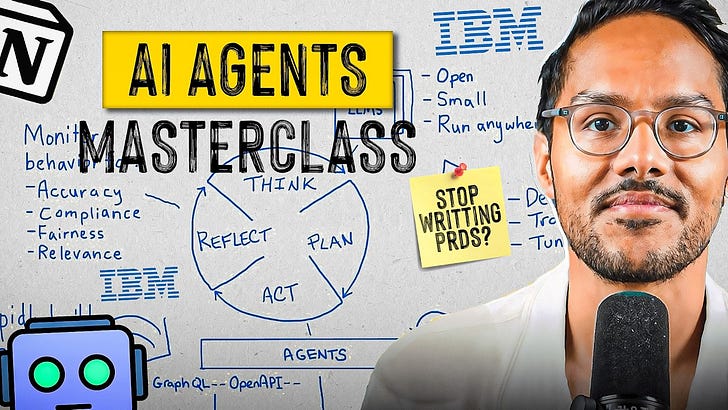
Vercel designer Pranati Perry advises viewing AI models as interns. This mindset shifts the focus from blindly accepting output to actively guiding the AI and reviewing its work. This collaborative approach helps designers build deeper technical understanding rather than just shipping code they don't comprehend.

AI evaluation shouldn't be confined to engineering silos. Subject matter experts (SMEs) and business users hold the critical domain knowledge to assess what's "good." Providing them with GUI-based tools, like an "eval studio," is crucial for continuous improvement and building trustworthy enterprise AI.
Designers need to get into code faster not just for prototyping, but because the AI model is an active participant in the user experience. You cannot fully design the user's interaction without directly understanding how this non-human "third party" behaves, responds, and affects the outcome.
An effective Human-in-the-Loop (HITL) system isn't a one-size-fits-all "edit" button. It should be designed as a core differentiator for power users, like a Head of Research who wants deep control, while remaining optional for users like a Product Manager who prioritize speed.
Unlike many AI tools that hide the model's reasoning, Spiral displays it by default. This intentional design choice frames the AI as a "writing partner," helping users understand its perspective, spot misunderstandings, and collaborate more effectively, which builds trust in the process.
