Get your free personalized podcast brief
We scan new podcasts and send you the top 5 insights daily.
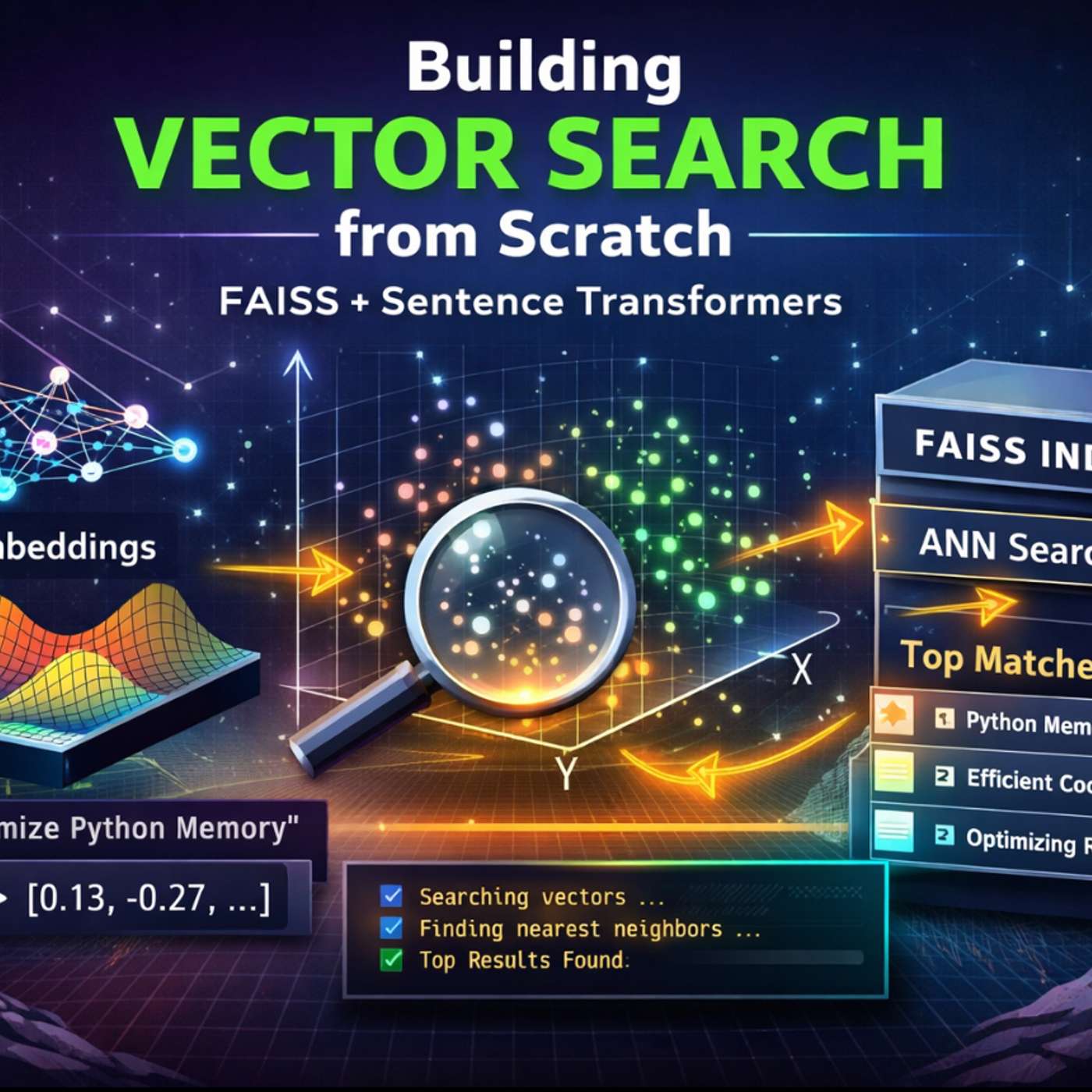
Managed vector databases are convenient, but building a search engine from scratch using a library like FAISS provides a deeper understanding of index types, latency tuning, and memory trade-offs, which is crucial for optimizing AI systems.
Related Insights
TurboPuffer achieved its massive cost savings by building on slow S3 storage. While this increased write latency by 1000x—unacceptable for transactional systems—it was a perfectly acceptable trade-off for search and AI workloads, which prioritize fast reads over fast writes.

Systems like FAISS are optimized for vector similarity search and do not store the original data. Engineers must build and maintain a separate system to map the returned vector IDs back to the actual documents or metadata, a crucial step for production applications.
For millions of vectors, exact search (like a FAISS flat index) is too slow. Production systems use Approximate Nearest Neighbor (ANN) algorithms which trade a small amount of accuracy for orders-of-magnitude faster search performance, making large-scale applications feasible.
To move beyond keyword search in their media archive, Tim McLear's system generates two vector embeddings for each asset: one from the image thumbnail and another from its AI-generated text description. Fusing these enables a powerful semantic search that understands visual similarity and conceptual relationships, not just exact text matches.

AI's hunger for context is making search a critical but expensive component. As illustrated by Turbo Puffer's origin, a single recommendation feature using vector embeddings can cost tens of thousands per month, forcing companies to find cheaper solutions to make AI features economically viable at scale.

While vector search is a common approach for RAG, Anthropic found it difficult to maintain and a security risk for enterprise codebases. They switched to "agentic search," where the AI model actively uses tools like grep or find to locate code, achieving similar accuracy with a cleaner deployment.

Retrieval Augmented Generation (RAG) uses vector search to find relevant documents based on a user's query. This factual context is then fed to a Large Language Model (LLM), forcing it to generate responses based on provided data, which significantly reduces the risk of "hallucinations."
Dell's CTO identifies a new architectural component: the "knowledge layer" (vector DBs, knowledge graphs). Unlike traditional data architectures, this layer should be placed near the dynamic AI compute (e.g., on an edge device) rather than the static primary data, as it's perpetually hot and used in real-time.

Teams often agonize over which vector database to use for their Retrieval-Augmented Generation (RAG) system. However, the most significant performance gains come from superior data preparation, such as optimizing chunking strategies, adding contextual metadata, and rewriting documents into a Q&A format.

Vector search excels at semantic meaning but fails on precise keywords like product SKUs. Effective enterprise search requires a hybrid system combining the strengths of lexical search (e.g., BM25) for keywords and vector search for concepts to serve all user needs accurately.
