Get your free personalized podcast brief
We scan new podcasts and send you the top 5 insights daily.
While Agile favored communication over documentation, AI coding tools require explicit, unambiguous instructions. Product teams must now prioritize detailed specifications to leverage AI for development, marking a significant shift in the product lifecycle and a departure from lean principles.

Related Insights
To get superior results from AI coding agents, treat them like human developers by providing a detailed plan. Creating a Product Requirements Document (PRD) upfront leads to a more focused and accurate MVP, saving significant time on debugging and revisions later on.

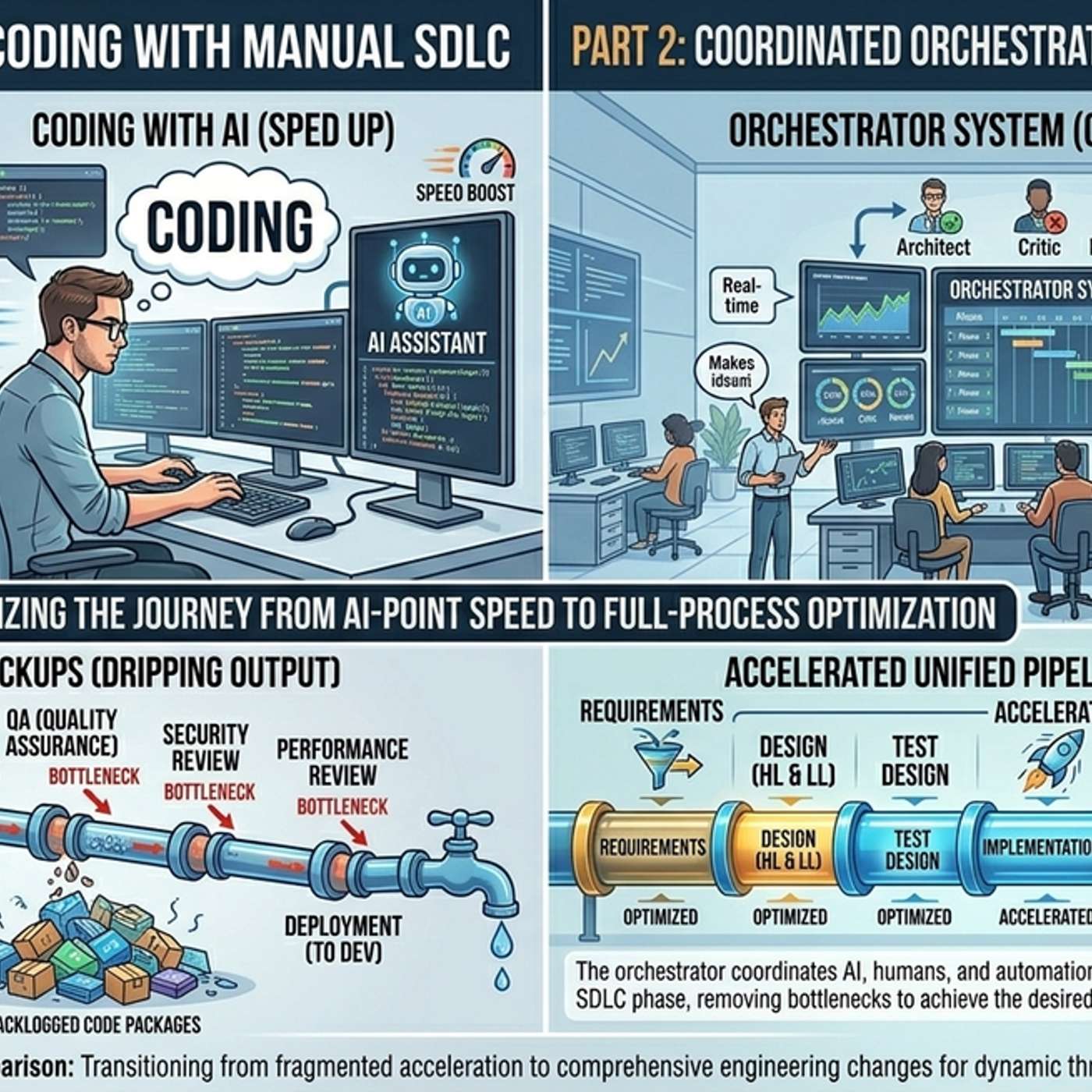
For AI to manage the software development process from idea to completion, the entire SDLC cannot be an unspoken or abstract set of habits. It must be explicitly documented with defined inputs, tasks, outputs, and quality gates that an AI agent can interpret and execute against.
Exploratory AI coding, or 'vibe coding,' proved catastrophic for production environments. The most effective developers adapted by treating AI like a junior engineer, providing lightweight specifications, tests, and guardrails to ensure the output was viable and reliable.

Interacting with powerful coding agents requires a new skill: specifying requirements with extreme clarity. The creative process will be driven less by writing code line-by-line and more by crafting unambiguous natural language prompts. This elevates clear specification as a core competency for software engineers.
AI's rapid capability growth makes top-down product specs obsolete. Product Managers now work bottoms-up with engineers, prototyping and even checking in code using AI tools. This blurs traditional roles, shifting the PM's focus to defining high-level customer needs and evaluating outcomes rather than prescribing features.
![Gokul Rajaram - Lessons from Investing in 700 Companies - [Invest Like the Best, EP.456] thumbnail](https://megaphone.imgix.net/podcasts/a35cb364-fc94-11f0-a24d-836fa963ece3/image/f64963c59af651cbb2d022f3a0dd7199.jpg?ixlib=rails-4.3.1&max-w=3000&max-h=3000&fit=crop&auto=format,compress)
With autonomous AI coding loops, the most leveraged human activity is no longer writing code but meticulously crafting the initial Product Requirements Document (PRD) and user stories. Spending significant upfront time defining the 'what' and 'why' ensures the AI has a perfect blueprint, as the 'garbage-in, garbage-out' principle still applies.
AI coding agents compress product development by turning specs directly into code. This transforms the PM's role from a translator between customers and engineers into a "shaper of intent." The key skill becomes defining a problem so clearly that an agent can execute it, making the spec itself the prototype.

As AI handles code generation, the most durable asset engineers create will shift from the code itself to the documentation that guides the AI. This documentation captures the 'why'—the intention, PRD, and customer problem—making it the essential input for future AI-driven development and iteration.

Successfully building with AI, even using no-code tools, demands a new level of detail from product managers. One must go deeper than a standard PRD and translate a high-level vision into extremely literal, step-by-step instructions, as the AI system cannot infer intent or fill in logical gaps.

Product Managers at Ramp now write specs with the primary audience being an AI agent. The spec is effectively a prompt, and its output is a working product, not just a document for engineers to interpret. This changes the entire dynamic of product definition from documentation to direct creation.
