Get your free personalized podcast brief
We scan new podcasts and send you the top 5 insights daily.
A biological model predicting high raw accuracy is dangerous if its confidence estimates are miscalibrated. Calibrated uncertainty, such as AlphaFold's pLDDT score, provides critical behavioral characterization so practitioners can trust where predictions are reliable and avoid wasted laboratory effort.

Related Insights
Don't dismiss a model because its output is a wide, uncertain distribution. This is often the correct answer, as it accurately reflects the state of knowledge and prevents acting on a false sense of certainty from intuition. The model's value is in defining the bounds of what's possible.

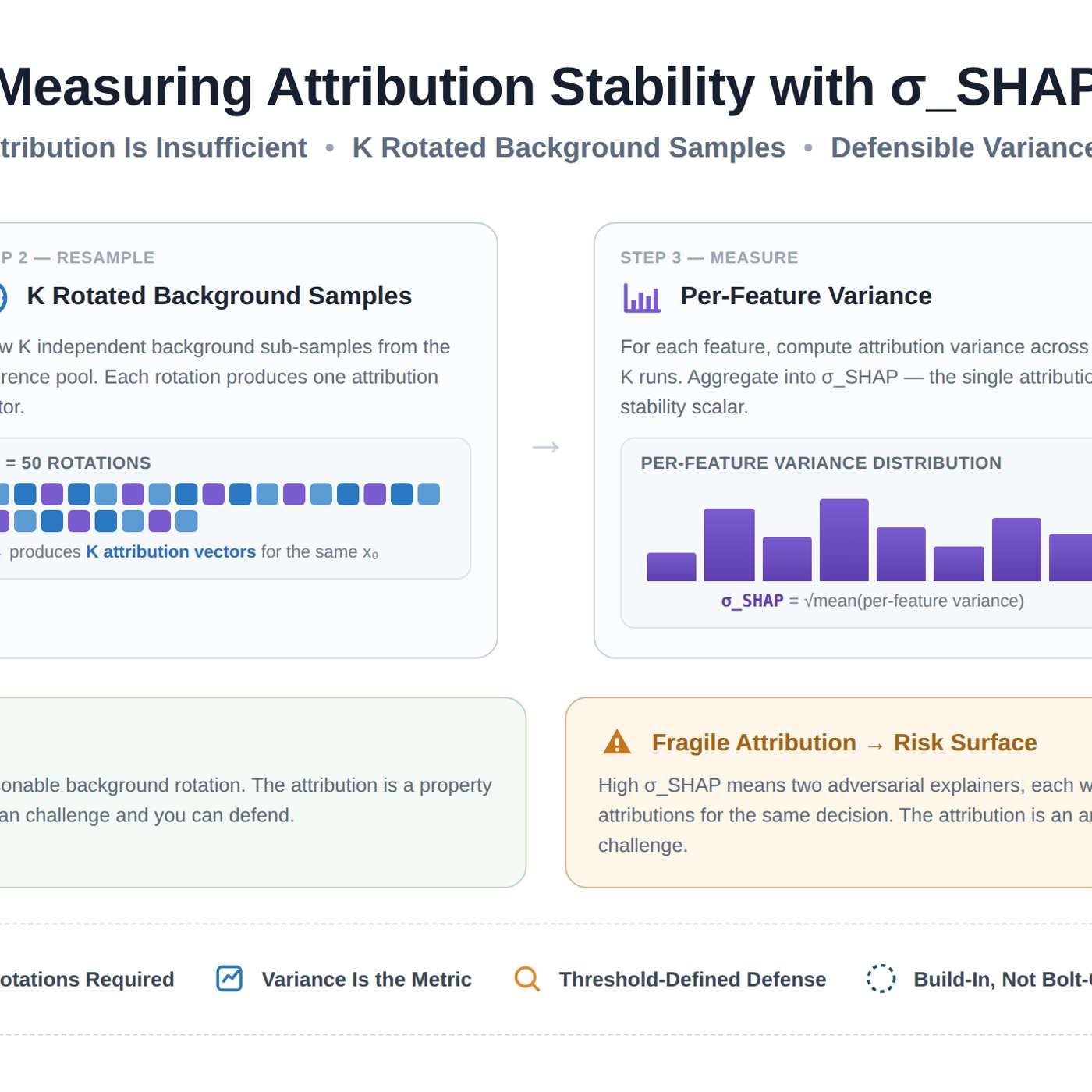
In regulated industries, the best model isn't always the most accurate. A model with slightly lower predictive performance but highly stable and defensible explanations is more valuable operationally. Attribution stability should be a key criterion in model selection, alongside traditional metrics like F1-score.
The researchers' failure case analysis is highlighted as a key contribution. Understanding why the model fails—due to ambiguous data or unusual inputs—provides a realistic scope of application and a clear roadmap for improvement, which is more useful for practitioners than high scores alone.
Unlike generative tools that always produce an output, BindCraft sometimes yields no passing designs. This "failure" is a valuable feature, acting as a strong negative predictor that saves researchers months of wasted lab effort on low-probability targets. This builds user confidence in the designs that do pass.

The most successful organizations won't have the most accurate AI models, but rather the clearest plans for when those models are wrong, unavailable, or receive incomplete data. The core challenge is managing uncertainty, not just optimizing for success.

A key risk for AI in healthcare is its tendency to present information with unwarranted certainty, like an "overconfident intern who doesn't know what they don't know." To be safe, these systems must display "calibrated uncertainty," show their sources, and have clear accountability frameworks for when they are inevitably wrong.

An AI model that is confidently wrong is more dangerous and less trustworthy than one that is simply incorrect. As adversarial examples show, the ability for an AI to express calibrated confidence is as important as its raw accuracy for building reliable systems.

When selecting foundational models, engineering teams often prioritize "taste" and predictable failure patterns over raw performance. A model that fails slightly more often but in a consistent, understandable way is more valuable and easier to build robust systems around than a top-performer with erratic, hard-to-debug errors.

Reinforcement Learning from Human Feedback (RLHF) forces models to be overly conservative to avoid obvious errors. This causes "mode collapse," where the model drops less common but valid possibilities, destroying its calibration and making it unreliable for programmatic decision-making that requires true confidence assessment.

Instead of a single prediction, advanced weather models generate a range of possible scenarios. This probabilistic approach, which explicitly represents uncertainty by creating an "ensemble" of forecasts, leads to more robust and accurate overall predictions, which is a counterintuitive result.