Get your free personalized podcast brief
We scan new podcasts and send you the top 5 insights daily.
Quantum computers will not replace classical systems but will integrate with them as specialized accelerators, much like GPUs. Future architecture will be a hybrid model where CPUs, GPUs, and QPUs (Quantum Processing Units) share workloads, with specific, complex calculations being offloaded to the quantum component.

Related Insights
The AI ecosystem will evolve into an "orchestration age" where large 'boss' models delegate tasks to a network of smaller, faster, specialized models. This means different chip architectures (e.g., NVIDIA for large models, Cerebras for speed) will function as complementary parts of a larger system, not just direct competitors.

As performance gains from general-purpose CPUs stalled, the industry shifted to domain-specific architectures (DSAs). By designing hardware like GPUs and TPUs for narrow tasks like AI, architects can achieve dramatic performance improvements that are no longer possible with traditional CPUs.
The primary benefit of quantum for AI may not be faster training, but creating entirely new datasets. By solving problems intractable for classical computers (like complex fluid dynamics), quantum systems can generate unique data. This novel information can then be used to train fundamentally smarter and more differentiated AI models.
No longer just a theoretical concept, quantum computing has transitioned from a physics problem to an engineering and scaling challenge. With multiple qubit modalities and error correction now proven, meaningful results that solve currently intractable problems in chemistry and logistics are expected within this decade.

The AI hardware market will not be a winner-take-all landscape. Instead, it will evolve into a hybrid model where large, intelligent 'boss' models delegate tasks to smaller, specialized, high-speed 'worker' models. This creates a durable niche for specialized hardware like Cerebras, which can excel at speed-sensitive sub-tasks.

The long-promised arrival of practical quantum computing is getting closer due to a two-sided convergence. Software advancements are drastically reducing the number of qubits needed for useful calculations, while hardware progress is rapidly increasing the number of physical qubits available, with the two projected to meet around 2030.
The current approach of scaling a single type of qubit technology is inefficient. The founder of quantum startup Sigildry argues the future lies in a multi-modal architecture, architecting systems that combine various quantum hardware types (e.g., trapped ions, photonics) specifically tailored to AI workloads.

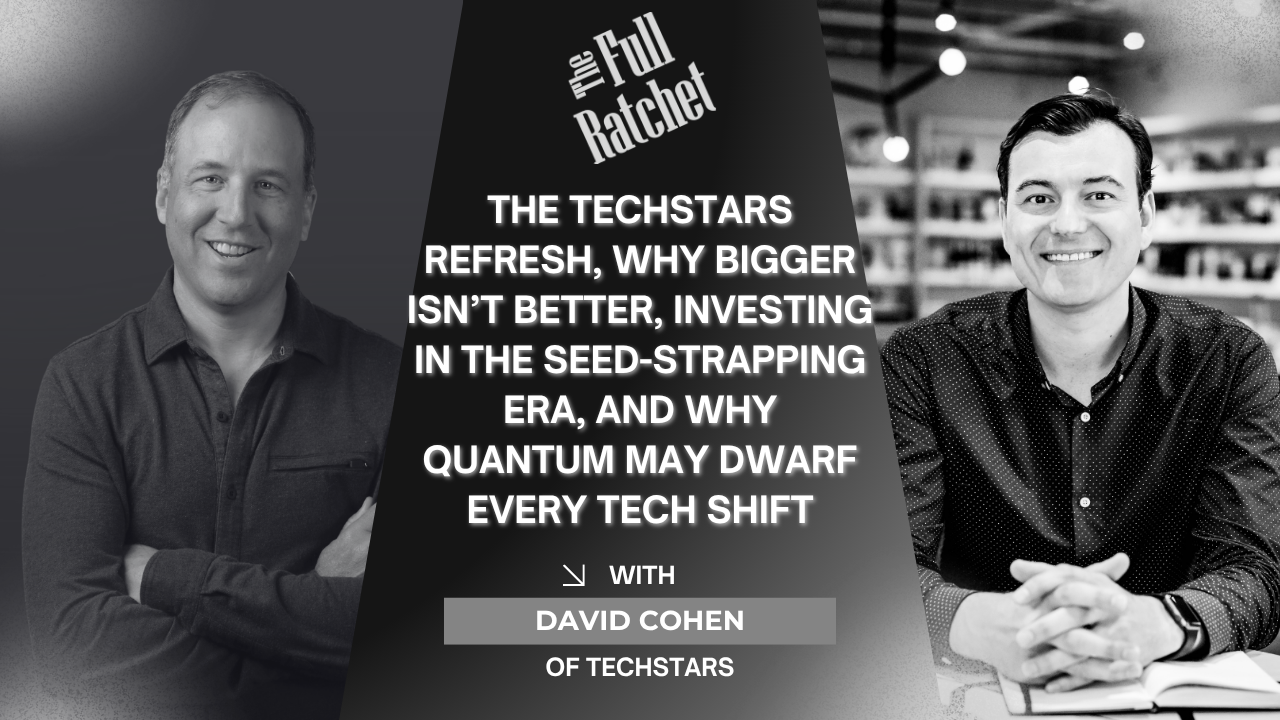
While AI dominates current conversations, Techstars' David Cohen believes Quantum Computing represents a far larger future paradigm shift. He posits that a single quantum computer will eventually surpass the combined power of all AI-driven classical computers. The "killer app" for this new era will be in healthcare, enabling truly personalized medicine.
A symbiotic relationship exists between AI and quantum computing, where AI is used to significantly speed up the optimization and calibration of quantum machines. By automating solutions to the critical 'noise' and error-rate problems, AI is shortening the development timeline for achieving stable, powerful quantum computers.

The primary impact of quantum computing won't just be faster calculations. It will be its ability to generate entirely new insights into complex systems like molecules—knowledge that is currently out of reach. This new data can then be fed into AI models, creating a powerful synergistic loop of discovery.
