Get your free personalized podcast brief
We scan new podcasts and send you the top 5 insights daily.
Despite the commoditization of AI, a durable premium market exists. For high-stakes or ambiguous tasks, users will pay significantly more for a model that is even marginally more reliable to avoid the high cost of rework or a single critical mistake, creating a defensible niche for frontier models.

Related Insights
For critical enterprise uses like coding, the cost to remediate a single error from a cheaper AI model far outweighs any savings. This high cost of failure ensures businesses will continue paying a premium for more reliable, high-end proprietary models for crucial tasks, while using open-source options for lower-stakes work.

While techniques like model distillation can reduce costs for near-frontier AI capabilities, this hasn't dampened demand for the absolute best models. The market shows very little desire for the third-best model, but exceptional demand for the top-performing one for any given task, demonstrating a winner-take-all dynamic.

The market for AI models follows a power law with a very strong preference for quality. Amodei compares it to hiring employees: people will disproportionately seek out the single best "cognitively capable" model, making price and other factors secondary.

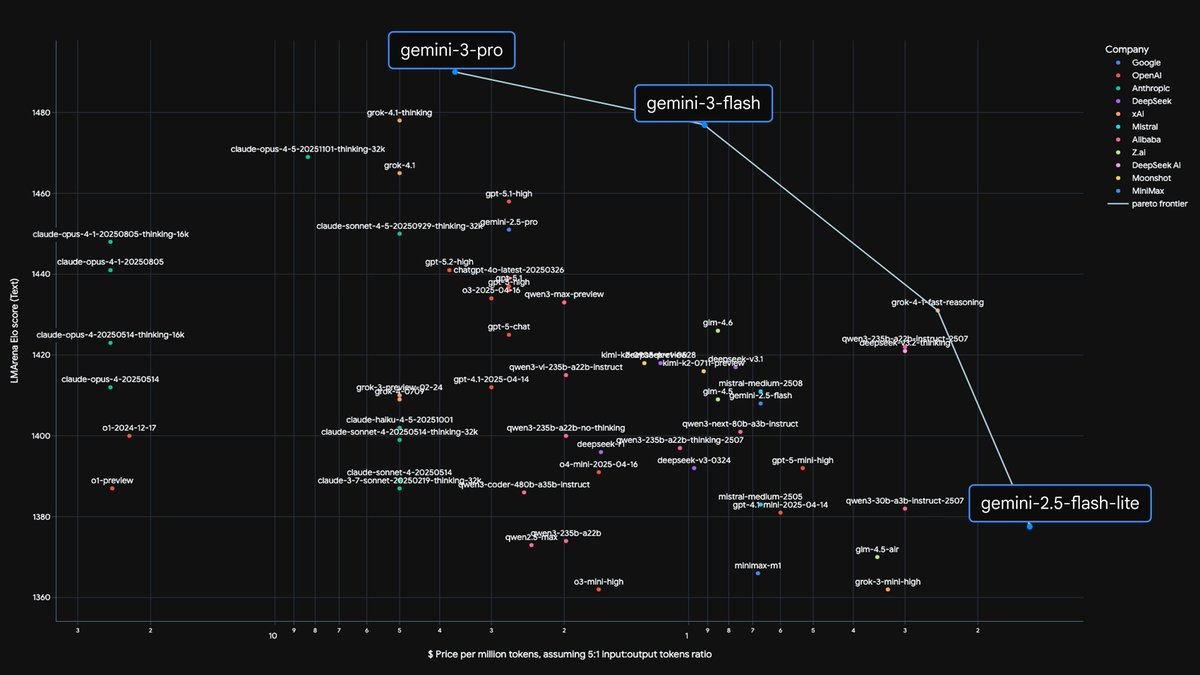
The AI model market has two clear segments: expensive, high-IQ frontier models for critical tasks like cybersecurity, and small, cheap, fast models for high-volume, simple tasks. Mid-tier models are struggling to find a clear product-market fit, as users gravitate to either extreme.

The market for AI models is bifurcating. Users either pay a premium for top-tier frontier models for high-stakes tasks like cybersecurity or use extremely cheap, small models for high-volume, simple tasks. Mid-tier models struggle to find a viable use case, getting squeezed from both ends.
The push towards enterprise fine-tuning directly challenges the 'bitter lesson'—the theory that massive scale in general models will inevitably outperform specialized, human-curated approaches. The success of this new market segment hinges on proving that customized models can maintain a durable advantage over ever-improving, cheaper generalist models.

The moment a new, more powerful AI model is released, user demand for the previous “state-of-the-art” version collapses. This intense desire for the absolute best model means only the frontier provider has significant pricing power, while older, slightly inferior models become commoditized almost instantly.
![Dylan Patel - The Infinite Demand for Tokens, Claude Mythos, and Supply Constraints - [Invest Like the Best, EP.468] thumbnail](https://megaphone.imgix.net/podcasts/ceb34422-3ec7-11f1-97a5-8bd036d5980c/image/e8a75bd4ab83f059c746a594afd471a8.jpg?ixlib=rails-4.3.1&max-w=3000&max-h=3000&fit=crop&auto=format,compress)
While most of the AI market will gravitate towards cheap, 'good enough' open-source models, Anthropic is capturing a lucrative high-end segment. These users are willing to pay significantly more for even marginal improvements in performance, creating a durable 'luxury token' niche.
Don't assume that a "good enough" cheap model will satisfy all future needs. Jeff Dean argues that as AI models become more capable, users' expectations and the complexity of their requests grow in tandem. This creates a perpetual need for pushing the performance frontier, as today's complex tasks become tomorrow's standard expectations.
The AI market is bifurcating. Large, general-purpose frontier models will dominate the massive consumer sector. However, the enterprise world, where "good enough is not good enough," will increasingly adopt more accurate, cost-effective, and accountable domain-specific sovereign models to achieve real productivity benefits.
