Get your free personalized podcast brief
We scan new podcasts and send you the top 5 insights daily.
The CIA operates under a different legal code (Title XV) than the military (Title X). This allows the President to use the agency to execute executive power without the legal constraints of war that bind the armed forces, effectively creating a "hidden hand" for covert operations.

Related Insights
There are two legal frameworks for combat: Title 10 (military) and Title 50 (CIA covert action). Title 50 gives the President sole discretionary power to use any US asset, including the military, under a covert action framework, a precedent expanded by Obama and continued by Trump.

The Trump administration's strategy for control isn't writing new authoritarian laws, but aggressively using latent executive authority that past administrations ignored. This demonstrates how a democracy's own structures can be turned against it without passing a single new piece of legislation, as seen with the FCC.

The US executive branch increasingly initiates military action by citing inherent commander-in-chief powers, sidestepping the constitutional requirement for Congress to declare war. This shift, exemplified by the Venezuela operation, marks a 'third founding' of the American republic where historical checks and balances on war-making are now considered quaint.
USAID functions with greater operational secrecy and fewer restrictions than the CIA. While the CIA requires a presidential finding for covert actions, USAID has no such oversight, allowing it to run operations under misleading grant descriptions, like a Cuban program disguised as Pakistani humanitarian aid.

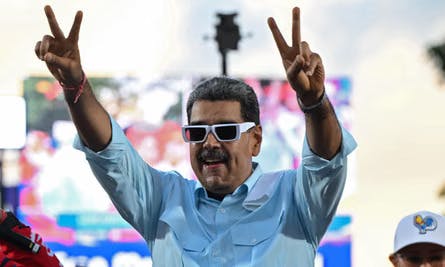
The US has established a precedent of using military force to apprehend fugitives abroad based on domestic legal actions, as seen with Noriega in 1989 and Maduro now. This practice blurs the line between law enforcement and an act of war, creating a thin legal justification for military intervention without traditional congressional or international approval.
Unlike past administrations that used pretexts like 'democracy,' the Trump administration openly states its transactional goals, such as seizing oil. This 'criming in plain sight' approach is merely an overt version of historical covert US actions in regions like Latin America.

Ex-CIA spy Andrew Bustamante explains that sanitized national threat assessments are available to the public. These documents reveal official government priorities and funding, which can directly contradict the narratives politicians present to justify military actions, as seen with Iran.
A president can legally initiate military actions like a blockade without congressional approval by first designating the target regime as a 'Foreign Terrorist Organization.' This provides a separate legal playbook and set of executive powers, circumventing the formal declaration of war process.
The US executes high-stakes foreign operations while maintaining plausible deniability by deploying elite units like Navy SEALs to train and equip local special forces. This model, used in Mexico against the CJNG cartel, allows partner nations to conduct raids with US intelligence and expertise.

The CIA intentionally seeks individuals who can operate in legal and ethical gray areas, but not full-blown sociopaths who are uncontrollable. This trait enables them to perform tasks like breaking into foreign embassies, which a 'normal' person would refuse to do.