Get your free personalized podcast brief
We scan new podcasts and send you the top 5 insights daily.
Galloway explains that the true goal of business forecasting is not exact predictive accuracy, but catalyzing conversations that guide strategic planning and scenario analysis. However, forecasters face a paradox: when an initially provocative prediction proves correct—such as Amazon acquiring Whole Foods or WeWork's IPO being pulled—the outcome appears self-evident in hindsight, diminishing the credit the forecaster receives for identifying non-obvious outcomes before they materialized.

Related Insights
The role of a futurist or strategist is not merely to predict a new technology (the automobile) but to anticipate its second-order consequences and systemic challenges (the traffic jam). This highlights the importance of forecasting unintended negative outcomes of innovation.

Executives favor forecasting not because it's accurate, but because it creates an illusion of control in an uncertain world. The human mind attributes an unearned certainty to numbers, leading to rigid plans that prevent adaptive, creative responses to market changes.

Galloway asserts that standard strategic forecasts often fail because they rely exclusively on macro datasets while ignoring executive psychology. He notes that predicting corporate moves requires understanding the human motivations of decision-makers, specifically aging, high-ego male CEOs. Empathizing with these leaders' personal perspectives and midlife concerns yields sharper, more accurate business predictions than relying purely on abstract economic and market models.
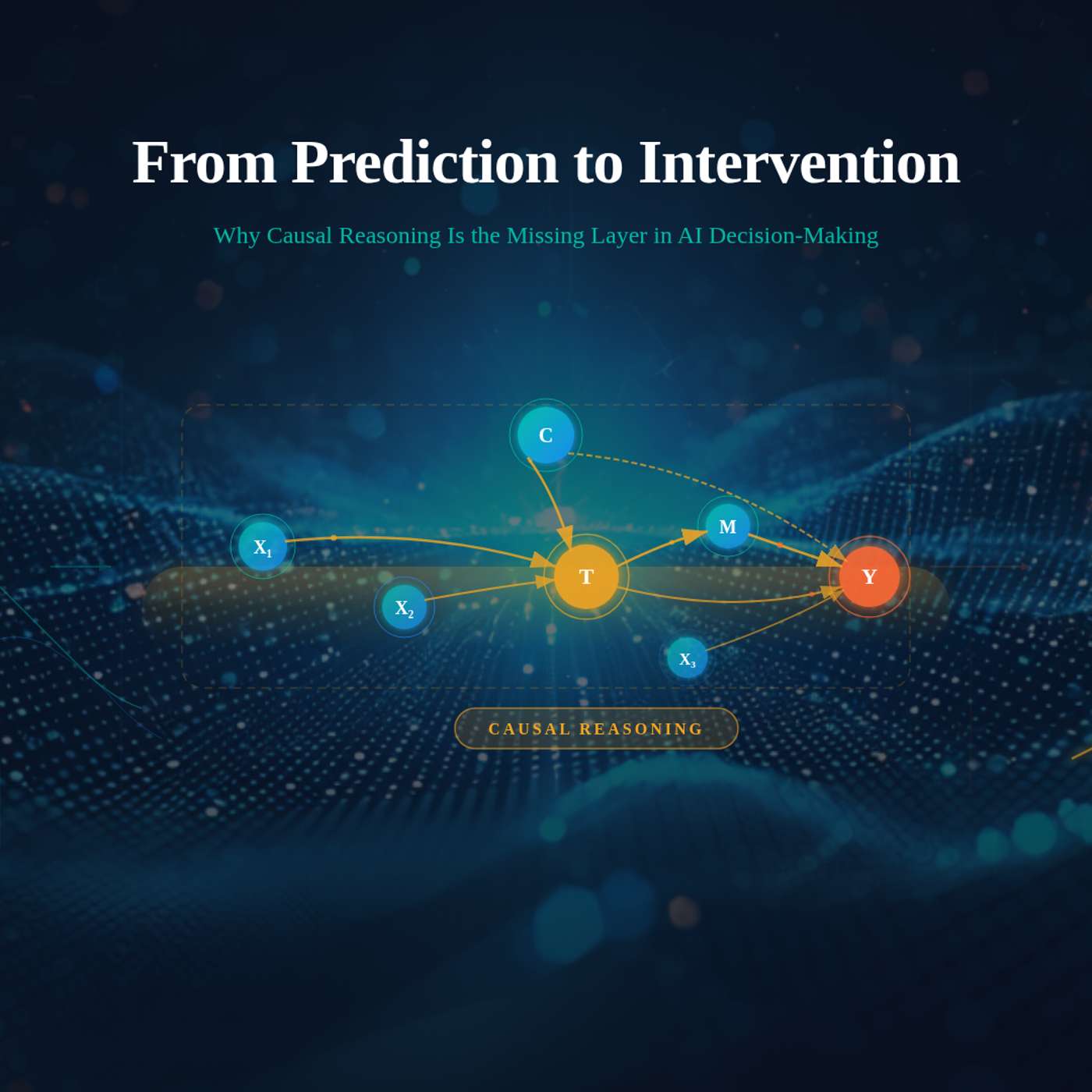
An estimated 80% of companies fail to scale their AI initiatives because they are caught in a 'prediction trap.' Their models produce accurate forecasts but do not support or inform actual business decisions, rendering them commercially ineffective. Causal reasoning is positioned as the solution to bridge this gap from prediction to actionable intelligence.
Sam Altman operates on a 10+ year timescale, while the world thinks quarter-to-quarter. This 'time horizon mismatch' is why his statements often seem crazy in the present but become reality in a few years, creating a constant cycle of public whiplash where his last prediction isn't reconciled before the next one lands.

When predicting major economic shifts like a bond market crisis or an AI stock correction, being wrong in a specific year doesn't invalidate the thesis. The underlying pressures may still exist, with the predicted event simply postponed. This reframes forecast misses as primarily errors in timing rather than analysis.

The market for financial forecasts is driven by a psychological need to reduce uncertainty, not a demand for accuracy. Pundits who offer confident, black-and-white predictions thrive because they soothe this anxiety. This is why the industry persists despite a terrible track record; it's selling a feeling, not a result.

The most transformative future possibilities are often the ones we initially dismiss as absurd or impossible. Taking these 'ridiculous' ideas seriously is a strategic exercise to identify and prepare for our biggest blind spots, preventing us from being shocked and paralyzed by disruptive change.

Howard Marks highlights a critical paradox for investors and forecasters: a correct prediction that materializes too late is functionally the same as an incorrect one. This implies that timing is as crucial as the thesis itself, requiring a willingness to look wrong in the short term.
A common forecasting error is to select the most likely outcome at each step. This creates an unrealistically 'normal' future. Realistic scenarios must instead sample from the distribution of possibilities, ensuring they include a plausible number of low-probability, high-impact events that shape the long-term trajectory.
