Get your free personalized podcast brief
We scan new podcasts and send you the top 5 insights daily.
Executives favor forecasting not because it's accurate, but because it creates an illusion of control in an uncertain world. The human mind attributes an unearned certainty to numbers, leading to rigid plans that prevent adaptive, creative responses to market changes.

Related Insights
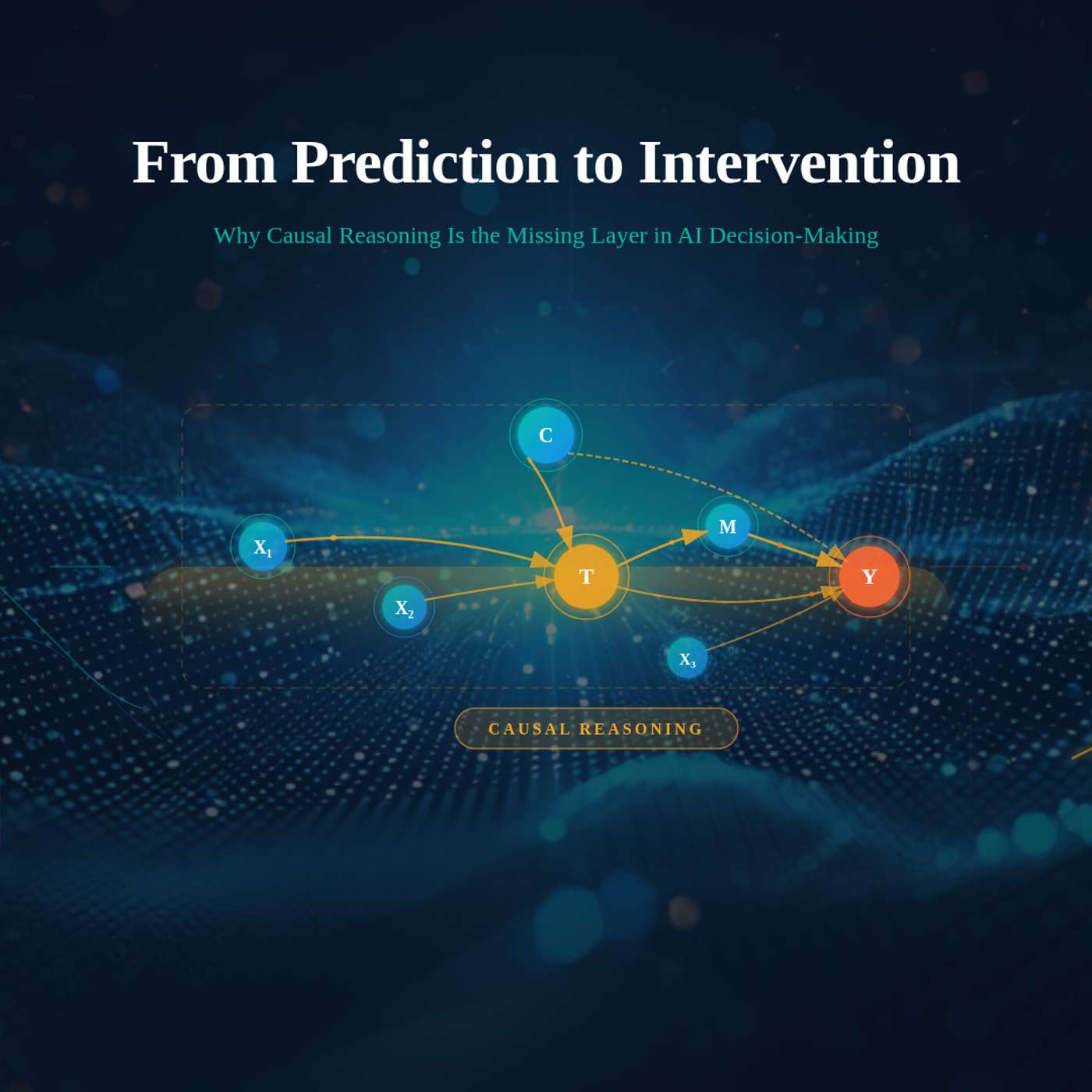
An estimated 80% of companies fail to scale their AI initiatives because they are caught in a 'prediction trap.' Their models produce accurate forecasts but do not support or inform actual business decisions, rendering them commercially ineffective. Causal reasoning is positioned as the solution to bridge this gap from prediction to actionable intelligence.
Given AI's unpredictability, leaders should prioritize creating adaptable and curious teams rather than getting locked into long-range forecasts. Focus on equipping the organization to adjust, as even experts can't predict outcomes beyond 12 weeks.

Relying too heavily on models like 2x2 matrices can suppress the essential human element of creativity. Leaders must balance structured analysis with unstructured thought, recognizing frameworks are tools, not ultimate solutions. The human element of creative thinking is irreplaceable for winning strategically.

Relying solely on A/B tests and obvious data points leads to incremental optimization, not breakthrough innovation. True leadership requires a strong vision to guide massive extrapolations from data and make bold decisions beyond what the numbers can directly prove.

Expertise allows leaders to operate on 'autopilot,' relying on subconscious mental models. While efficient in a stable environment, this mode is dangerous in a volatile world as it causes them to miss new signals, threats, and opportunities that fall outside their established patterns.
The true obstacle to running experiments in a business setting is not resources but culture. An experiment, by definition, requires admitting ignorance upfront. This directly conflicts with the organizational expectation that leaders should possess expertise and certainty, thus stifling learning and innovation.

Established companies operate an 'execution engine' that values predictability and eliminates failure. This directly conflicts with the 'innovation engine,' which requires uncertainty, experimentation, and learning from failure to discover future value. This fundamental tension is the primary reason corporate innovation initiatives often stall or fail.

Diller asserts that in creative fields like media, relying on data for big decisions is a trap. Leaders use it to seek comfort and avoid the insecurity inherent in relying on instinct. This creates a "delusion" of safety, allowing them to blame numbers for failure instead of taking responsibility for their own judgment.

Even the most rigorous academic forecasters can only see 400 days out. For most businesses, this window shrinks to 150 days, which undermines the entire "forecast, plan, execute" management model that relies on long-term predictability and control.
Companies often hit earnings targets with statistically impossible precision by "tweaking the finances to fit the forecast." This is a form of shadow work that diverts creative energy and intellectual horsepower away from genuine innovation and addressing customer needs.