Get your free personalized podcast brief
We scan new podcasts and send you the top 5 insights daily.
Sam Altman operates on a 10+ year timescale, while the world thinks quarter-to-quarter. This 'time horizon mismatch' is why his statements often seem crazy in the present but become reality in a few years, creating a constant cycle of public whiplash where his last prediction isn't reconciled before the next one lands.

Related Insights
The recurring prediction that a transformative technology (fusion, quantum, AGI) is "a decade away" is a strategic sweet spot. The timeframe is long enough to generate excitement and investment, yet distant enough that by the time it arrives, everyone will have forgotten the original forecast, avoiding accountability.

Altman argues that as AI capabilities grow, abstract technical benchmarks become less relevant. He suggests the ultimate measure of an AI's effectiveness will be its direct economic contribution, jokingly proposing "GDP impact" as the next major metric to watch.
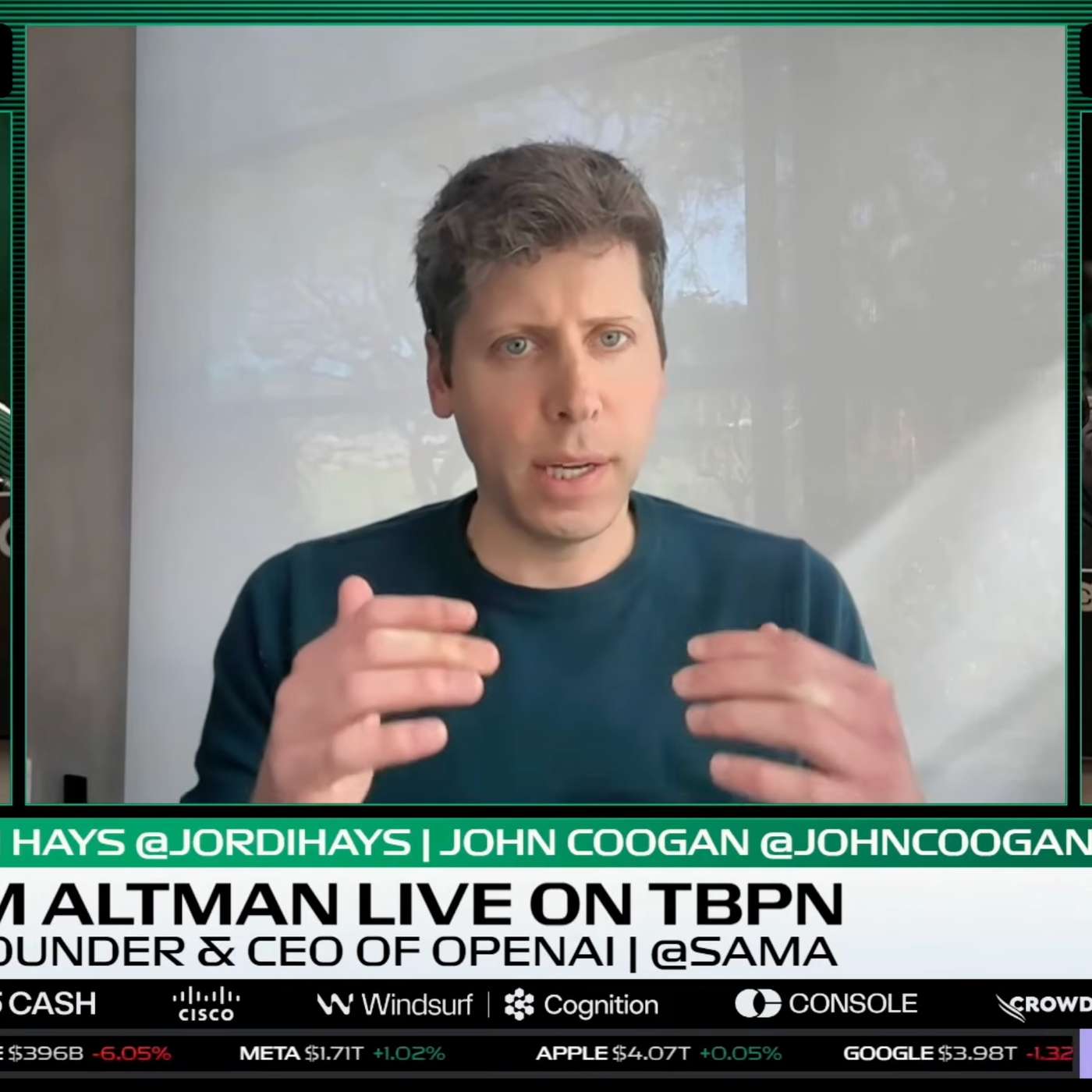
Sam Altman's ability to tell a compelling, futuristic story is likened to Steve Jobs' "reality distortion field." This storytelling is not just a personality trait but a necessary skill for founders of moonshot companies to secure capital and talent when their vision is still just a PowerPoint slide and a lot of hand-waving.

The tech community's convergence on a 10-year AGI timeline is less a precise forecast and more a psychological coping mechanism. A decade is the default timeframe people use for complex, uncertain events—far enough to seem plausible but close enough to feel relevant, making it a convenient but potentially meaningless consensus.

In a world where AI can efficiently predict outcomes based on past data, predictable behavior becomes less valuable. Sam Altman suggests that the ability to generate ideas that are both contrarian—even to one's own patterns—and correct will see its value increase significantly.

A consensus is forming among tech leaders that AGI is about a decade away. This specific timeframe may function as a psychological tool: it is optimistic enough to inspire action, but far enough in the future that proponents cannot be easily proven wrong in the short term, making it a safe, non-falsifiable prediction for an uncertain event.
Opinions on Sam Altman are intensely polarized. Those who share his vision view him as a uniquely persuasive and effective leader. Those who don't, including former top colleagues, often feel manipulated by him into supporting a future they fundamentally oppose.

The tech community's negative reaction to a 10-year AGI forecast reveals just how accelerated expectations have become. A decade ago, such a prediction would have been seen as wildly optimistic, highlighting a massive psychological shift in the industry's perception of AI progress.
Driven by rapid advances in AI agents, top tech CEOs are now publicly predicting the arrival of Artificial General Intelligence (AGI) or superintelligence within the next 2-5 years. This is a significant acceleration from previous estimates that often cited a decade or more.

OpenAI's CEO believes a significant gap exists between what current AI models can do and how people actually use them. He calls this "overhang," suggesting most users still query powerful models with simple tasks, leaving immense economic value untapped because human workflows adapt slowly.
