Get your free personalized podcast brief
We scan new podcasts and send you the top 5 insights daily.
The vast majority of enterprise information, previously trapped in formats like PDFs and documents, was largely unusable. AI, through techniques like RAG and automated structure extraction, is unlocking this data for the first time, making it queryable and enabling new large-scale analysis.

Related Insights
The industry has already exhausted the public web data used to train foundational AI models, a point underscored by the phrase "we've already run out of data." The next leap in AI capability and business value will come from harnessing the vast, proprietary data currently locked behind corporate firewalls.

Public internet data has been largely exhausted for training AI models. The real competitive advantage and source for next-generation, specialized AI will be the vast, untapped reservoirs of proprietary data locked inside corporations, like R&D data from pharmaceutical or semiconductor companies.

The long-sought goal of "information at your fingertips," envisioned by Bill Gates, wasn't achieved through structured databases as expected. Instead, large neural networks unexpectedly became the key, capable of finding patterns in messy, unstructured enterprise data where rigid schemas failed.

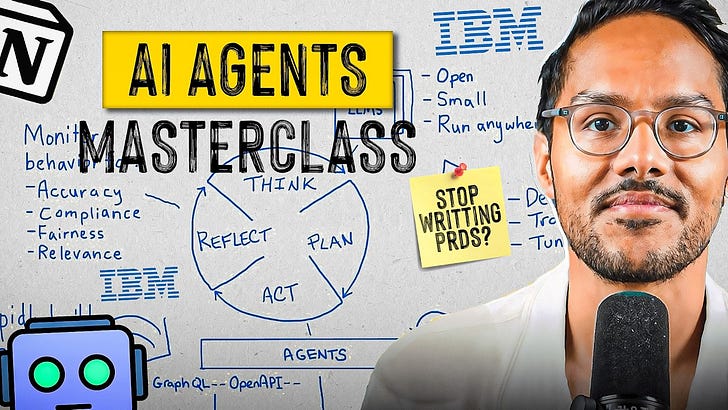
According to IBM's AI Platform VP, Retrieval-Augmented Generation (RAG) was the killer app for enterprises in the first year after ChatGPT's release. RAG allows companies to connect LLMs to their proprietary structured and unstructured data, unlocking immense value from existing knowledge bases and proving to be the most powerful initial methodology.
Text-to-SQL has historically been unreliable. However, recent advancements in reasoning models, combined with AI-assisted semantic layer creation, have boosted quality enough for broad deployment to non-technical business users, democratizing data access.
The entire workflow of transforming unstructured data into interactive visualizations, generating strategic insights, and creating executive-level presentations, which previously took days, can now be completed in minutes using AI.

Before diving into SQL, analysts can use enterprise AI search (like Notion AI) to query internal documents, PRDs, and Slack messages. This rapidly generates context and hypotheses about metric changes, replacing hours of manual digging and leading to better, faster analysis.
YipitData had data on millions of companies but could only afford to process it for a few hundred public tickers due to high manual cleaning costs. AI and LLMs have now made it economically viable to tag and structure this messy, long-tail data at scale, creating massive new product opportunities.

Before complex modeling, the main challenge for AI in biomanufacturing is dealing with unstructured data like batch records, investigation reports, and operator notes. The initial critical task for AI is to read, summarize, and connect these sources to identify patterns and root causes, transforming raw information into actionable intelligence.

The ultimate value of AI will be its ability to act as a long-term corporate memory. By feeding it historical data—ICPs, past experiments, key decisions, and customer feedback—companies can create a queryable "brain" that dramatically accelerates onboarding and institutional knowledge transfer.
