Get your free personalized podcast brief
We scan new podcasts and send you the top 5 insights daily.
A key efficiency of Swiss machining is its use of main and sub-spindles that work independently. While the main spindle is cutting the front of a part, the sub-spindle can perform operations on the back of the previous part. This overlapping work is considered "free time," dramatically reducing overall cycle time.

Related Insights
Integrating capabilities like machining isn't just a cost-saver. For startups, it's a strategic advantage that grants direct control over the development lifecycle, enabling rapid iteration and faster time-to-market by eliminating vendor dependencies.
Hardware development is often stalled by supplier lead times. To combat this, proactively map out multiple, redundant manufacturing options for every component. By maintaining a constantly updated "lookup table" of suppliers, processes, and their current lead times, teams can parallelize workflows and minimize downtime.

Atomic Industries is scaling its manufacturing operations by creating a bifurcated factory system. Its first facility is dedicated solely to designing and creating molds. These molds are then shipped to a second, larger facility focused exclusively on high-volume part production, optimizing the workflow for both complex tooling and mass manufacturing.

The speaker found that auto body shops took 18 days (cycle time) to complete 6-8 hours of work (touch time). This absurd inefficiency signaled a $50B market ripe for disruption by applying assembly-line principles to drastically reduce customer wait times.

While known for small, round parts, Swiss machining can be adapted for unconventional jobs. By creating non-standard rectangular guide bushings and collets, it's possible to process long, non-round stock—such as machining features along a 12-foot I-beam—in a single, continuous operation.
Unlike conventional lathes, Swiss machines feed material through a guide bushing past stationary tools. This supports the workpiece right at the point of the cut, virtually eliminating tool deflection and enabling tight tolerances (like +/- a tenth) over long part lengths.
Kaizen, typically associated with manufacturing lines, is a powerful change system for any business process. By mapping the flow and identifying wasted time or communication, it can dramatically improve efficiency in areas like sales, accounting, or finance, as demonstrated by a two-week quote time being reduced to 48 hours.
Boom Supersonic accelerates development by manufacturing its own parts. This shrinks the iteration cycle for a component like a turbine blade from 6-9 months (via an external supplier) to just 24 hours. This rapid feedback loop liberates engineers from "analysis paralysis" and allows them to move faster.

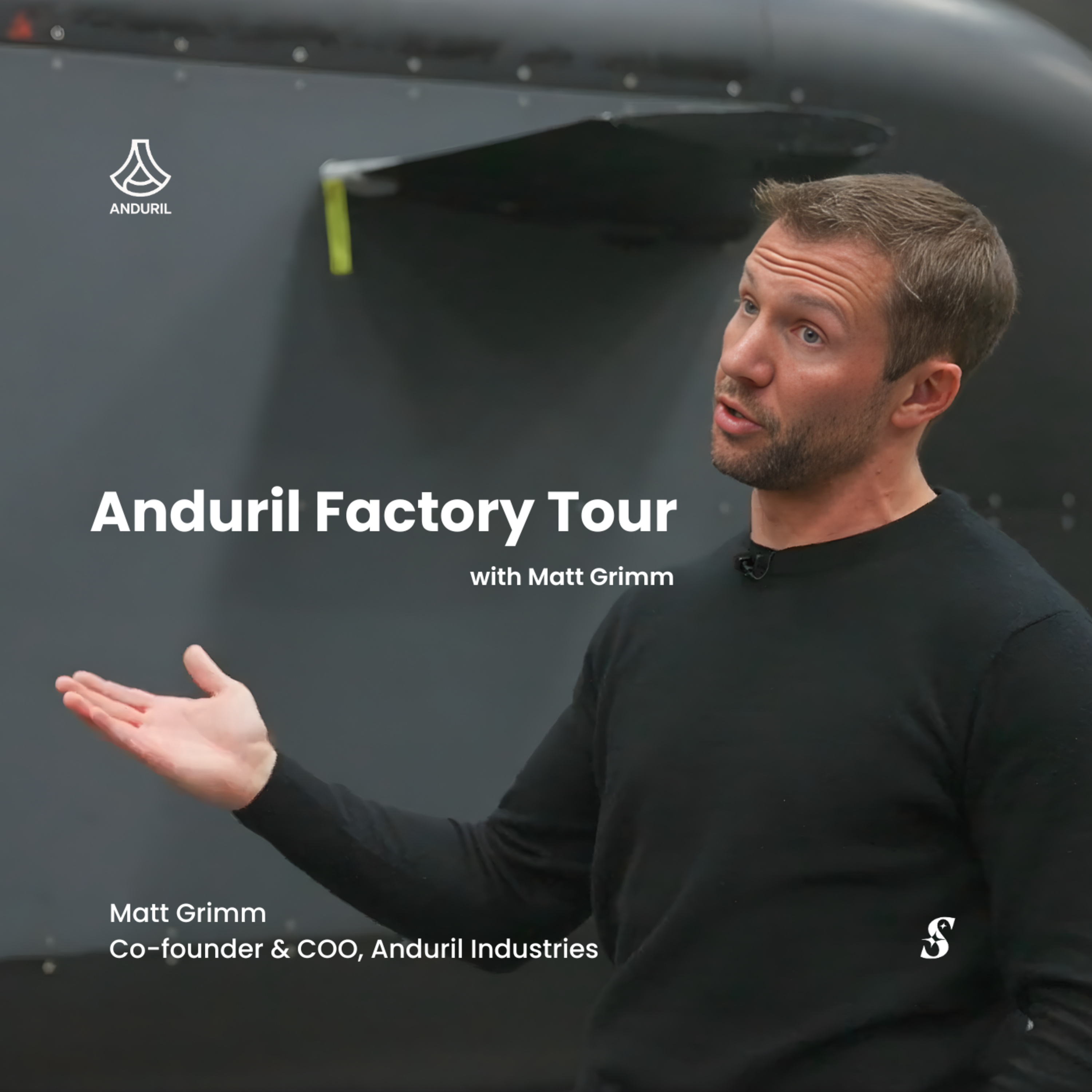
Anduril prototypes drone frames by milling them from solid metal blocks. While extremely wasteful and expensive for mass production, this method bypasses the slow and costly process of creating molds for casting, drastically reducing latency during the critical iterative design phase and getting products to market faster.
Contrary to the perception of being just for turning, modern Swiss machines are highly versatile. They are equipped with multiple live (spinning) tools for milling, drilling, tapping, and engraving, enabling them to produce complex, finished parts in a single, unattended operation from bar stock.