Get your free personalized podcast brief
We scan new podcasts and send you the top 5 insights daily.
A core challenge of industrial resilience is paying for idle but ready capacity—"warm factories" and trained staff. This is politically difficult because it's a costly insurance policy that looks like paying people and companies to do nothing during peacetime, making it a hard sell for policymakers.

Related Insights
Policies designed to avoid economic downturns at all costs can lead to significant long-term risks. Capital and labor become trapped in inefficient companies that would otherwise fail, hindering productivity growth and creating a less dynamic economy.

The American defense industrial base is not constrained by a lack of capital but by crippling uncertainty over future demand. The reliance on single-year congressional budgets prevents companies from making the long-term, multi-year investments necessary to plan for and build capacity efficiently.

Policymakers find it easier to implement offensive measures like sanctions because they appear decisive. In contrast, building domestic industrial resilience is a harder political sell, as it requires significant, long-term spending with no immediate, tangible benefit to voters until a crisis hits.
True economic security isn't just about production capacity; it's about having the "capability"—the qualified know-how and processes. This drastically shortens the 2-3 year time-to-recovery after a supply chain disruption, as qualifying a new fab for a specific product is the most time-consuming step.
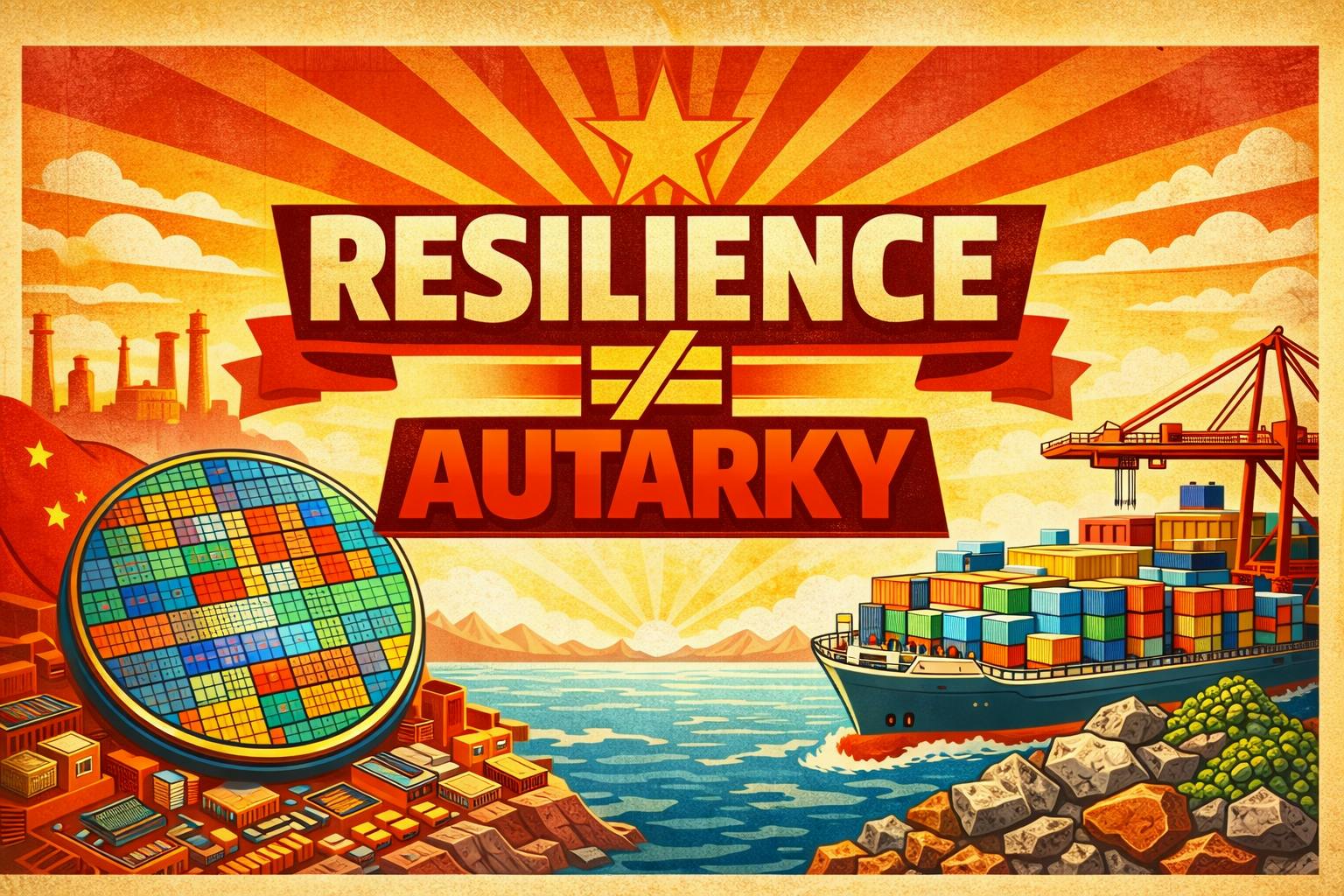
The US is a services economy that designs systems but lacks the industrial plant to build them. A global supply chain collapse would force a rapid reshoring effort, but this would happen during a massive shortage of the very components and materials needed to build that capacity.

Companies offshore production because it's cheaper. Forcing manufacturing back to the US via policy results in more expensive or lower-quality goods. While it improves supply chain resilience, this should be viewed as an insurance premium—a cost, not a productive investment.

Guy Ward-Jackson suggests a strategy where the U.S. maintains the industrial capability to rapidly scale production in critical sectors during a crisis, without maintaining full production in peacetime. This mirrors the concept of nuclear latency, where a country can build a bomb quickly without possessing one.
The CEO of Lockheed Martin made it clear that the company will not triple missile production on promises alone. They require government cost-sharing and firm financial commitments to de-risk the massive capital expenditure required to ramp up their capacity and that of their suppliers.
Companies are abandoning the long-held "just-in-time" optimization model in favor of resiliency. Faced with continuous supply shocks, businesses now see holding larger buffer stocks as a permanent feature, not a temporary bug, accepting higher working capital demands to ensure operational stability.

The economic regime has shifted from demand-driven problems (post-GFC) to supply-driven ones. This includes negative shocks like energy crises and positive ones like AI. These are fundamentally "engineering problems"—rewiring physical production and transport—which are much harder and slower to solve than boosting demand via policy.
